
PUBLISHER: Global Market Insights Inc. | PRODUCT CODE: 1936566

PUBLISHER: Global Market Insights Inc. | PRODUCT CODE: 1936566
Rear Spoiler Market Opportunity, Growth Drivers, Industry Trend Analysis, and Forecast 2026 - 2035
The Global Rear Spoiler Market was valued at USD 5.7 billion in 2025 and is estimated to grow at a CAGR of 6.1% to reach USD 10.2 billion by 2035.
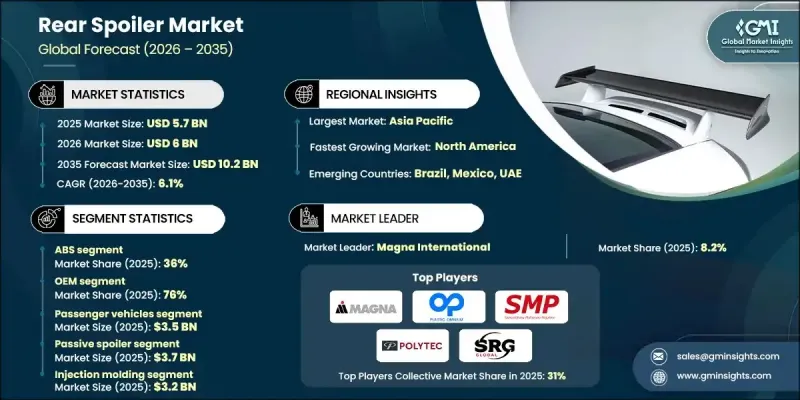
The market is propelled by the rapid expansion of global vehicle production, the rising adoption of electric and hybrid vehicles, and increasing consumer preference for enhanced aerodynamics, fuel efficiency, and vehicle styling. Automakers, OEMs, and aftermarket suppliers are prioritizing rear spoiler solutions to improve handling, stability, and overall vehicle performance while reducing lifecycle costs. Technological advancements, including active and passive spoiler systems, lightweight composite materials, precision aerodynamic designs, and adjustable spoilers, are transforming vehicle manufacturing. These innovations enhance downforce, reduce drag, and improve fuel economy. Meanwhile, the growing production of passenger cars, SUVs, sports vehicles, and EVs is driving demand for lightweight, durable, and high-performance spoilers. Emerging trends like sustainable materials, AI-driven aerodynamic optimization, digital monitoring, and predictive maintenance are further shaping the market.
| Market Scope | |
|---|---|
| Start Year | 2025 |
| Forecast Year | 2026-2035 |
| Start Value | $5.7 Billion |
| Forecast Value | $10.2 Billion |
| CAGR | 6.1% |
The ABS material segment held 36% share in 2025 and is projected to grow at a CAGR of 4.6% through 2035. ABS remains a preferred choice for passenger cars, SUVs, commercial vehicles, and EVs due to its lightweight nature, durability, impact resistance, and design flexibility. High-performance materials such as carbon fiber, fiberglass, and aluminum are increasingly used in premium and EV applications, offering superior stiffness, strength-to-weight ratios, and aesthetic appeal.
The OEMs segment held 76% share and is expected to grow at a CAGR of 6.2% from 2026 to 2035. OEMs integrate spoilers directly into new vehicle assembly, prioritize lightweight, durable, and aerodynamically optimized systems, and leverage active and passive designs along with high-strength composites and EV-compatible solutions. Their strong collaborations with vehicle manufacturers ensure stability, safety, fuel efficiency, and long-term performance, making the OEM segment the largest by value and volume.
China Rear Spoiler Market held a 21% share, generating USD 420.4 million in 2025. Its position as the largest automotive manufacturing hub, along with rapid growth in EV and hybrid production, drives demand for advanced spoiler solutions. Domestic OEM expansion and adoption of lightweight, precision-engineered, and aerodynamically optimized spoiler technologies make China the primary revenue contributor in the region.
Key players in the Global Rear Spoiler Market include Magna International, Wurth, Plastic Omnium, SRG Global, AP Plasman, Samvardhana Motherson Peguform (SMP Automotive), REHAU Automotive, Illinois Tool Works (ITW), Polytec, and Stanley Black & Decker. Companies in the rear spoiler market strengthen their position by investing in lightweight and high-performance materials, expanding R&D for active and passive aerodynamic systems, and collaborating closely with OEMs. Strategic partnerships, integration with EV platforms, and adoption of AI-based aerodynamic optimization enhance product offerings. Firms also focus on expanding aftermarket reach, improving precision manufacturing capabilities, and leveraging digital monitoring and predictive maintenance solutions to enhance product value, performance, and customer trust.
Table of Contents
Chapter 1 Methodology & Scope
- 1.1 Market scope and definition
- 1.2 Research design
- 1.2.1 Research approach
- 1.2.2 Data collection methods
- 1.3 Data mining sources
- 1.3.1 Global
- 1.3.2 Regional/Country
- 1.4 Base estimates and calculations
- 1.4.1 Base year calculation
- 1.4.2 Key trends for market estimation
- 1.5 Primary research and validation
- 1.5.1 Primary sources
- 1.6 Forecast
- 1.7 Research assumptions and limitations
Chapter 2 Executive Summary
- 2.1 Industry 360° synopsis, 2022 - 2035
- 2.2 Key market trends
- 2.2.1 Regional
- 2.2.2 Material
- 2.2.3 Vehicle
- 2.2.4 System
- 2.2.5 Technology
- 2.2.6 Distribution Channel
- 2.3 TAM Analysis, 2026-2035
- 2.4 CXO perspectives: Strategic imperatives
- 2.4.1 Executive decision points
- 2.4.2 Critical success factors
- 2.5 Future outlook and strategic recommendations
Chapter 3 Industry Insights
- 3.1 Industry ecosystem analysis
- 3.1.1 Supplier Landscape
- 3.1.2 Profit Margin
- 3.1.3 Cost structure
- 3.1.4 Value addition at each stage
- 3.1.5 Factor affecting the value chain
- 3.1.6 Disruptions
- 3.2 Industry impact forces
- 3.2.1 Growth drivers
- 3.2.1.1 Rapid Expansion of Global Vehicle Production
- 3.2.1.2 Increasing Consumer Demand for Aerodynamics and Styling
- 3.2.1.3 Advancements in Lightweight, High-Strength Materials
- 3.2.1.4 Technological Innovations in Spoiler Systems
- 3.2.2 Industry pitfalls and challenges
- 3.2.2.1 High Cost of Advanced Materials and Systems
- 3.2.2.2 Limited Adoption in Certain Vehicle Segments
- 3.2.3 Market opportunities
- 3.2.3.1 Expansion of Aftermarket and Customization Segments
- 3.2.3.2 Integration with EVs and Smart Vehicle Platforms
- 3.2.3.3 Advanced Active and Adaptive Spoiler Technologies
- 3.2.3.4 Lightweight and Sustainable Material Integration
- 3.2.1 Growth drivers
- 3.3 Growth potential analysis
- 3.4 Regulatory landscape
- 3.4.1 North America
- 3.4.1.1 U.S. Federal Motor Vehicle Safety Standards (FMVSS)
- 3.4.1.2 Canada Motor Vehicle Safety Standards (CMVSS)
- 3.4.2 Europe
- 3.4.2.1 Germany TUV & BaFin Compliance
- 3.4.2.2 France DGITM Guidelines
- 3.4.2.3 UK Vehicle Certification Agency (VCA) Regulations
- 3.4.2.4 Italy Ministry of Infrastructure & Transport
- 3.4.3 Asia Pacific
- 3.4.3.1 China MIIT Guidelines
- 3.4.3.2 Japan MLIT Standards
- 3.4.3.3 South Korea MOLIT Regulations
- 3.4.3.4 India Ministry of MoRTH & BIS Guidelines
- 3.4.4 Latin America
- 3.4.4.1 Brazil DENATRAN & ANFAVEA Regulations
- 3.4.4.2 Mexico SCT & NOM Standards
- 3.4.5 Middle East and Africa
- 3.4.5.1 UAE Roads & Transport Authority (RTA) Guidelines
- 3.4.5.2 Saudi Arabia General Authority for Transport (GAT) Regulations
- 3.4.1 North America
- 3.5 Porter's analysis
- 3.6 PESTEL analysis
- 3.7 Technology and Innovation Landscape
- 3.7.1 Current technological trends
- 3.7.2 Emerging technologies
- 3.8 Price trends
- 3.8.1 By region
- 3.8.2 By product
- 3.9 Cost breakdown analysis
- 3.10 Patent analysis
- 3.11 Sustainability and Environmental Aspects
- 3.11.1 Sustainable practices
- 3.11.2 Waste reduction strategies
- 3.11.3 Energy efficiency in production
- 3.11.4 Eco-friendly initiatives
- 3.11.5 Carbon footprint considerations
- 3.12 Use case scenarios
- 3.13 Installation & Integration Cost Analysis
- 3.14 Platform & Vehicle Architecture Compatibility
- 3.15 Customization & Design Differentiation Trends
- 3.16 Future Design Disruption Risks
Chapter 4 Competitive Landscape, 2025
- 4.1 Introduction
- 4.2 Company market share analysis
- 4.2.1 North America
- 4.2.2 Europe
- 4.2.3 Asia Pacific
- 4.2.4 Latin America
- 4.2.5 Middle East & Africa
- 4.3 Competitive analysis of major market players
- 4.4 Competitive positioning matrix
- 4.5 Strategic outlook matrix
- 4.6 Key developments
- 4.6.1 Mergers & acquisitions
- 4.6.2 Partnerships & collaborations
- 4.6.3 New product launches
- 4.6.4 Expansion plans and funding
Chapter 5 Market Estimates & Forecast, By Material, 2022 - 2035 ($ Bn, Units)
- 5.1 Key trends
- 5.2 ABS
- 5.3 Carbon Fiber
- 5.4 Fiberglass
- 5.5 Aluminum
- 5.6 Others
Chapter 6 Market Estimates & Forecast, By Vehicle, 2022 - 2035 ($ Bn, Units)
- 6.1 Key trends
- 6.2 Passenger vehicles
- 6.2.1 Hatchbacks
- 6.2.2 Sedans
- 6.2.3 SUV
- 6.3 Commercial vehicles
- 6.3.1 Light commercial vehicles (LCV)
- 6.3.2 Medium commercial vehicles (MCV)
- 6.3.3 Heavy commercial vehicles (HCV)
Chapter 7 Market Estimates & Forecast, By System, 2022 - 2035 ($ Bn, Units)
- 7.1 Key trends
- 7.2 Passive Spoiler
- 7.3 Active Spoiler
Chapter 8 Market Estimates & Forecast, By Technology, 2022 - 2035 ($ Bn, Units)
- 8.1 Key trends
- 8.2 Injection Molding
- 8.3 Blow Molding
- 8.4 Reaction Injection Molding
Chapter 9 Market Estimates & Forecast, By Distribution Channel, 2022 - 2035 ($ Bn, Units)
- 9.1 Key trends
- 9.2 OEM
- 9.3 Aftermarket
Chapter 10 Market Estimates & Forecast, By Region, 2022 - 2035 ($ Bn, Units)
- 10.1 Key trends
- 10.2 North America
- 10.2.1 US
- 10.2.2 Canada
- 10.3 Europe
- 10.3.1 UK
- 10.3.2 Germany
- 10.3.3 France
- 10.3.4 Italy
- 10.3.5 Spain
- 10.3.6 Belgium
- 10.3.7 Netherlands
- 10.3.8 Sweden
- 10.4 Asia Pacific
- 10.4.1 China
- 10.4.2 India
- 10.4.3 Japan
- 10.4.4 Australia
- 10.4.5 Singapore
- 10.4.6 South Korea
- 10.4.7 Vietnam
- 10.4.8 Indonesia
- 10.4.9 Malaysia
- 10.5 Latin America
- 10.5.1 Brazil
- 10.5.2 Mexico
- 10.5.3 Argentina
- 10.6 MEA
- 10.6.1 UAE
- 10.6.2 South Africa
- 10.6.3 Saudi Arabia
Chapter 11 Company Profiles
- 11.1 Global Player
- 11.1.1 AP Plasman
- 11.1.2 Illinois Tool Works (ITW)
- 11.1.3 Magna International
- 11.1.4 Plastic Omnium
- 11.1.5 Polytec
- 11.1.6 REHAU Automotive
- 11.1.7 Samvardhana Motherson Peguform (SMP Automotive)
- 11.1.8 SRG Global
- 11.1.9 Stanley Black & Decker
- 11.1.10 Wurth
- 11.2 Regional Player
- 11.2.1 AeroPlas Technologies
- 11.2.2 Bossard
- 11.2.3 Bulten
- 11.2.4 CIE Automotive
- 11.2.5 KAMAX
- 11.2.6 LISI Automotive
- 11.2.7 Modulo Automotive
- 11.2.8 Nedschroef
- 11.2.9 Novares
- 11.2.10 Pentair Rear Spoilers
- 11.3 Emerging Players
- 11.3.1 Composite Dynamics
- 11.3.2 Ecomotive Spoilers
- 11.3.3 EV Aero Solutions
- 11.3.4 GreenTech Composites
- 11.3.5 Lighter Materials Solutions

