
PUBLISHER: Global Market Insights Inc. | PRODUCT CODE: 1936583

PUBLISHER: Global Market Insights Inc. | PRODUCT CODE: 1936583
Divinylbenzene Market Opportunity, Growth Drivers, Industry Trend Analysis, and Forecast 2026 - 2035
The Global Divinylbenzene Market was valued at USD 77.1 million in 2025 and is estimated to grow at a CAGR of 5.9% to reach USD 137 million by 2035.
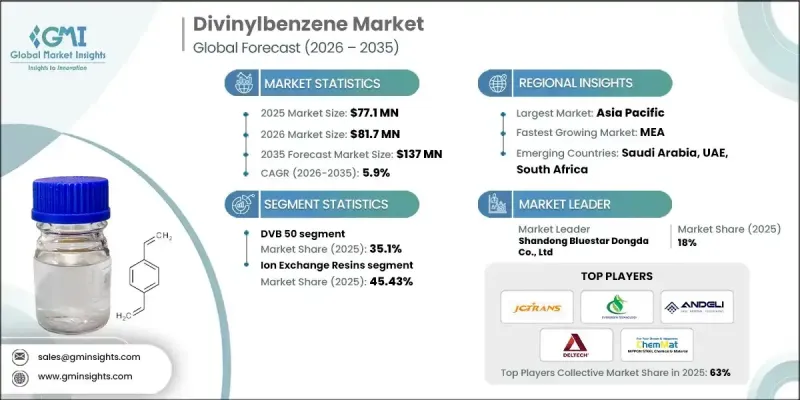
Market expansion is supported by rising demand for high-performance crosslinked polymer systems, particularly within ion-exchange and chromatographic resin applications. Ongoing investments in urban water infrastructure, combined with tighter water quality and discharge regulations, are increasing the need for durable and chemically stable resin materials. This trend is strengthening demand for divinylbenzene across key regions, including Asia, Europe, and North America. Since 2022, consumption has also increased across advanced manufacturing sectors where engineered plastics, specialty resins, coatings, and adhesives require enhanced structural integrity. Growth in regional production capacity, especially in Asia, has supported rising exports of DVB-based resins to Western markets. End users are increasingly shifting toward higher divinylbenzene concentrations, moving from lower-content grades to DVB 63 and DVB 80, to achieve improved resin performance, durability, and chemical resistance. This shift is being reinforced by resin manufacturers that are aligning product portfolios with higher crosslink density requirements across purification and separation applications.
| Market Scope | |
|---|---|
| Start Year | 2025 |
| Forecast Year | 2026-2035 |
| Start Value | $77.1 Million |
| Forecast Value | $137 Million |
| CAGR | 5.9% |
The ion-exchange resins segment accounted for 45.43% share in 2025 and is expected to grow at a CAGR of 5.4% from 2026 to 2035. Demand growth is being driven by stricter environmental compliance requirements, expansion of industrial processing capacity, and increasing use of high-purity separation systems. DVB-crosslinked resins are gaining preference due to their long service life, structural stability, and consistent performance under regulated operating conditions. This segment benefits from steady, compliance-driven demand rather than short-term cyclical fluctuations.
U.S. Divinylbenzene Market reached USD 14.6 million in 2025, supported by a strong base of specialty chemical and resin manufacturing and continued upgrades in municipal and industrial infrastructure. Sustained investment in purification and processing systems is contributing to consistent growth in domestic divinylbenzene consumption.
Key companies operating in the Global Divinylbenzene Market include Dupont, Nippon Steel Chemical & Material Co., Ltd., Shandong Bluestar Dongda Co., Ltd, Jiangsu Evergreen New Material Technology Co., Ltd, Deltech Corporation LLC, Jiangsu Andeli New Material Technology Co., Ltd., Jiangsu Danhua, Sigma Aldrich, TCI Chemicals, Alfa Aesar, ABCR GmbH, Clearsynth, Angene International Limited, Alfa Chemistry, and AA Blocks. Companies in the Global Divinylbenzene Market are strengthening their market position by expanding production capacity and upgrading manufacturing processes to support higher-purity and higher-DVB-content grades. Manufacturers are investing in formulation optimization to improve crosslink efficiency, durability, and end-use performance. Strategic partnerships with resin producers and downstream processors are helping secure long-term supply agreements and stable demand. Firms are also focusing on regional expansion to support export growth and reduce logistics dependency. Continuous investment in research and quality control is enabling suppliers to meet evolving regulatory standards while maintaining consistent product performance, supporting sustained competitiveness in global specialty chemical markets.
Table of Contents
Chapter 1 Methodology & Scope
- 1.1 Market scope and definition
- 1.2 Research design
- 1.2.1 Research approach
- 1.2.2 Data collection methods
- 1.3 Data mining sources
- 1.3.1 Global
- 1.3.2 Regional/Country
- 1.4 Base estimates and calculations
- 1.4.1 Base year calculation
- 1.4.2 Key trends for market estimation
- 1.5 Primary research and validation
- 1.5.1 Primary sources
- 1.6 Forecast model
- 1.7 Research assumptions and limitations
Chapter 2 Executive Summary
- 2.1 Industry 3600 synopsis
- 2.2 Key market trends
- 2.2.1 Regional
- 2.2.2 Type
- 2.2.3 Application
- 2.3 TAM Analysis, 2026-2035
- 2.4 CXO perspectives: Strategic imperatives
- 2.4.1 Executive decision points
- 2.4.2 Critical success factors
- 2.5 Future Outlook and Strategic Recommendations
Chapter 3 Industry Insights
- 3.1 Industry ecosystem analysis
- 3.1.1 Supplier landscape
- 3.1.2 Profit margin
- 3.1.3 Value addition at each stage
- 3.1.4 Factor affecting the value chain
- 3.1.5 Disruptions
- 3.2 Industry impact forces
- 3.2.1 Growth drivers
- 3.2.1.1 Rising demand for ion exchange and chromatographic resins
- 3.2.1.2 Growth in water treatment and urban infrastructure projects
- 3.2.1.3 Expansion of electronics, pharma, and advanced materials
- 3.2.2 Industry pitfalls and challenges
- 3.2.2.1 Feedstock price volatility for benzene and styrene
- 3.2.2.2 Environmental regulations on aromatics and emissions
- 3.2.3 Market opportunities
- 3.2.3.1 Advanced resins for semiconductor and pharmaceutical sectors
- 3.2.3.2 New high-performance adhesives, coatings, and engineered plastics
- 3.2.1 Growth drivers
- 3.3 Growth potential analysis
- 3.4 Regulatory landscape
- 3.4.1 North America
- 3.4.2 Europe
- 3.4.3 Asia Pacific
- 3.4.4 Latin America
- 3.4.5 Middle East & Africa
- 3.5 Porter's analysis
- 3.6 PESTEL analysis
- 3.7 Price trends
- 3.7.1 By region
- 3.7.2 By type
- 3.8 Future market trends
- 3.9 Technology and Innovation landscape
- 3.9.1 Current technological trends
- 3.9.2 Emerging technologies
- 3.10 Patent Landscape
- 3.11 Trade statistics (HS code) ( Note: the trade statistics will be provided for key countries only)
- 3.11.1 Major importing countries
- 3.11.2 Major exporting countries
- 3.12 Sustainability and environmental aspects
- 3.12.1 Sustainable practices
- 3.12.2 Waste reduction strategies
- 3.12.3 Energy efficiency in production
- 3.12.4 Eco-friendly initiatives
- 3.13 Carbon footprint consideration
Chapter 4 Competitive Landscape, 2025
- 4.1 Introduction
- 4.2 Company market share analysis
- 4.2.1 By region
- 4.2.1.1 North America
- 4.2.1.2 Europe
- 4.2.1.3 Asia Pacific
- 4.2.1.4 LATAM
- 4.2.1.5 MEA
- 4.2.1 By region
- 4.3 Company matrix analysis
- 4.4 Competitive analysis of major market players
- 4.5 Competitive positioning matrix
- 4.6 Key developments
- 4.6.1 Mergers & acquisitions
- 4.6.2 Partnerships & collaborations
- 4.6.3 New Product Launches
- 4.6.4 Expansion Plans
Chapter 5 Market Estimates and Forecast, By Type, 2022-2035 (USD Million) (Kilo Tons)
- 5.1 Key trends
- 5.2 DVB 50
- 5.3 DVB 63
- 5.4 DVB 80
- 5.5 Others
Chapter 6 Market Estimates and Forecast, By Application, 2022-2035 (USD Million) (Kilo Tons)
- 6.1 Key trends
- 6.2 Ion exchange resins
- 6.2.1 Water treatment resins
- 6.2.2 Industrial and chemical process resins
- 6.3 Chromatographic resins
- 6.3.1 Analytical chromatography media
- 6.3.2 Preparative/process chromatography media
- 6.4 Adhesives & coatings
- 6.4.1 Structural adhesives
- 6.4.2 Industrial and protective coatings
- 6.5 Ceramics
- 6.5.1 Polymer-derived ceramic precursors
- 6.5.2 Porous ceramic/binder applications
- 6.6 Plastics & elastomers
- 6.6.1 Crosslinked plastics
- 6.6.2 Crosslinked elastomers
- 6.7 Others
Chapter 7 Market Estimates and Forecast, By Region, 2022-2035 (USD Million) (Kilo Tons)
- 7.1 Key trends
- 7.2 North America
- 7.2.1 U.S.
- 7.2.2 Canada
- 7.3 Europe
- 7.3.1 Germany
- 7.3.2 UK
- 7.3.3 France
- 7.3.4 Spain
- 7.3.5 Italy
- 7.3.6 Rest of Europe
- 7.4 Asia Pacific
- 7.4.1 China
- 7.4.2 India
- 7.4.3 Japan
- 7.4.4 Australia
- 7.4.5 South Korea
- 7.4.6 Rest of Asia Pacific
- 7.5 Latin America
- 7.5.1 Brazil
- 7.5.2 Mexico
- 7.5.3 Argentina
- 7.5.4 Rest of Latin America
- 7.6 Middle East and Africa
- 7.6.1 Saudi Arabia
- 7.6.2 South Africa
- 7.6.3 UAE
- 7.6.4 Rest of Middle East and Africa
Chapter 8 Company Profiles
- 8.1 Shandong Bluestar Dongda Co., Ltd
- 8.2 Jiangsu Evergreen New Material Technology Co., Ltd
- 8.3 Jiangsu Andeli New Material Technology Co., Ltd.
- 8.4 Nippon Steel Chemical & Material Co., Ltd
- 8.5 Dupont
- 8.6 Deltech Corporation LLC
- 8.7 Jiangsu Danhua
- 8.8 Sigma Aldrich
- 8.9 TCI Chemicals
- 8.10 Alfa Aesar
- 8.11 ABCR GmbH
- 8.12 Clearsynth
- 8.13 Angene International Limited
- 8.14 Alfa Chemistry
- 8.15 AA Blocks

