PUBLISHER: Global Market Insights Inc. | PRODUCT CODE: 1936589

PUBLISHER: Global Market Insights Inc. | PRODUCT CODE: 1936589
Melt Blown Nonwovens Market Opportunity, Growth Drivers, Industry Trend Analysis, and Forecast 2026 - 2035
The Global Melt Blown Nonwovens Market was valued at USD 2.9 billion in 2025 and is estimated to grow at a CAGR of 7% to reach USD 5.6 billion by 2035.
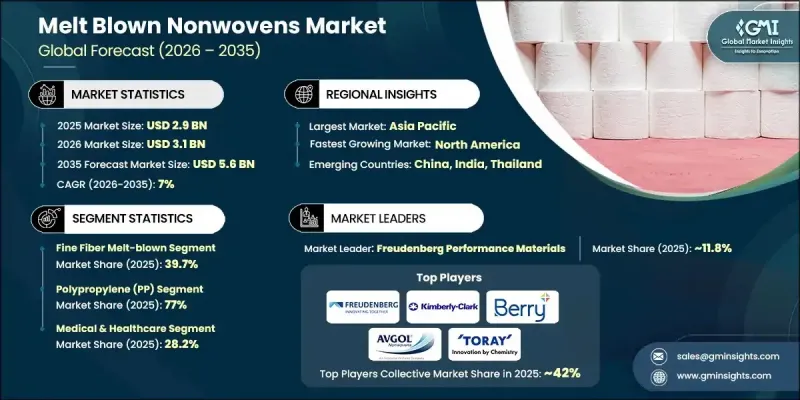
Market growth is driven by increasing demand for high-performance nonwoven materials across healthcare, filtration, hygiene, automotive, and industrial sectors. Melt blown nonwovens are manufactured using specialized processes that convert molten polymers into ultra-fine fibers, resulting in materials with exceptional filtration efficiency, barrier protection, absorption capacity, and durability. These materials play a critical role in applications that require precision performance, safety, and consistency. Continuous improvements in fiber formation techniques, material engineering, and performance optimization are enhancing product reliability and expanding end-use adoption. Rising global emphasis on healthcare preparedness, air and liquid filtration efficiency, and technical textile performance continues to support market expansion. Investments in advanced production technologies and process automation are allowing manufacturers to scale output while maintaining quality, enabling sustained demand across developed and emerging markets alike.
| Market Scope | |
|---|---|
| Start Year | 2025 |
| Forecast Year | 2026-2035 |
| Start Value | $2.9 Billion |
| Forecast Value | $5.6 Billion |
| CAGR | 7% |
Fine fiber melt blown materials segment accounted for 39.7% share in 2025 and is expected to grow at a CAGR of 7.2% from 2026 to 2035. This segment leads due to its ability to deliver a strong balance of filtration effectiveness, barrier integrity, and airflow performance. Ultra-fine fiber structures provide enhanced surface area and capture efficiency while maintaining functional usability across demanding applications. Consistent performance, adaptability to multiple processing conditions, and compatibility with performance enhancement techniques continue to support the segment's leadership across global manufacturing regions.
The polypropylene segment held 77% share in 2025 and is projected to grow at a CAGR of 7.2% through 2035. This dominance is attributed to its favorable processing characteristics, cost efficiency, and stable performance across melt blown production systems. Polypropylene enables consistent fiber formation, strong chemical resistance, and reliable mechanical properties, making it a preferred polymer for large-scale manufacturing. Its compatibility with advanced performance-enhancing processes further reinforces its widespread adoption across global nonwoven production facilities.
United States Melt Blown Nonwovens Market accounted for USD 612.9 million in 2025, representing a significant share of the global melt blown nonwovens market. Strong domestic demand is supported by advanced manufacturing infrastructure, a focus on supply chain resilience, and continued investment in high-performance material production. Ongoing upgrades in processing capabilities and emphasis on localized manufacturing contribute to steady market expansion and reinforce the country's position as a key contributor to global demand.
Key companies operating in the Global Melt Blown Nonwovens Market include Kimberly-Clark Corporation, Berry Global Inc., Freudenberg Performance Materials, Toray Industries Inc., Avgol Ltd., Fitesa, Mogul Nonwoven, KINGFA Science & Technology, Qingdao Taimei Products Co., Ltd., Filtrafine, PFNonwovens Group, Japan Vilene Company, OXCO, Hubei Wanli Protective Products Co., Ltd., and Reifenhauser Reicofil GmbH & Co. KG. Companies in the melt blown nonwovens market are adopting a range of strategic initiatives to strengthen their market position and expand global reach. Significant investments are being directed toward advanced manufacturing technologies to improve fiber uniformity, production efficiency, and material performance. Firms are expanding capacity to meet rising global demand while ensuring supply stability across regions. Strategic collaborations with downstream manufacturers help secure long-term contracts and broaden application coverage. Product innovation focused on enhanced filtration efficiency, durability, and sustainability remains a priority.
Table of Contents
Chapter 1 Methodology & Scope
- 1.1 Market scope and definition
- 1.2 Research design
- 1.2.1 Research approach
- 1.2.2 Data collection methods
- 1.3 Data mining sources
- 1.3.1 Global
- 1.3.2 Regional/Country
- 1.4 Base estimates and calculations
- 1.4.1 Base year calculation
- 1.4.2 Key trends for market estimation
- 1.5 Primary research and validation
- 1.5.1 Primary sources
- 1.6 Forecast model
- 1.7 Research assumptions and limitations
Chapter 2 Executive Summary
- 2.1 Industry 360° synopsis
- 2.2 Key market trends
- 2.2.1 Product
- 2.2.2 Material type
- 2.2.3 Application
- 2.2.4 Regional
- 2.3 TAM Analysis, 2026-2035
- 2.4 CXO perspectives: Strategic imperatives
- 2.4.1 Executive decision points
- 2.4.2 Critical success factors
- 2.5 Future outlook and strategic recommendations
Chapter 3 Industry Insights
- 3.1 Industry ecosystem analysis
- 3.1.1 Supplier landscape
- 3.1.2 Profit margin
- 3.1.3 Value addition at each stage
- 3.1.4 Factor affecting the value chain
- 3.1.5 Disruptions
- 3.2 Industry impact forces
- 3.2.1 Growth drivers
- 3.2.2 Industry pitfalls and challenges
- 3.2.3 Market opportunities
- 3.3 Growth potential analysis
- 3.4 Regulatory landscape
- 3.4.1 North America
- 3.4.2 Europe
- 3.4.3 Asia Pacific
- 3.4.4 Latin America
- 3.4.5 Middle East & Africa
- 3.5 Porter's analysis
- 3.6 PESTEL analysis
- 3.7 Technology and innovation landscape
- 3.7.1 Current technological trends
- 3.7.2 Emerging technologies
- 3.8 Price trends
- 3.8.1 By region
- 3.8.2 By product
- 3.9 Future market trends
- 3.10 Technology and innovation landscape
- 3.10.1 Current technological trends
- 3.10.2 Emerging technologies
- 3.11 Patent landscape
- 3.12 Trade statistics (HS code) ( Note: the trade statistics will be provided for key countries only)
- 3.12.1 Major importing countries
- 3.12.2 Major exporting countries
- 3.13 Sustainability and environmental aspects
- 3.13.1 Sustainable practices
- 3.13.2 Waste reduction strategies
- 3.13.3 Energy efficiency in production
- 3.13.4 Eco-friendly initiatives
- 3.14 Carbon footprint consideration
Chapter 4 Competitive Landscape, 2025
- 4.1 Introduction
- 4.2 Company market share analysis
- 4.2.1 By region
- 4.2.1.1 North America
- 4.2.1.2 Europe
- 4.2.1.3 Asia Pacific
- 4.2.1.4 LATAM
- 4.2.1.5 MEA
- 4.2.1 By region
- 4.3 Company matrix analysis
- 4.4 Competitive analysis of major market players
- 4.5 Competitive positioning matrix
- 4.6 Key developments
- 4.6.1 Mergers & acquisitions
- 4.6.2 Partnerships & collaborations
- 4.6.3 New product launches
- 4.6.4 Expansion plans
Chapter 5 Market Estimates and Forecast, By Product, 2022-2035 (USD Million) (Kilo Tons)
- 5.1 Key trends
- 5.2 Fine fiber melt-blown
- 5.3 Dual texture melt-blown
- 5.4 Composite melt-blown structures
- 5.4.1 SMS
- 5.4.2 SMMS
- 5.4.3 SSMMS
- 5.5 Electret-charged melt-blown
- 5.6 Others
Chapter 6 Market Estimates and Forecast, By Material Type, 2022-2035 (USD Million) (Kilo Tons)
- 6.1 Key trends
- 6.2 Polypropylene (PP)
- 6.3 Polyester (PET)
- 6.4 Polybutylene terephthalate (PBT)
- 6.5 Thermoplastic polyurethane (TPU)
- 6.6 Polyamide (PA)
- 6.7 Polylactic acid (PLA) & bio-based polymers
- 6.8 Others
Chapter 7 Market Estimates and Forecast, By Application, 2022-2035 (USD Million) (Kilo Tons)
- 7.1 Medical & healthcare
- 7.2 Air filtration
- 7.3 Liquid filtration
- 7.4 Hygiene & personal care
- 7.5 Industrial & technical
- 7.6 Automotive
- 7.7 Building & construction
- 7.8 Agriculture & horticulture
- 7.9 Others
Chapter 8 Market Estimates and Forecast, By Region, 2022-2035 (USD Million) (Kilo Tons)
- 8.1 Key trends
- 8.2 North America
- 8.2.1 U.S.
- 8.2.2 Canada
- 8.3 Europe
- 8.3.1 Germany
- 8.3.2 UK
- 8.3.3 France
- 8.3.4 Spain
- 8.3.5 Italy
- 8.3.6 Rest of Europe
- 8.4 Asia Pacific
- 8.4.1 China
- 8.4.2 India
- 8.4.3 Japan
- 8.4.4 Australia
- 8.4.5 South Korea
- 8.4.6 Rest of Asia Pacific
- 8.5 Latin America
- 8.5.1 Brazil
- 8.5.2 Mexico
- 8.5.3 Argentina
- 8.5.4 Rest of Latin America
- 8.6 Middle East and Africa
- 8.6.1 Saudi Arabia
- 8.6.2 South Africa
- 8.6.3 UAE
- 8.6.4 Rest of Middle East and Africa
Chapter 9 Company Profiles
- 9.1 Freudenberg Performance Materials
- 9.2 Kimberly-Clark Corporation
- 9.3 Berry Global Inc
- 9.4 Avgol Ltd
- 9.5 Toray Industries Inc
- 9.6 Fitesa
- 9.7 Mogul Nonwoven
- 9.8 KINGFA Science & Technology
- 9.9 Qingdao Taimei Products Co., Ltd.
- 9.10 Filtrafine
- 9.11 Hubei Wanli Protective Products Co., Ltd.
- 9.12 OXCO
- 9.13 PFNonwovens Group
- 9.14 Japan Vilene Company
- 9.15 Reifenhauser Reicofil GmbH & Co. KG

