
PUBLISHER: Global Market Insights Inc. | PRODUCT CODE: 1936592

PUBLISHER: Global Market Insights Inc. | PRODUCT CODE: 1936592
Printed Circuit Board (PCB) Assembly Market Opportunity, Growth Drivers, Industry Trend Analysis, and Forecast 2026 - 2035
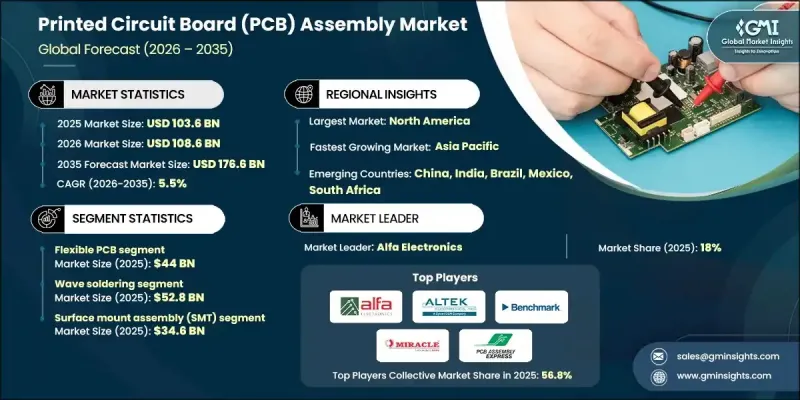
The Global Printed Circuit Board (PCB) Assembly Market was valued at USD 103.6 billion in 2025 and is estimated to grow at a CAGR of 5.5% to reach USD 176.6 billion by 2035.
Market growth is driven by the increasing sophistication of electronic products and a structural shift toward larger and more complex circuit board designs. Manufacturers are facing rising demand for advanced assembly solutions that can efficiently manage higher component density, improved thermal performance, and enhanced signal reliability. As digital infrastructure continues to evolve, demand is rising for multi-layered boards capable of supporting faster data transmission while maintaining electrical stability. Printed circuit board assembly involves the precise placement and soldering of electronic components onto boards to create operational circuits. This process relies heavily on automation, inspection systems, and accuracy-driven manufacturing technologies to ensure consistent quality and scalability across a wide range of electronic applications. Continuous innovation in materials, assembly techniques, and production efficiency is positioning PCB assembly as a critical foundation for modern electronics manufacturing worldwide.
| Market Scope | |
|---|---|
| Start Year | 2025 |
| Forecast Year | 2026-2035 |
| Start Value | $103.6 Billion |
| Forecast Value | $176.6 Billion |
| CAGR | 5.5% |
The flexible segment reached USD 44 billion in 2025. This segment holds the largest share due to its ability to support lightweight construction, compact layouts, and adaptable form factors. Flexible assemblies are widely adopted across compact and portable electronic designs, benefiting from mature manufacturing processes and large-scale production capabilities that ensure reliability and cost efficiency.
The wave soldering segment accounted for USD 52.8 billion in 2025. This method remains preferred for high-volume production environments due to its consistent soldering performance, reduced defect rates, and compatibility with automated assembly lines. Strong demand for precise and efficient assembly continues to support segment growth.
North America Printed Circuit Board (PCB) Assembly Market held 75.9% share in 2025. Regional growth is supported by strong demand for high-reliability electronics, increased domestic manufacturing investment, and a focus on advanced assembly standards. Rising adoption of advanced board designs and environmentally responsible production processes further contributes to market expansion.
Key companies operating in the Global Printed Circuit Board (PCB) Assembly Market include PCBWay, Benchmark Electronics, Inc., ALLPCB.com, Vexos, Eurocircuits, Bittele Electronics Inc., WellPCB Technology Co., Ltd., RAYMING TECHNOLOGY, Tempo, Visual Communications Company, LLC, Seeed Technology Co., Ltd., PCB Unlimited, Podrain Electronics, Altek Electronics, Inc., PCBGOGO, PCB Assembly Express, INC, Jayshree Instruments Pvt. Ltd., Miracle Electronics Devices Pvt Ltd, Alfa Electronics, PCB Power Market, and Clarydon Electronic Services Limited. Companies in the printed circuit board assembly market are strengthening their market position through investments in automation, process optimization, and advanced quality control systems. Many players are expanding capabilities for high-density and flexible assemblies to address evolving customer requirements. Strategic focus on faster turnaround times, scalable production, and customization services is helping manufacturers attract a broader client base. Firms are also emphasizing sustainability by adopting lead-free processes and environmentally responsible materials.
Table of Contents
Chapter 1 Methodology and Scope
- 1.1 Market scope and definition
- 1.2 Research design
- 1.2.1 Research approach
- 1.2.2 Data collection methods
- 1.3 Data mining sources
- 1.3.1 Global
- 1.3.2 Regional/Country
- 1.4 Base estimates and calculations
- 1.4.1 Base year calculation
- 1.4.2 Key trends for market estimation
- 1.5 Primary research and validation
- 1.5.1 Primary sources
- 1.6 Forecast model
- 1.7 Research assumptions and limitations
Chapter 2 Executive Summary
- 2.1 Industry 360° synopsis, 2022 - 2035
- 2.2 Key market trends
- 2.2.1 Type of PCB trends
- 2.2.2 Components trends
- 2.2.3 Volume trends
- 2.2.4 Assembly trends
- 2.2.5 Soldering process trends
- 2.2.6 Technology trends
- 2.2.7 Vertical trends
- 2.2.8 Regional trends
- 2.3 TAM analysis, 2025-2035
- 2.4 CXO perspectives: Strategic imperatives
- 2.4.1 Executive decision points
- 2.4.2 Critical success factors
- 2.5 Future outlook and strategic recommendations
Chapter 3 Industry Insights
- 3.1 Industry ecosystem analysis
- 3.1.1 Supplier landscape
- 3.1.2 Profit margin analysis
- 3.1.3 Cost structure
- 3.1.4 Value addition at each stage
- 3.1.5 Factor affecting the value chain
- 3.1.6 Disruptions
- 3.2 Industry impact forces
- 3.2.1 Growth drivers
- 3.2.1.1 Increasing demand for high-precision large board PCB assembly
- 3.2.1.2 Increasing use of PCBs in vehicle electronics for safety, connectivity, and automation
- 3.2.1.3 Rising demand for smartphones, tablets, wearables, and smart home devices
- 3.2.1.4 Expansion of the aerospace & defense industry
- 3.2.1.5 Growing adoption of industrial automation and IoT applications
- 3.2.2 Industry pitfalls and challenges
- 3.2.2.1 Increasing complexity of PCBs
- 3.2.2.2 Quality control and testing
- 3.2.3 Market opportunities
- 3.2.3.1 Increasing use of flexible and rigid-flex PCBs
- 3.2.3.2 Rising adoption of sustainable and lead-free assembly processes
- 3.2.1 Growth drivers
- 3.3 Growth potential analysis
- 3.4 Regulatory landscape
- 3.4.1 North America
- 3.4.2 Europe
- 3.4.3 Asia Pacific
- 3.4.4 Latin America
- 3.4.5 Middle East & Africa
- 3.5 Porter's analysis
- 3.6 PESTEL analysis
- 3.7 Technology and innovation landscape
- 3.7.1 Current technological trends
- 3.7.2 Emerging technologies
- 3.8 Price trends
- 3.8.1 By region
- 3.8.2 By product
- 3.9 Pricing Strategies
- 3.10 Emerging Business Models
- 3.11 Compliance Requirements
- 3.12 Sustainability Measures
- 3.13 Consumer Sentiment Analysis
- 3.14 Patent and IP analysis
- 3.15 Geopolitical and trade dynamics
Chapter 4 Competitive Landscape, 2025
- 4.1 Introduction
- 4.2 Company market share analysis
- 4.2.1 By region
- 4.2.1.1 North America
- 4.2.1.2 Europe
- 4.2.1.3 Asia Pacific
- 4.2.1.4 Latin America
- 4.2.1.5 Middle East & Africa
- 4.2.1 By region
- 4.3 Competitive benchmarking of key players
- 4.3.1 Financial performance comparison
- 4.3.1.1 Revenue
- 4.3.1.2 Profit margin
- 4.3.1.3 R&D
- 4.3.2 Product portfolio comparison
- 4.3.2.1 Product range breadth
- 4.3.2.2 Technology
- 4.3.2.3 Innovation
- 4.3.3 Geographic presence comparison
- 4.3.3.1 Global footprint analysis
- 4.3.3.2 Service network coverage
- 4.3.3.3 Market penetration by region
- 4.3.4 Competitive positioning matrix
- 4.3.4.1 Leaders
- 4.3.4.2 Challengers
- 4.3.4.3 Followers
- 4.3.4.4 Niche players
- 4.3.5 Strategic outlook matrix
- 4.3.1 Financial performance comparison
- 4.4 Key developments, 2022-2025
- 4.4.1 Mergers and acquisitions
- 4.4.2 Partnerships and collaborations
- 4.4.3 Technological advancements
- 4.4.4 Expansion and investment strategies
- 4.4.5 Digital transformation initiatives
- 4.5 Emerging/ startup competitors landscape
Chapter 5 Market Estimates and Forecast, By Type of PCB, 2022 - 2035 (USD Billion)
- 5.1 Key trends
- 5.2 Rigid PCB
- 5.3 Flexible PCB
- 5.4 Metal core PCB
Chapter 6 Market Estimates and Forecast, By Components, 2022 - 2035 (USD Billion)
- 6.1 Key trends
- 6.2 Active
- 6.2.1 Resistors
- 6.2.2 Capacitors
- 6.2.3 Inductors
- 6.3 Passive
- 6.4 Integrated circuits (ICs)
- 6.5 Microprocessors
- 6.6 Microcontrollers
Chapter 7 Market Estimates and Forecast, By Volume, 2022 - 2035 (USD Billion)
- 7.1 Key trends
- 7.2 Low (1-100 units)
- 7.3 Medium (100-10,000 Units)
- 7.4 High (More than 10,000 Units)
Chapter 8 Market Estimates and Forecast, By Assembly, 2022 - 2035 (USD Billion)
- 8.1 Key trends
- 8.2 In-House
- 8.3 Outsourced/ Contract
Chapter 9 Market Estimates and Forecast, By Soldering Process, 2022 - 2035 (USD Billion)
- 9.1 Key trends
- 9.2 Wave soldering
- 9.3 Manual soldering
- 9.4 Reflow soldering
Chapter 10 Market Estimates and Forecast, By Technology, 2022 - 2035 (USD Billion)
- 10.1 Key trends
- 10.2 Surface mount assembly (SMT)
- 10.3 Through-hole assembly
- 10.4 Ball Grid Array (BGA) Assembly
- 10.5 Mixed technology (SMT / Through hole)
- 10.6 Rigid-Flex Assembly
Chapter 11 Market Estimates and Forecast, By Vertical, 2022 - 2035 (USD Billion)
- 11.1 Key trends
- 11.2 Consumer electronics
- 11.3 Automotive
- 11.4 Healthcare
- 11.5 IT & Telecom
- 11.6 Industrial
- 11.7 Others
Chapter 12 Market Estimates and Forecast, By Region, 2022 - 2035 (USD Billion)
- 12.1 Key trends
- 12.2 North America
- 12.2.1 U.S.
- 12.2.2 Canada
- 12.3 Europe
- 12.3.1 Germany
- 12.3.2 UK
- 12.3.3 France
- 12.3.4 Spain
- 12.3.5 Italy
- 12.3.6 Netherlands
- 12.4 Asia Pacific
- 12.4.1 China
- 12.4.2 India
- 12.4.3 Japan
- 12.4.4 Australia
- 12.4.5 South Korea
- 12.5 Latin America
- 12.5.1 Brazil
- 12.5.2 Mexico
- 12.5.3 Argentina
- 12.6 Middle East and Africa
- 12.6.1 South Africa
- 12.6.2 Saudi Arabia
- 12.6.3 UAE
Chapter 13 Company Profiles
- 13.1 Alfa Electronics
- 13.2 ALLPCB.com
- 13.3 Altek Electronics, Inc.
- 13.4 Benchmark Electronics, Inc
- 13.5 Bittele Electronics Inc.
- 13.6 Clarydon Electronic Services Limited
- 13.7 Eurocircuits
- 13.8 Jayshree Instruments Pvt. Ltd
- 13.9 Miracle Electronics Devices Pvt Ltd
- 13.10 PCB Assembly Express, INC
- 13.11 PCB Power Market
- 13.12 PCB Unlimited.
- 13.13 PCBGOGO.
- 13.14 PCBWay
- 13.15 Podrain Electronics
- 13.16 RAYMING TECHNOLOGY
- 13.17 Seeed Technology Co.,Ltd.
- 13.18 Tempo
- 13.19 Vexos
- 13.20 Visual Communications Company, LLC
- 13.21 WellPCB Technology Co., Ltd.

