PUBLISHER: Global Market Insights Inc. | PRODUCT CODE: 1936605

PUBLISHER: Global Market Insights Inc. | PRODUCT CODE: 1936605
Game Engine Market Opportunity, Growth Drivers, Industry Trend Analysis, and Forecast 2026 - 2035
The Global Game Engine Market was valued at USD 1.5 billion in 2025 and is estimated to grow at a CAGR of 6.8% to reach USD 2.9 billion by 2035.
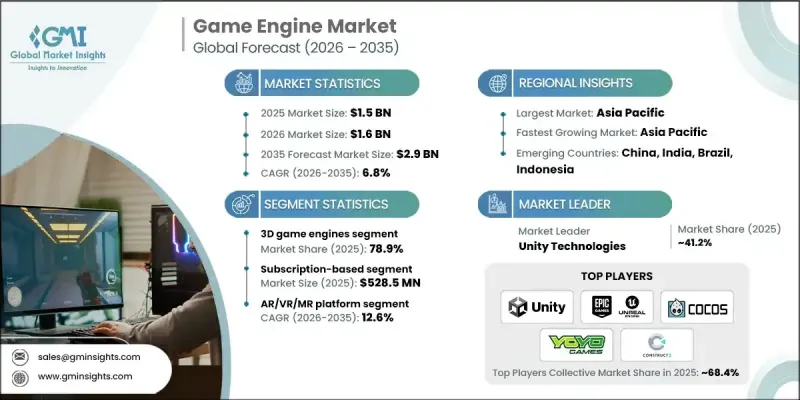
Growth is driven by the rising popularity of mobile and cross-platform gaming, as developers focus on delivering seamless experiences across multiple devices. Adoption is also expanding in non-gaming sectors, including film, architecture, automotive, and industrial simulations, where immersive visualization and digital twin applications are becoming essential. Cloud-based game engines are gaining traction as they support real-time development, collaborative workflows, and scalable asset management for distributed teams. This shift has accelerated since the remote work trend and live service gaming model became widespread. Faster development cycles, reduced infrastructure requirements, and recurring subscription-based revenue are further propelling market expansion. Developers increasingly use engines for high-quality graphics, real-time rendering, and simulation applications across entertainment, automotive, aerospace, and defense sectors.
| Market Scope | |
|---|---|
| Start Year | 2025 |
| Forecast Year | 2026-2035 |
| Start Value | $1.5 Billion |
| Forecast Value | $2.9 Billion |
| CAGR | 6.8% |
The 3D game engines segment held 78.9% share in 2025. This segment benefits from growing demand for photorealistic graphics, real-time physics, and immersive gameplay on PC, console, mobile, and extended reality platforms. Beyond gaming, 3D engines are widely used for AAA titles, virtual production, automotive visualization, and digital twin projects. Their scalability, cross-industry applications, and ability to deliver lifelike experiences have significantly boosted revenue.
The subscription-based segment reached USD 528.5 million in 2025. SaaS-based delivery models offer predictable recurring revenue, integrated development tools, cloud services, and continuous updates. These benefits reduce upfront costs for developers while supporting collaborative, cross-platform, and scalable game development workflows.
North America Game Engine Market held a 31.5% share in 2025. The region's growth is supported by major engine developers, strong AAA gaming studios, and early adoption of cloud-based and immersive technologies. Expanding applications in automotive, aerospace, and film production are also driving demand for high-quality 3D engines, creating diverse revenue opportunities. The rise of esports, simulation-based training, and virtual production is further broadening the scope of game engine use, while AI-powered tools enhance efficiency and creative capabilities.
Key players in the Global Game Engine Market include Cocos, Construct (Scirra Ltd.), Crytek GmbH, Epic Games, Inc. (Unreal Engine), GDevelop, Godot Foundation, Marmalade SDK, MonoGame, Open 3D Engine, RPG Maker (ASCII Corporation), Solar2D LLC, Stencyl LLC, The Game Creators Ltd., Torque3D (GarageGames), Unity Technologies, Ren'Py, and YoYo Games Ltd. Companies in the game engine market are adopting several strategies to strengthen their market position. They are investing heavily in R&D to improve rendering quality, cross-platform capabilities, and support for immersive technologies. Strategic partnerships with cloud providers, software vendors, and enterprise clients enable wider adoption and integration. Mergers and acquisitions are used to expand technology portfolios and gain access to new markets. Firms are also emphasizing subscription-based models for predictable revenue streams and global reach. Additionally, companies are developing AI-powered tools, real-time collaboration features, and scalable cloud-based solutions to enhance usability, attract developers, and maintain a competitive advantage.
Table of Contents
Chapter 1 Methodology and Scope
- 1.1 Market scope and definition
- 1.2 Research design
- 1.2.1 Research approach
- 1.2.2 Data collection methods
- 1.3 Data mining sources
- 1.3.1 Global
- 1.3.2 Regional/Country
- 1.4 Base estimates and calculations
- 1.4.1 Base year calculation
- 1.4.2 Key trends for market estimation
- 1.5 Primary research and validation
- 1.5.1 Primary sources
- 1.6 Forecast model
- 1.7 Research assumptions and limitations
Chapter 2 Executive Summary
- 2.1 Industry 360° synopsis, 2022 - 2035
- 2.2 Key market trends
- 2.2.1 Engine type trends
- 2.2.2 Deployment model trends
- 2.2.3 Licensing model trends
- 2.2.4 Platform trends
- 2.2.5 Application trends
- 2.2.6 Regional trends
- 2.3 TAM Analysis, 2026-2035
- 2.4 CXO perspectives: Strategic imperatives
- 2.4.1 Executive decision points
- 2.4.2 critical success factors
- 2.5 Future outlook and strategic recommendations
Chapter 3 Industry Insights
- 3.1 Industry ecosystem analysis
- 3.1.1 Supplier Landscape
- 3.1.2 Profit Margin
- 3.1.3 Value addition at each stage
- 3.1.4 Factor affecting the value chain
- 3.1.5 Disruptions
- 3.2 Industry impact forces
- 3.2.1 Growth drivers
- 3.2.1.1 Growing demand for immersive gaming experiences and AAA game development
- 3.2.1.2 Expansion of AR/VR/MR and metaverse applications
- 3.2.1.3 Increasing adoption of cloud-based game engines
- 3.2.1.4 Rising use in non-gaming industries
- 3.2.1.5 Growth of mobile and cross-platform gaming
- 3.2.2 Industry pitfalls and challenges
- 3.2.2.1 Intense competition and price pressure from freemium/open-source engines
- 3.2.2.2 Complexity and high learning curve of advanced engines
- 3.2.3 Market opportunities
- 3.2.3.1 Adoption of AI-powered engine features and procedural content generation
- 3.2.3.2 Integration with cloud gaming, SaaS, and collaborative development platforms
- 3.2.1 Growth drivers
- 3.3 Growth potential analysis
- 3.4 Regulatory landscape
- 3.4.1 North America
- 3.4.2 Europe
- 3.4.3 Asia Pacific
- 3.4.4 Latin America
- 3.4.5 Middle East & Africa
- 3.5 Porter's analysis
- 3.6 PESTEL analysis
- 3.7 Technology and Innovation landscape
- 3.7.1 Current technological trends
- 3.7.2 Emerging technologies
- 3.8 Emerging Business Models
- 3.9 Compliance Requirements
- 3.10 Patent and IP analysis
- 3.11 Geopolitical and trade dynamics
Chapter 4 Competitive Landscape, 2025
- 4.1 Introduction
- 4.2 Company market share analysis
- 4.2.1 By region
- 4.2.1.1 North America
- 4.2.1.2 Europe
- 4.2.1.3 Asia Pacific
- 4.2.1.4 Latin America
- 4.2.1.5 Middle East & Africa
- 4.2.2 Market concentration analysis
- 4.2.1 By region
- 4.3 Competitive benchmarking of key players
- 4.3.1 Financial performance comparison
- 4.3.1.1 Revenue
- 4.3.1.2 Profit margin
- 4.3.1.3 R&D
- 4.3.2 Product portfolio comparison
- 4.3.2.1 Product range breadth
- 4.3.2.2 Technology
- 4.3.2.3 Innovation
- 4.3.3 Geographic presence comparison
- 4.3.3.1 Global footprint analysis
- 4.3.3.2 Service network coverage
- 4.3.3.3 Market penetration by region
- 4.3.4 Competitive positioning matrix
- 4.3.4.1 Leaders
- 4.3.4.2 Challengers
- 4.3.4.3 Followers
- 4.3.4.4 Niche players
- 4.3.5 Strategic outlook matrix
- 4.3.1 Financial performance comparison
- 4.4 Key developments
- 4.4.1 Mergers and acquisitions
- 4.4.2 Partnerships and collaborations
- 4.4.3 Technological advancements
- 4.4.4 Expansion and investment strategies
- 4.4.5 Digital transformation initiatives
- 4.5 Emerging/ startup competitors landscape
Chapter 5 Market Estimates and Forecast, By Engine Type, 2022 - 2035 (USD Million)
- 5.1 Key trends
- 5.2 2D game engines
- 5.3 3D game engines
- 5.4 Hybrid
Chapter 6 Market Estimates and Forecast, By Deployment Model, 2022 - 2035 (USD Million)
- 6.1 Key trends
- 6.2 On-premise
- 6.3 Cloud-based
- 6.4 Hybrid
Chapter 7 Market Estimates and Forecast, By Licensing Model, 2022 - 2035 (USD Million)
- 7.1 Key trends
- 7.2 Freemium
- 7.3 Subscription-based
- 7.4 Perpetual license
- 7.5 Revenue-sharing / royalty-based
Chapter 8 Market Estimates and Forecast, By Platform, 2022 - 2035 (USD Million)
- 8.1 Key trends
- 8.2 PC
- 8.3 Console
- 8.4 Mobile
- 8.5 Web
- 8.6 AR/VR/MR
Chapter 9 Market Estimates and Forecast, By Application, 2022 - 2035 (USD Million)
- 9.1 Key trends
- 9.2 Gaming
- 9.2.1 Console
- 9.2.2 PC
- 9.2.3 Mobile
- 9.2.4 Online
- 9.3 Film & animation / virtual production
- 9.4 Architecture, engineering & construction (AEC)
- 9.5 Automotive & transportation
- 9.6 Aerospace & defense
- 9.7 Others
Chapter 10 Market Estimates and Forecast, By Region, 2022 - 2035 (USD Million)
- 10.1 Key trends
- 10.2 North America
- 10.2.1 U.S.
- 10.2.2 Canada
- 10.3 Europe
- 10.3.1 Germany
- 10.3.2 UK
- 10.3.3 France
- 10.3.4 Spain
- 10.3.5 Italy
- 10.3.6 Netherlands
- 10.4 Asia Pacific
- 10.4.1 China
- 10.4.2 India
- 10.4.3 Japan
- 10.4.4 Australia
- 10.4.5 South Korea
- 10.5 Latin America
- 10.5.1 Brazil
- 10.5.2 Mexico
- 10.5.3 Argentina
- 10.6 Middle East and Africa
- 10.6.1 South Africa
- 10.6.2 Saudi Arabia
- 10.6.3 UAE
Chapter 11 Company Profiles
- 11.1 Global Key Players
- 11.1.1 Unity Technologies
- 11.1.2 Epic Games, Inc. (Unreal Engine)
- 11.1.3 YoYo Games Ltd.
- 11.2 Regional key players
- 11.2.1 North America
- 11.2.1.1 MonoGame
- 11.2.1.2 Open 3D Engine
- 11.2.1.3 GDevelop
- 11.2.2 Asia Pacific
- 11.2.2.1 Cocos
- 11.2.2.2 RPG Maker (ASCII Corporation)
- 11.2.2.3 Solar2D LLC
- 11.2.3 Europe
- 11.2.3.1 YoYo Games Ltd.
- 11.2.3.2 Construct (Scirra Ltd.)
- 11.2.3.3 Crytek GmbH
- 11.2.3.4 Godot Foundation
- 11.2.3.5 Stencyl LLC
- 11.2.1 North America
- 11.3 Niche Players/Disruptors
- 11.3.1 Ren’Py
- 11.3.2. Torque3 D (GarageGames)

