PUBLISHER: Global Market Insights Inc. | PRODUCT CODE: 1936613

PUBLISHER: Global Market Insights Inc. | PRODUCT CODE: 1936613
Automotive Regenerative Braking Market Opportunity, Growth Drivers, Industry Trend Analysis, and Forecast 2026 - 2035
The Global Automotive Regenerative Braking Market was valued at USD 7.5 billion in 2025 and is estimated to grow at a CAGR of 19.9% to reach USD 45.9 billion by 2035.
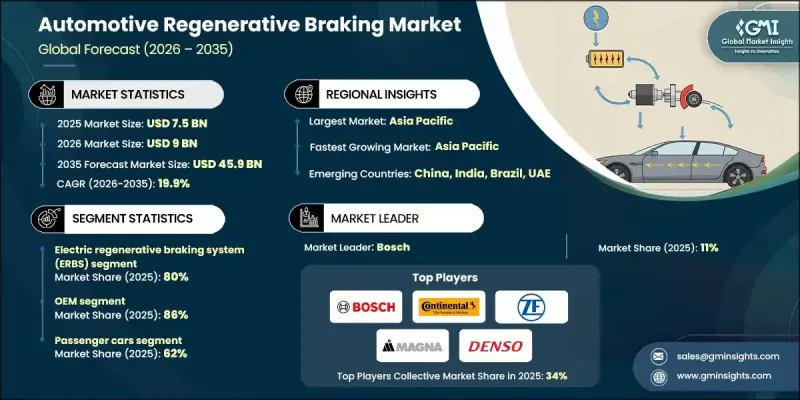
Regenerative braking systems capture kinetic energy during deceleration and convert it into reusable electrical energy, supporting the automotive industry's shift toward electrification and sustainability. These systems span electric, hydraulic, kinetic, and pneumatic technologies and are used across passenger vehicles, commercial vehicles, two-wheelers, and specialized applications. They play an essential role in autonomous and advanced driver-assistance systems (ADAS) by delivering precise braking and recovering energy efficiently. With advanced sensors, real-time data processing, and machine learning, these systems maximize energy recovery under diverse driving conditions. Government regulations aimed at reducing emissions, coupled with innovations in batteries, supercapacitors, and power electronics, have significantly enhanced performance. Lithium-ion batteries now surpass 250 Wh/kg, and silicon carbide semiconductors reduce energy conversion losses by 40-50%, improving regenerative braking efficiency from 70% to over 90%. Market growth is fueled by the automotive sector's increasing focus on digitalization, electrification, and energy-efficient mobility solutions.
| Market Scope | |
|---|---|
| Start Year | 2025 |
| Forecast Year | 2026-2035 |
| Start Value | $7.5 Billion |
| Forecast Value | $45.9 Billion |
| CAGR | 19.9% |
The electric regenerative braking systems (ERBS) segment accounted for 80% share in 2025 and is expected to grow at a CAGR of 20.3% from 2026 to 2035. ERBS converts kinetic energy into electricity via the traction motor's generator mode, storing it in the vehicle battery. This technology offers high energy conversion efficiency, seamless integration with electric and hybrid powertrains, and compatibility with advanced vehicle control systems. ERBS is widely used in battery electric and plug-in hybrid vehicles, with adoption expanding in mild hybrids with 48-volt systems.
The OEM segment held 86% share in 2025 and is growing at a CAGR of 20.2% through 2035. OEM channels involve regenerative braking systems integrated during vehicle production, including factory-installed units and those supplied to automakers for assembly. Integration during manufacturing ensures compatibility with vehicle powertrains and control systems, offering supply chain stability and facilitating collaborative development across multiple vehicle programs and model years.
China Automotive Regenerative Braking Market is expected to grow at a CAGR of 20.3% from 2026 to 2035. With annual vehicle sales of 26 million, China leads global adoption, supported by government policies promoting EV use through subsidies, licensing incentives, and restrictions on conventional engines. Domestic manufacturers have established regenerative braking as a standard feature, accelerating technology deployment across their vehicle portfolios.
Key companies operating in the Global Automotive Regenerative Braking Market include Brembo, Aisin Seiki, Denso, BorgWarner, Robert Bosch, Continental, Valeo, Magna, Hitachi Astemo, and ZF Friedrichshafen. Market players are strengthening their presence by developing next-generation regenerative braking solutions with higher energy recovery efficiency and seamless integration with electrified powertrains. They are forming strategic partnerships with automakers to ensure early adoption across multiple vehicle platforms. Investments in R&D focus on advanced sensors, real-time energy management, and machine learning to optimize system performance. Companies are also expanding production capabilities and supply chain networks to meet growing demand. Additionally, collaborations with battery and power electronics manufacturers enhance system efficiency and reliability, while marketing efforts highlight sustainability and compliance with evolving global emission standards, reinforcing competitive positioning and market credibility.
Table of Contents
Chapter 1 Methodology
- 1.1 Research approach
- 1.2 Quality commitments
- 1.3 Research trail and confidence scoring
- 1.3.1 Research trail components
- 1.3.2 Scoring components
- 1.4 Data collection
- 1.4.1 Partial list of primary sources
- 1.5 Data mining sources
- 1.5.1 Paid sources
- 1.6 Best estimates and calculations
- 1.6.1 Base year calculation for any one approach
- 1.7 Forecast model
- 1.8 Research transparency addendum
Chapter 2 Executive Summary
- 2.1 Industry 3600 synopsis, 2022 - 2035
- 2.2 Key market trends
- 2.2.1 Regional
- 2.2.2 Technology
- 2.2.3 Vehicles
- 2.2.4 Sales Channel
- 2.2.5 Propulsion
- 2.3 TAM Analysis, 2026-2035
- 2.4 CXO perspectives: Strategic imperatives
- 2.4.1 Executive decision points
- 2.4.2 Critical success factors
- 2.5 Future outlook and strategic recommendations
Chapter 3 Industry Insights
- 3.1 Industry ecosystem analysis
- 3.1.1 Supplier landscape
- 3.1.2 Profit margin analysis
- 3.1.3 Cost structure
- 3.1.4 Value addition at each stage
- 3.1.5 Factor affecting the value chain
- 3.1.6 Disruptions
- 3.2 Industry impact forces
- 3.2.1.1 Growth drivers
- 3.2.1.2 Rapid adoption of EVs, HEVs, and PHEVs.
- 3.2.1.3 Stricter emission regulations and environmental awareness.
- 3.2.1.4 Rising demand for fuel-efficient vehicles.
- 3.2.1.5 Technological advancements in braking systems.
- 3.2.1.6 Shift toward smart and connected vehicles.
- 3.2.2 Industry pitfalls and challenges
- 3.2.2.1 High cost of regenerative braking systems
- 3.2.2.2 Complex integration with existing vehicle systems
- 3.2.3 Market opportunities
- 3.2.3.1 Rising electric and hybrid vehicle adoption
- 3.2.3.2 Expansion of EV charging infrastructure
- 3.2.3.3 Growing demand for fuel-efficient and eco-friendly vehicles
- 3.2.3.4 Government incentives and subsidies
- 3.2.3.5 Integration with smart and connected vehicle technologies
- 3.3 Growth potential analysis
- 3.4 Regulatory landscape
- 3.4.1 North America
- 3.4.1.1 US- FMVSS regulating braking and energy recovery systems
- 3.4.1.2 Canada - MVSR covering brake system performance and safety compliance
- 3.4.2 Europe
- 3.4.2.1 Germany- EU Regulation 168/2013 on advanced braking systems
- 3.4.2.2 UK- UK road vehicles (Construction and Use) regulations 1986
- 3.4.2.3 France- RE2020 promoting energy-efficient braking
- 3.4.2.4 Italy- PNRR road safety mandates
- 3.4.3 Asia Pacific
- 3.4.3.1 China- GB/T vehicle safety standards
- 3.4.3.2 India- Motor vehicles (Amendment) Act 2019
- 3.4.3.3 Japan- i-Construction and road traffic act
- 3.4.3.4 Australia- ADR covering regenerative braking integration
- 3.4.4 LATAM
- 3.4.4.1 Mexico- Official Mexican standard NOM-036-SCFI-2018
- 3.4.4.2 Argentina- National traffic law 24.449
- 3.4.5 MEA
- 3.4.5.1 South Africa- National road traffic act (1996)
- 3.4.5.2 Saudi Arabia- Traffic law & vision 2030 transport initiatives
- 3.4.1 North America
- 3.5 Porter's analysis
- 3.6 PESTEL analysis
- 3.7 Technology and innovation landscape
- 3.7.1 Current technological trends
- 3.7.2 Emerging technologies
- 3.8 Production statistics
- 3.8.1 Production hubs
- 3.8.2 Consumption hubs
- 3.8.3 Export and import
- 3.9 Pricing analysis
- 3.10 Cost breakdown analysis
- 3.11 Patent analysis
- 3.12 Use cases & success stories
- 3.13 Sustainability and environmental aspects
- 3.13.1 Sustainable practices
- 3.13.2 Waste reduction strategies
- 3.13.3 Energy efficiency in production
- 3.13.4 Eco-friendly Initiatives
- 3.13.5 Carbon footprint considerations
- 3.14 Future outlook and opportunities
Chapter 4 Competitive Landscape, 2025
- 4.1 Introduction
- 4.2 Company market share analysis
- 4.2.1 North America
- 4.2.2 Europe
- 4.2.3 Asia Pacific
- 4.2.4 LATAM
- 4.2.5 MEA
- 4.3 Competitive analysis of major market players
- 4.4 Competitive positioning matrix
- 4.5 Strategic outlook matrix
- 4.6 Key developments
- 4.6.1 Mergers & acquisitions
- 4.6.2 Partnerships & collaborations
- 4.6.3 New product launches
- 4.6.4 Expansion plans and funding
Chapter 5 Market Estimates & Forecast, By Technology, 2022 - 2035 ($Bn, Units)
- 5.1 Key trends
- 5.2 Electric regenerative braking system (ERBS)
- 5.3 Hydraulic regenerative braking system (HRBS)
- 5.4 Kinetic regenerative braking system (KRBS)
- 5.5 Pneumatic regenerative braking
Chapter 6 Market Estimates & Forecast, By Vehicles, 2022 - 2035 ($Bn, Units)
- 6.1 Key trends
- 6.2 Passenger cars
- 6.2.1 Hatchback
- 6.2.2 SUV
- 6.2.3 Sedan
- 6.3 Commercial vehicles
- 6.3.1 Light commercial vehicles (LCVs)
- 6.3.2 Medium commercial vehicles (MCVs)
- 6.3.3 Heavy commercial vehicles (HCVs)
- 6.4 Two-Wheelers
- 6.4.1 Electric scooters
- 6.4.2 Electric motorcycles
- 6.5 Others
- 6.5.1 Buses
- 6.5.2 Specialty vehicles
Chapter 7 Market Estimates & Forecast, By Sales Channel, 2022 - 2035 ($Bn, Units)
- 7.1 Key trends
- 7.2 OEM
- 7.3 Aftermarket
Chapter 8 Market Estimates & Forecast, By Propulsion, 2022 - 2035 ($Bn, Units)
- 8.1 Key trends
- 8.2 Internal combustion engine (ICE) vehicles
- 8.3 Hybrid electric vehicles (HEV)
- 8.4 Plug-in hybrid electric vehicles (PHEV)
- 8.5 Battery electric vehicles (BEV)
Chapter 9 Market Estimates & Forecast, By Region, 2022 - 2035 ($Bn, Units)
- 9.1 Key trends
- 9.2 North America
- 9.2.1 US
- 9.2.2 Canada
- 9.3 Europe
- 9.3.1 Germany
- 9.3.2 UK
- 9.3.3 France
- 9.3.4 Italy
- 9.3.5 Spain
- 9.3.6 Russia
- 9.3.7 Nordics
- 9.3.8 Benelux
- 9.4 Asia Pacific
- 9.4.1 China
- 9.4.2 India
- 9.4.3 Japan
- 9.4.4 Australia
- 9.4.5 South Korea
- 9.4.6 Singapore
- 9.4.7 Thailand
- 9.4.8 Indonesia
- 9.4.9 Vietnam
- 9.5 Latin America
- 9.5.1 Brazil
- 9.5.2 Mexico
- 9.5.3 Argentina
- 9.5.4 Colombia
- 9.6 MEA
- 9.6.1 South Africa
- 9.6.2 Saudi Arabia
- 9.6.3 UAE
Chapter 10 Company Profiles
- 10.1 Global Players
- 10.1.1 Aisin Seiki
- 10.1.2 BorgWarner
- 10.1.3 Continental
- 10.1.4 Delphi Technologies
- 10.1.5 Denso
- 10.1.6 Eaton
- 10.1.7 Hitachi Astemo
- 10.1.8 Hyundai Mobis
- 10.1.9 Magna International
- 10.1.10 Robert Bosch
- 10.1.11 Valeo
- 10.1.12 ZF Friedrichshafen
- 10.2 Regional Players
- 10.2.1 ADVICS
- 10.2.2 Akebono Brake Industry
- 10.2.3 Brembo
- 10.2.4 General Motors
- 10.2.5 Honda Motor
- 10.2.6 Mando
- 10.2.7 Mazda Motor
- 10.2.8 Nissin Kogyo
- 10.2.9 Schaeffler
- 10.2.10 Toyota Motor
- 10.3 Emerging Technology Innovators
- 10.3.1 Faurecia
- 10.3.2 Punch Powertrain
- 10.3.3 Skeleton Technologies

