
PUBLISHER: Global Market Insights Inc. | PRODUCT CODE: 1936626

PUBLISHER: Global Market Insights Inc. | PRODUCT CODE: 1936626
Sulfone Polymers Market Opportunity, Growth Drivers, Industry Trend Analysis, and Forecast 2026 - 2035
The Global Sulfone Polymers Market was valued at USD 2.1 billion in 2025 and is estimated to grow at a CAGR of 5.6% to reach USD 3.6 billion by 2035.
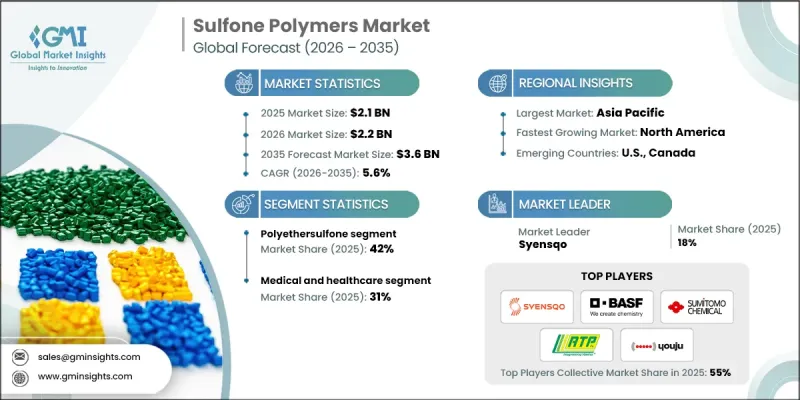
The market includes revenue generated from polysulfone (PSU), polyethersulfone (PESU), polyphenylsulfone (PPSU), and polyetherimide (PEI), offered as virgin pellets, membrane-grade powders, and compounded formulations. Pricing structures are influenced by factors such as molecular weight distribution, material purity, sterilization certifications, flame-retardant ratings, and approvals for food and water contact, which can command 20-40% premiums for specialized grades. Even small shifts in volume toward healthcare or membrane applications can have a disproportionate impact on revenue due to the high-value nature of these grades. In the healthcare sector, buyers prioritize biocompatibility, sterilization durability, and long lifecycle performance, which allow PPSU medical components to withstand multiple steam cycles. In water treatment, membrane performance, including flux efficiency and fouling recovery, is critical, and PES-based membranes have demonstrated high throughput with rapid recovery after cleaning. In electronics and aerospace, high glass transition temperatures, dimensional stability, and heat deflection capabilities support critical applications under extreme conditions, driving consistent demand and higher per-unit revenue. The combination of high-performance material properties and the ability to meet stringent regulatory standards is fueling global market expansion across multiple industries.
| Market Scope | |
|---|---|
| Start Year | 2025 |
| Forecast Year | 2026-2035 |
| Start Value | $2.1 Billion |
| Forecast Value | $3.6 Billion |
| CAGR | 5.6% |
The polyethersulfone segment held 42% share in 2025. Its balanced property-to-cost ratio, combined with hydrophilic behavior, excellent chemical resistance, and thermal stability up to 220°C, makes PESU highly suitable for water filtration, hemodialysis, and industrial separation membranes. Commercial powders of PESU, with molecular weights ranging from 45,000 to 68,000, are designed for ease of dissolution and membrane fabrication.
The electronics and electrical applications segment held 22% share in 2025, leveraging sulfone polymers' thermal stability, chemical resistance, and precise dimensional control. These materials are increasingly used in high-temperature electronic components, insulating modules, and assemblies where chemical exposure is high, but tolerances must be maintained. Transparent and UV-stable grades are also favored in lighting applications where long-term reliability and resistance to heat degradation are essential. The versatility of sulfone polymers, coupled with their performance in demanding operating environments, continues to reinforce their adoption across diverse industrial applications.
North America Sulfone Polymers Market represented 27% share in 2025. The strong regional demand is driven by advanced medical device manufacturing, strict healthcare quality standards, and a robust aerospace sector. Regulatory frameworks, including FDA recognition and ASTM standards for medical applications, support the use of sulfone polymers for critical devices. Emphasis on reusable medical devices to reduce waste and per-procedure costs further enhances the appeal of sterilization-resistant materials such as PSU and PPSU. The concentration of aerospace manufacturing in the U.S. and Canada, supported by extensive supply chains and large-scale industrial operations, also fuels demand for aerospace-grade sulfone polymers.
Key players operating in the Global Sulfone Polymers Market include Shandong Haoran Special Plastic, Mitsubishi Gas Chemical Company, RTP Company, Sumitomo Chemical, BASF SE, SABIC, Youju New Materials, Syensqo, Atul Ltd, and Solvay. To strengthen their presence, companies in the sulfone polymers industry are adopting multiple strategic initiatives. They are investing heavily in research and development to produce polymers with superior thermal, chemical, and sterilization performance, tailored for healthcare, aerospace, and membrane applications. Strategic collaborations, joint ventures, and mergers allow firms to expand their geographical footprint, access new customer segments, and improve supply chain efficiency. Many companies are optimizing production processes to reduce costs while enhancing material purity and performance. Firms are also focusing on regulatory compliance, obtaining medical and industrial certifications to improve credibility and customer trust. Advanced digital platforms for material testing, real-time quality monitoring, and customer support further enhance operational efficiency.
Table of Contents
Chapter 1 Methodology & Scope
- 1.1 Market scope and definition
- 1.2 Research design
- 1.2.1 Research approach
- 1.2.2 Data collection methods
- 1.3 Data mining sources
- 1.3.1 Global
- 1.3.2 Regional/Country
- 1.4 Base estimates and calculations
- 1.4.1 Base year calculation
- 1.4.2 Key trends for market estimation
- 1.5 Primary research and validation
- 1.5.1 Primary sources
- 1.6 Forecast model
- 1.7 Research assumptions and limitations
Chapter 2 Executive Summary
- 2.1 Industry 3600 synopsis
- 2.2 Key market trends
- 2.2.1 Product
- 2.2.2 Performance grade
- 2.2.3 End use industry
- 2.3 TAM analysis, 2025-2034
- 2.4 CXO perspectives: Strategic imperatives
- 2.4.1 Executive decision points
- 2.4.2 Critical success factors
- 2.5 Outlook and strategic recommendations
Chapter 3 Industry Insights
- 3.1 Industry ecosystem analysis
- 3.1.1 Supplier landscape
- 3.1.2 Profit margin
- 3.1.3 Value addition at each stage
- 3.1.4 Factor affecting the value chain
- 3.1.5 Disruptions
- 3.2 Industry impact forces
- 3.2.1 Growth drivers
- 3.2.2 Industry pitfalls and challenges
- 3.2.3 Market opportunities
- 3.3 Growth potential analysis
- 3.4 Regulatory landscape
- 3.4.1 North America
- 3.4.2 Europe
- 3.4.3 Asia Pacific
- 3.4.4 Latin America
- 3.4.5 Middle East & Africa
- 3.5 Porter's analysis
- 3.6 PESTEL analysis
- 3.7 Price trends
- 3.7.1 By region
- 3.8 Future market trends
- 3.9 Technology and innovation landscape
- 3.9.1 Current technological trends
- 3.9.2 Emerging technologies
- 3.10 Patent landscape
- 3.11 Trade statistics (HS code) (Note: the trade statistics will be provided for key countries only)
- 3.11.1 Major importing countries
- 3.11.2 Major exporting countries
- 3.12 Sustainability and environmental aspects
- 3.12.1 Sustainable practices
- 3.12.2 Waste reduction strategies
- 3.12.3 Energy efficiency in production
- 3.12.4 Eco-friendly initiatives
- 3.13 Carbon footprint considerations
Chapter 4 Competitive Landscape, 2025
- 4.1 Introduction
- 4.2 Company market share analysis
- 4.2.1 By region
- 4.2.1.1 North America
- 4.2.1.2 Europe
- 4.2.1.3 Asia Pacific
- 4.2.1.4 Latin America
- 4.2.1.5 Middle East & Africa
- 4.2.1 By region
- 4.3 Company matrix analysis
- 4.4 Competitive analysis of major market players
- 4.5 Competitive positioning matrix
- 4.6 Key developments
- 4.6.1 Mergers & acquisitions
- 4.6.2 Partnerships & collaborations
- 4.6.3 New product launches
- 4.6.4 Expansion plans
Chapter 5 Market Size and Forecast, By Product, 2022-2035 (USD Billion, Kilo Tons)
- 5.1 Key trends
- 5.2 Polysulfone (PSU)
- 5.3 Polyethersulfone (PESU)
- 5.4 Polyphenylsulfone (PPSU)
- 5.5 Polyetherimide (PEI)
- 5.6 Others
Chapter 6 Market Size and Forecast, By Performance Grade, 2022-2035 (USD Billion, Kilo Tons)
- 6.1 Key trends
- 6.2 Standard/commercial grade
- 6.3 Medical/healthcare grade
- 6.4 Food contact grade
- 6.5 Aerospace grade
- 6.6 Flame retardant grade
- 6.7 Others
Chapter 7 Market Size and Forecast, By End Use Industry , 2022-2035 (USD Billion, Kilo Tons)
- 7.1 Key trends
- 7.2 Medical & healthcare
- 7.2.1 Hospitals & dialysis centers
- 7.2.2 Medical device manufacturers
- 7.2.3 Pharmaceutical processing equipment
- 7.3 Aerospace
- 7.3.1 Commercial aviation
- 7.3.2 Military & defense aircraft
- 7.3.3 Space applications
- 7.4 Automotive
- 7.4.1 Internal combustion engine (ICE) vehicles
- 7.4.2 Electric vehicles (EVs)
- 7.4.3 Hybrid vehicles
- 7.5 Electrical & electronics
- 7.5.1 Consumer electronics
- 7.5.2 Semiconductor manufacturing
- 7.5.3 Data centers & servers
- 7.5.4 5g infrastructure
- 7.6 Water & wastewater treatment
- 7.6.1 Municipal utilities
- 7.6.2 Industrial water treatment
- 7.6.3 Desalination plants
- 7.7 Food & beverage processing
- 7.7.1 Food processing equipment manufacturers
- 7.7.2 Commercial kitchens & restaurants
- 7.7.3 Household appliances
- 7.8 Industrial & manufacturing
- 7.8.1 Plumbing & HVAC
- 7.8.2 Chemical processing equipment
- 7.8.3 Oil & gas applications
- 7.9 Energy & hydrogen economy
- 7.9.1 Fuel cell manufacturers
- 7.9.2 Electrolyzer manufacturers
- 7.9.3 Hydrogen infrastructure development
- 7.10 Others
Chapter 8 Market Size and Forecast, By Region, 2022-2035 (USD Billion, Kilo Tons)
- 8.1 Key trends
- 8.2 North America
- 8.2.1 U.S.
- 8.2.2 Canada
- 8.3 Europe
- 8.3.1 UK
- 8.3.2 Germany
- 8.3.3 France
- 8.3.4 Italy
- 8.3.5 Spain
- 8.3.6 Rest of Europe
- 8.4 Asia Pacific
- 8.4.1 China
- 8.4.2 India
- 8.4.3 Japan
- 8.4.4 South Korea
- 8.4.5 Australia
- 8.4.6 Rest of Asia Pacific
- 8.5 Latin America
- 8.5.1 Brazil
- 8.5.2 Mexico
- 8.5.3 Argentina
- 8.5.4 Rest of Latin America
- 8.6 Middle East & Africa
- 8.6.1 South Africa
- 8.6.2 Saudi Arabia
- 8.6.3 UAE
- 8.6.4 Rest of Middle East & Africa
Chapter 9 Company Profiles
- 9.1 RTP Company
- 9.2 Youju New Materials
- 9.3 BASF SE
- 9.4 SABIC
- 9.5 Solvay
- 9.6 Sumitomo Chemical
- 9.7 Shandong Haoran Special Plastic
- 9.8 Syensqo
- 9.9 Mitsubishi Gas Chemical Company
- 9.10 Atul Ltd
- 9.11 Avient Corporation
- 9.12 Ovation Polymers
- 9.13 ASEP Industries Sdn Bhd
- 9.14 Aurorium
- 9.15 3DXTech
- 9.16 Foshan Plolima Material

