PUBLISHER: Global Market Insights Inc. | PRODUCT CODE: 1936636

PUBLISHER: Global Market Insights Inc. | PRODUCT CODE: 1936636
Dual Clutch Transmission Market Opportunity, Growth Drivers, Industry Trend Analysis, and Forecast 2026 - 2035
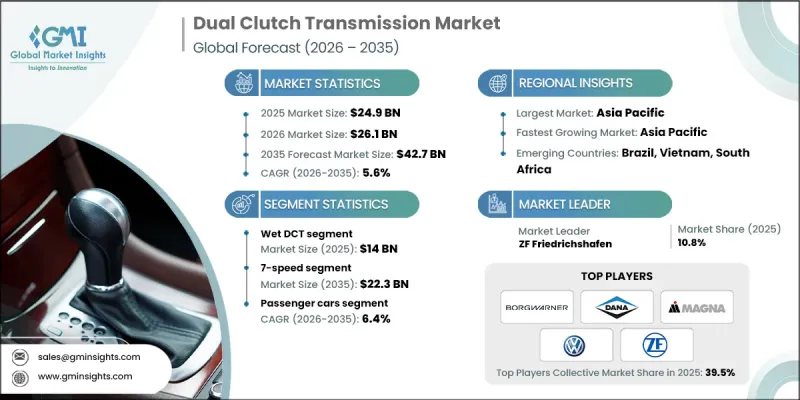
The Global Dual Clutch Transmission Market was valued at USD 24.9 billion in 2025 and is estimated to grow at a CAGR of 5.6% to reach USD 42.7 billion by 2035.
DCTs are advanced transmission systems that offer rapid, seamless gear shifts, initially popularized in premium passenger cars and high-performance vehicles, and gradually expanding into commercial vehicles and select motorcycles. Their growing adoption is driven by the pursuit of better fuel efficiency, smoother acceleration, and improved driving dynamics. Manufacturers are increasingly integrating DCTs with hybrid and connected vehicle platforms, while investing in lightweight materials and advanced control systems to optimize torque handling and reduce energy loss. Wet and dry clutch designs are enhanced for heat management, durability, and cost efficiency, while software integration with vehicle diagnostics supports trends in autonomous and performance-oriented vehicles. These developments position DCTs as a key technology for modern automotive innovation, bridging performance, efficiency, and sustainability demands across global markets.
| Market Scope | |
|---|---|
| Start Year | 2025 |
| Forecast Year | 2026-2035 |
| Start Value | $24.9 Billion |
| Forecast Value | $42.7 Billion |
| CAGR | 5.6% |
The wet DCT segment held 55% share, generating USD 14 billion in 2025. Wet dual clutch transmissions are preferred for high-torque and performance vehicles due to their oil-lubricated clutches, which improve heat dissipation, reliability, and performance under heavy traffic and extreme conditions.
The 7-speed segment accounted for 52.7% in 2025 and is expected to reach USD 22.3 billion by 2035. These transmissions balance efficiency, drivability, and reliability, offering smooth acceleration and precise torque control. Mid-range sedans, hatchbacks, and compact SUVs commonly employ 7-speed DCTs, providing optimal performance without the complexity of 8-speed alternatives.
North America Dual Clutch Transmission Market is projected to reach USD 5.2 billion by 2035, growing at a CAGR of 5.2% from 2026 to 2035. The region's strong automotive base, presence of leading carmakers, and growing adoption of high-performance vehicles drive demand for DCTs, particularly in premium and sports segments.
Key players in the Global Dual Clutch Transmission Market include Magna, ZF Friedrichshafen, BorgWarner, Volkswagen, Aisin, Schaeffler, Great Wall Motors, Dana, TREMEC, and Punch Powertrain. Companies in the Dual Clutch Transmission Market are strengthening their foothold through multiple strategies. They invest heavily in R&D to enhance clutch materials, torque handling, and software integration for hybrid and electric drivetrains. Partnerships with automakers allow tailored solutions for premium, mid-range, and commercial vehicles. Manufacturers are expanding global production facilities to meet rising demand, optimizing supply chains for cost efficiency and faster delivery. Innovation in adaptive and connected transmission systems enhances compatibility with autonomous and smart vehicle platforms. Firms also focus on aftermarket services, retrofitting, and customer support to increase brand loyalty. Strategic collaborations, licensing agreements, and acquisitions help widen geographic reach and consolidate market presence while maintaining competitive advantage.
Table of Contents
Chapter 1 Methodology
- 1.1 Research approach
- 1.2 Quality commitments
- 1.2.1 GMI AI policy & data integrity commitment
- 1.3 Research trail & confidence scoring
- 1.3.1 Research trail components
- 1.3.2 Scoring components
- 1.4 Data collection
- 1.4.1 Partial list of primary sources
- 1.5 Data mining sources
- 1.5.1 Paid sources
- 1.6 Base estimates and calculations
- 1.6.1 Base year calculation
- 1.7 Forecast model
- 1.8 Research transparency addendum
Chapter 2 Executive Summary
- 2.1 Industry 3600 synopsis
- 2.2 Key market trends
- 2.2.1 Regional
- 2.2.2 Product
- 2.2.3 Transmission Speed
- 2.2.4 Powertrain
- 2.2.5 Vehicle
- 2.2.6 Sales Channel
- 2.3 TAM analysis, 2026-2035
- 2.4 CXO perspectives: Strategic imperatives
- 2.4.1 Executive decision points
- 2.4.2 Critical success factors
- 2.5 Future outlook and recommendations
Chapter 3 Industry Insights
- 3.1 Industry ecosystem analysis
- 3.1.1 Supplier landscape
- 3.1.2 Profit margin
- 3.1.3 Cost structure
- 3.1.4 Value addition at each stage
- 3.1.5 Factor affecting the value chain
- 3.1.6 Disruptions
- 3.2 Industry impact forces
- 3.2.1 Growth drivers
- 3.2.1.1 Expansion of the worldwide passenger car production
- 3.2.1.2 Growing adoption of automatic and semi-automatic transmissions
- 3.2.1.3 Strong penetration of DCT in premium and sports cars
- 3.2.1.4 Increasing adoption of DCT in hybrid vehicles
- 3.2.2 Industry pitfalls and challenges
- 3.2.2.1 Rising penetration of battery electric vehicles (BEVs)
- 3.2.2.2 Complexity in design and manufacturing
- 3.2.3 Market opportunities
- 3.2.3.1 Rising adoption of DCT in hybrid powertrains
- 3.2.3.2 Growing demand for DCT in compact and mid-segment vehicles
- 3.2.3.3 Expansion opportunities in emerging automotive markets
- 3.2.3.4 OEM collaborations and strategic partnerships
- 3.2.1 Growth drivers
- 3.3 Growth potential analysis
- 3.4 Regulatory landscape
- 3.4.1 North America
- 3.4.1.1 National Highway Traffic Safety Administration (NHTSA)
- 3.4.1.2 Environmental Protection Agency (EPA)
- 3.4.1.3 Canadian Motor Vehicle Safety Standards (Transport Canada)
- 3.4.2 Europe
- 3.4.2.1 European Committee for Standardization (CEN)
- 3.4.2.2 European Union Vehicle Type Approval Authorities
- 3.4.2.3 European Environment Agency (EEA)
- 3.4.3 Asia Pacific
- 3.4.3.1 China National Standards (GB / Guobiao Standards)
- 3.4.3.2 Automotive Research Association of India (ARAI)
- 3.4.3.3 Japan Automobile Standards Internationalization Center (JASIC)
- 3.4.4 Latin America
- 3.4.4.1 Mercosur Automotive Regulatory Framework (MERCOSUR)
- 3.4.4.2 Brazilian National Traffic Department (DENATRAN / Contran)
- 3.4.5 Middle East & Africa
- 3.4.5.1 Gulf Cooperation Council (GCC) Standards Organization (GSO)
- 3.4.5.2 South African Bureau of Standards (SABS)
- 3.4.5.3 Saudi Standards, Metrology and Quality Organization (SASO)
- 3.4.1 North America
- 3.5 Porter's analysis
- 3.6 PESTEL analysis
- 3.7 Technology and innovation landscape
- 3.7.1 Current technological trends
- 3.7.2 Emerging technologies
- 3.8 Price trends
- 3.8.1 By region
- 3.8.2 By product
- 3.9 Production statistics
- 3.9.1 Production hubs
- 3.9.2 Consumption hubs
- 3.9.3 Export and import
- 3.10 Cost breakdown analysis
- 3.11 Sustainability and environmental impact
- 3.11.1 Environmental impact assessment
- 3.11.2 Social impact & community benefits
- 3.11.3 Governance & corporate responsibility
- 3.11.4 Sustainable finance & investment trends
- 3.12 DCT Architecture and Design Analysis
- 3.12.1 Single-shaft vs. dual-shaft DCT configurations
- 3.12.2 Wet clutch vs. dry clutch design trade-offs
- 3.12.3 Packaging constraints and vehicle integration challenges
- 3.12.4 Thermal management and lubrication system design
- 3.13 Impact of Electrification and EV Adoption
- 3.13.1 BEV architecture impact on DCT demand
- 3.13.2 HEV-driven continuity for DCT systems
- 3.13.3 PHEV-DCT integration dynamics
- 3.13.4 Regional EV transition impact on DCT adoption
- 3.14 Case studies
- 3.15 Future outlook & opportunities
Chapter 4 Competitive Landscape, 2025
- 4.1 Introduction
- 4.2 Company market share analysis
- 4.2.1 North America
- 4.2.2 Europe
- 4.2.3 Asia Pacific
- 4.2.4 LATAM
- 4.2.5 MEA
- 4.3 Competitive analysis of major market players
- 4.4 Competitive positioning matrix
- 4.5 Strategic outlook matrix
- 4.6 Key developments
- 4.6.1 Mergers & acquisitions
- 4.6.2 Partnerships & collaborations
- 4.6.3 New product launches
- 4.6.4 Expansion plans and funding
Chapter 5 Market Estimates & Forecast, By Product, 2022 - 2035 ($Bn, Units)
- 5.1 Key trends
- 5.2 Wet DCT
- 5.3 Dry DCT
Chapter 6 Market Estimates & Forecast, By Transmission Speed, 2022 - 2035 ($Bn, Units)
- 6.1 Key trends
- 6.2 6-Speed & below
- 6.3 7-Speed
- 6.4 8-Speed & above
Chapter 7 Market Estimates & Forecast, By Powertrain, 2022 - 2035 ($Bn, Units)
- 7.1 Key trends
- 7.2 Internal Combustion Engine (ICE)
- 7.3 Hybrid
- 7.3.1 HEV
- 7.3.2 PHEV
Chapter 8 Market Estimates & Forecast, By Vehicle, 2022 - 2035 ($Bn, Units)
- 8.1 Key trends
- 8.2 Passenger Cars
- 8.2.1 Hatchback
- 8.2.2 Sedan
- 8.2.3 SUV
- 8.3 Commercial Vehicle
- 8.3.1 LCV
- 8.3.2 MCV
- 8.3.3 HCV
- 8.4 Sports Cars
- 8.5 Two-wheelers
Chapter 9 Market Estimates & Forecast, By Sales Channel, 2022 - 2035 ($Bn, Units)
- 9.1 Key trends
- 9.2 OEM
- 9.3 Aftermarket
Chapter 10 Market Estimates & Forecast, By Region, 2022 - 2035 ($Bn, Units)
- 10.1 Key trends
- 10.2 North America
- 10.2.1 US
- 10.2.2 Canada
- 10.3 Europe
- 10.3.1 Germany
- 10.3.2 UK
- 10.3.3 France
- 10.3.4 Italy
- 10.3.5 Spain
- 10.3.6 Russia
- 10.3.7 Czech Republic
- 10.3.8 Belgium
- 10.3.9 Netherlands
- 10.4 Asia Pacific
- 10.4.1 China
- 10.4.2 India
- 10.4.3 Japan
- 10.4.4 South Korea
- 10.4.5 Australia
- 10.4.6 Singapore
- 10.4.7 Malaysia
- 10.4.8 Indonesia
- 10.4.9 Vietnam
- 10.4.10 Thailand
- 10.5 Latin America
- 10.5.1 Brazil
- 10.5.2 Mexico
- 10.5.3 Argentina
- 10.5.4 Colombia
- 10.6 MEA
- 10.6.1 South Africa
- 10.6.2 Saudi Arabia
- 10.6.3 UAE
Chapter 11 Company Profiles
- 11.1 Global companies
- 11.1.1 ZF Friedrichshafen
- 11.1.2 Magna
- 11.1.3 Volkswagen
- 11.1.4 BorgWarner
- 11.1.5 Schaeffler
- 11.1.6 Aisin Seiki
- 11.1.7 Continental
- 11.1.8 Eaton
- 11.1.9 Ricardo
- 11.1.10 TREMEC
- 11.1.11 Stellantis
- 11.1.12 General Motors
- 11.1.13 Ford Motor
- 11.1.14 Honda Motor
- 11.1.15 Renault
- 11.1.16 Porsche
- 11.2 Regional companies
- 11.2.1 Valeo
- 11.2.2 GKN Automotive
- 11.2.3 Punch Powertrain
- 11.2.4 Hofer Powertrain
- 11.2.5 Hyundai
- 11.3 Emerging companies
- 11.3.1 Divgi TorqTransfer Systems
- 11.3.2 Guangzhou Jiake Automatic Transmission
- 11.3.3 Bosch
- 11.3.4 NRB Bearings

