PUBLISHER: Global Market Insights Inc. | PRODUCT CODE: 1936645

PUBLISHER: Global Market Insights Inc. | PRODUCT CODE: 1936645
Anti-acne Cosmetics Market Opportunity, Growth Drivers, Industry Trend Analysis, and Forecast 2026 - 2035
The Global Anti-acne Cosmetics Market was valued at USD 6.5 billion in 2025 and is estimated to grow at a CAGR of 5.4% to reach USD 11 billion by 2035.
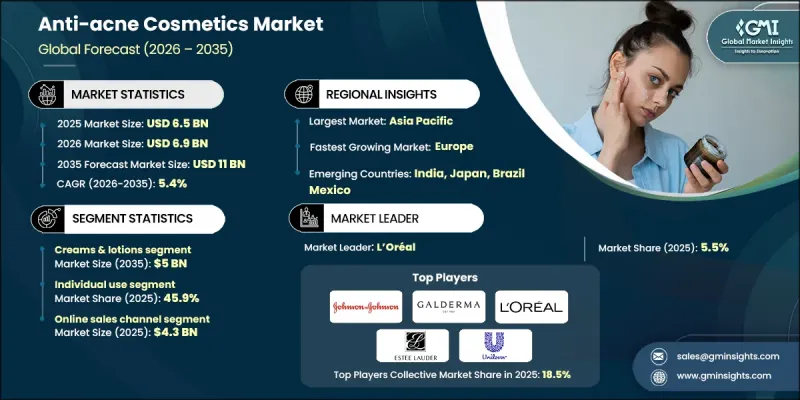
Market growth is strongly influenced by the expanding clean beauty movement and the rising preference for natural and organic skincare formulations. Consumers are increasingly prioritizing products made with gentle, non-toxic, and naturally derived ingredients, driven by growing concerns about the potential side effects of synthetic compounds. This shift in consumer behavior is reshaping product development strategies across the industry, with manufacturers responding by reformulating offerings to align with clean-label expectations. Rising awareness of skin health, combined with increased spending on personal care, continues to support sustained demand. Additionally, growing interest in sustainable beauty practices and supportive regulatory frameworks promoting environmentally responsible products are reinforcing long-term market expansion. As skincare routines become more ingredient-conscious and wellness-oriented, anti-acne cosmetics are gaining wider acceptance across diverse age groups and skin types, supporting consistent growth beyond 2025.
| Market Scope | |
|---|---|
| Start Year | 2025 |
| Forecast Year | 2026-2035 |
| Start Value | $6.5 Billion |
| Forecast Value | $11 Billion |
| CAGR | 5.4% |
The creams and lotions segment generated USD 2.9 billion in 2025 and is expected to reach USD 5 billion by 2035. This segment remains dominant due to its versatility and ease of application. Consumers favor topical formats that not only help manage acne but also deliver complementary benefits such as moisturization, skin tone enhancement, and long-term skin maintenance. Changing consumer expectations toward multifunctional skincare solutions continue to strengthen demand for creams and lotions within the anti-acne category.
The individual-use segment accounted for 45.9% share in 2025. Growth in this segment is driven by increasing consumer preference for accessible, affordable, and convenient acne care solutions used at home. The shift toward self-care routines has reduced reliance on frequent professional treatments, offering time and cost efficiency. This trend reflects a broader movement toward personalized skincare and independent product selection, reinforcing the importance of individual consumers in driving overall market growth.
United States Anti-acne Cosmetics Market held 74.5% share in 2025. Market leadership is supported by strong consumer awareness, high adoption of over-the-counter skincare products, and widespread availability of advanced dermatological solutions. The presence of established premium brands, combined with digital marketing influence and growing demand for clinically validated cosmetic products, continues to accelerate market penetration.
Key companies operating in the Global Anti-acne Cosmetics Market include L'Oreal, Johnson & Johnson, Unilever, Estee Lauder, Beiersdorf, Galderma, Shiseido, Bayer, AbbVie, Natura & Co, Pierre Fabre, Sunday Riley, Mario Badescu, Honasa Consumer, and Teva. Companies in the Anti-acne Cosmetics Market are strengthening their market position through product innovation, clean-label reformulations, and sustainability-focused strategies. Leading players are investing in research to develop gentle yet effective formulations that align with natural and dermatologically tested standards. Expansion across digital and direct-to-consumer channels is improving brand reach and customer engagement. Firms are also leveraging influencer marketing, personalization tools, and targeted product portfolios to capture specific consumer segments.
Table of Contents
Chapter 1 Methodology & Scope
- 1.1 Market scope and definition
- 1.2 Research design
- 1.2.1 Research approach
- 1.2.2 Data collection methods
- 1.3 Data mining sources
- 1.3.1 Global
- 1.3.2 Regional/Country
- 1.4 Base estimates and calculations
- 1.4.1 Base year calculation
- 1.4.2 Key trends for market estimation
- 1.5 Primary research and validation
- 1.5.1 Primary sources
- 1.6 Forecast model
- 1.7 Research assumptions and limitations
Chapter 2 Executive Summary
- 2.1 Industry 360° synopsis
- 2.2 Key market trends
- 2.2.1 Regional
- 2.2.2 Product Type
- 2.2.3 Price
- 2.2.4 End Use
- 2.2.5 Distribution Channel
- 2.3 CXO perspectives: Strategic imperatives
- 2.3.1 Key decision points for industry executives
- 2.3.2 Critical success factors for market players
- 2.4 Future outlook and strategic recommendations
Chapter 3 Industry Insights
- 3.1 Industry ecosystem analysis
- 3.1.1 Supplier landscape
- 3.1.2 Profit margin
- 3.1.3 Value addition at each stage
- 3.1.4 Factor affecting the value chain
- 3.2 Industry impact forces
- 3.2.1 Growth drivers
- 3.2.1.1 Rising prevalence of acne among adolescents and adults.
- 3.2.1.2 Growing awareness and dermatological consultations.
- 3.2.1.3 Innovation in formulations and delivery systems.
- 3.2.2 Industry pitfalls & challenges
- 3.2.2.1 Changing consumer preferences and trends
- 3.2.2.2 Counterfeit and imitation products
- 3.2.3 Opportunities
- 3.2.3.1 Integration of smart skincare and personalization.
- 3.2.3.2 Sustainability and clean beauty trends.
- 3.2.1 Growth drivers
- 3.3 Growth potential analysis
- 3.4 Future market trends
- 3.5 Technology and innovation landscape
- 3.5.1 Current technological trends
- 3.5.2 Emerging technologies
- 3.6 Price trends
- 3.6.1 By product type
- 3.6.2 By region
- 3.7 Regulatory landscape
- 3.7.1 Standards and compliance requirements
- 3.7.2 Regional regulatory frameworks
- 3.7.3 Certification standards
- 3.8 Trade statistics
- 3.8.1 Major importing countries
- 3.8.2 Major exporting countries
- 3.9 Gap analysis
- 3.10 Risk assessment and mitigation
- 3.11 Porter's analysis
- 3.12 PESTEL analysis
- 3.13 Consumer behaviour analysis
- 3.13.1 Purchasing patterns
- 3.13.2 Preference analysis
- 3.13.3 Regional variations in consumer behaviour
- 3.13.4 Impact of e-commerce on buying decisions
Chapter 4 Competitive Landscape, 2025
- 4.1 Introduction
- 4.2 Company market share analysis
- 4.2.1 By region
- 4.2.1.1 North America
- 4.2.1.2 Europe
- 4.2.1.3 Asia Pacific
- 4.2.1.4 Latin America
- 4.2.1.5 Middle East and Africa
- 4.2.1 By region
- 4.3 Company matrix analysis
- 4.4 Competitive analysis of major market players
- 4.5 Competitive positioning matrix
- 4.6 Key developments
- 4.6.1 Mergers & acquisitions
- 4.6.2 Partnerships & collaborations
- 4.6.3 New product launches
- 4.6.4 Expansion plans
Chapter 5 Market Estimates & Forecast, By Product Type, 2022-2035 (USD Billion) (Million Units)
- 5.1 Key trends
- 5.2 Masks
- 5.3 Creams & lotions
- 5.4 Cleansers & toners
- 5.5 Others
Chapter 6 Market Estimates & Forecast, By Price, 2022-2035 (USD Billion) (Million Units)
- 6.1 Key trends
- 6.2 Low
- 6.3 Medium
- 6.4 High
Chapter 7 Market Estimates & Forecast, By End Use, 2022-2035 (USD Billion) (Million Units)
- 7.1 Key trends
- 7.2 Individual use
- 7.3 Spas and parlors
- 7.4 Dermatological clinics
- 7.5 Others
Chapter 8 Market Estimates & Forecast, By Distribution Channel, 2022-2035 (USD Billion) (Million Units)
- 8.1 Key trends
- 8.2 Online
- 8.2.1 E-Commerce
- 8.2.2 Company website
- 8.3 Offline
- 8.3.1 Supermarkets/Hypermarkets
- 8.3.2 Specialty Stores
- 8.3.3 Others (Individual stores, Departmental stores, etc.)
Chapter 9 Market Estimates & Forecast, By Region, 2022-2035 (USD Billion) (Million Units)
- 9.1 Key trends
- 9.2 North America
- 9.2.1 U.S.
- 9.2.2 Canada
- 9.3 Europe
- 9.3.1 Germany
- 9.3.2 France
- 9.3.3 UK
- 9.3.4 Italy
- 9.3.5 Spain
- 9.4 Asia Pacific
- 9.4.1 China
- 9.4.2 India
- 9.4.3 Japan
- 9.4.4 South Korea
- 9.4.5 Australia
- 9.5 Latin America
- 9.5.1 Brazil
- 9.5.2 Mexico
- 9.5.3 Argentina
- 9.6 MEA
- 9.6.1 South Africa
- 9.6.2 Saudi Arabia
- 9.6.3 UAE
Chapter 10 Company Profiles
- 10.1 AbbVie
- 10.2 Bayer
- 10.3 Beiersdorf
- 10.4 Estee Lauder
- 10.5 Galderma
- 10.6 Honasa Consumer
- 10.7 Johnson & Johnson
- 10.8 L'Oreal
- 10.9 Mario Badescu
- 10.10 Natura & Co
- 10.11 Pierre Fabre
- 10.12 Shiseido
- 10.13 Sunday Riley
- 10.14 Teva
- 10.15 Unilever

