PUBLISHER: Global Market Insights Inc. | PRODUCT CODE: 1936656

PUBLISHER: Global Market Insights Inc. | PRODUCT CODE: 1936656
Smart Mattress Market Opportunity, Growth Drivers, Industry Trend Analysis, and Forecast 2026 - 2035
The Global Smart Mattress Market was valued at USD 1.76 billion in 2025 and is estimated to grow at a CAGR of 6.6% to reach USD 3.34 billion by 2035.
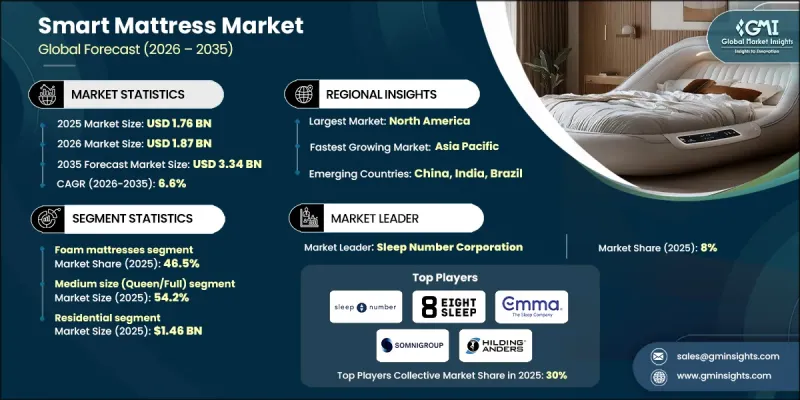
Market momentum is driven by growing consumer focus on long-term personal health management and increasing alignment with digital health frameworks. Smart mattresses are increasingly positioned as integral components of wellness-oriented lifestyles, offering data-enabled insights that go beyond traditional sleep support. Industry consolidation is accelerating innovation cycles, strengthening brand portfolios, and expanding global reach, which is further supporting market growth. Conventional sleep solutions centered on basic foam or orthopedic structures are losing relevance as consumers seek intelligent systems that actively respond to physical conditions and behavioral patterns. Smart mattresses create a more adaptive sleep environment by combining physical comfort with digital monitoring, reinforcing their role in health optimization. This evolution aligns closely with rising consumer demand for data-driven wellness solutions. Expanding adoption of connected home technologies, higher discretionary spending on premium lifestyles in North America, and growing healthcare and wellness investments across Europe and select Asia-Pacific markets are collectively enhancing the commercial attractiveness of smart mattress solutions.
| Market Scope | |
|---|---|
| Start Year | 2025 |
| Forecast Year | 2026-2035 |
| Start Value | $1.76 Billion |
| Forecast Value | $3.34 Billion |
| CAGR | 6.6% |
The foam-based smart mattresses segment accounted for 46.5% share in 2025, reflecting strong and sustained consumer preference. This segment continues to expand due to its suitability for embedding advanced sensing technologies and temperature regulation components without compromising comfort. Foam materials enable effective pressure distribution while supporting posture-responsive features, making them particularly appealing within the premium residential category. The combination of comfort, performance, and seamless technology integration is reinforcing demand and supporting long-term segment growth.
The residential segment held 82.7% share, generating USD 1.46 billion in 2025. Residential adoption remains the primary growth driver as consumers increasingly prioritize sleep quality as a core element of overall health and well-being. Investment in smart home ecosystems and personalized wellness solutions is reinforcing residential demand, with smart mattresses positioned as central components of home-based health optimization strategies.
North America Smart Mattress Market generated USD 537.3 million in 2025 and a projected growth rate of 7.2% through 2035. In this region, smart mattresses are widely perceived as advanced health-monitoring products rather than conventional bedding. Strong demand is supported by high consumer awareness, willingness to invest in premium wellness solutions, and seamless integration with connected home systems. Advanced features such as automated comfort adjustment and thermal regulation are meeting the expectations of a health-focused consumer base. Well-developed retail networks and the rapid expansion of direct-to-consumer digital channels continue to improve accessibility and accelerate adoption across the region.
Key companies operating in the Global Smart Mattress Market include Tempur Sealy International, Inc., Sleep Number Corporation, Eight Sleep, Casper Sleep Inc., Purple Innovation, LLC, Emma Sleep, Hilding Anders, Somnigroup International, Kingsdown, Inc., Amerisleep, Leesa Sleep, Nolah Sleep, ReST (Responsive Surface Technology), iOBED, and The Sleep Company. Companies active in the smart mattress market are strengthening their market position through product innovation, technology integration, and brand expansion strategies. Leading players are investing in advanced sensor technology, AI-driven sleep analytics, and adaptive comfort systems to differentiate their offerings. Many companies are expanding direct-to-consumer channels to improve margins and deepen customer engagement. Strategic collaborations across the health and smart home ecosystems are enhancing interoperability and value perception.
Table of Contents
Chapter 1 Methodology and Scope
- 1.1 Market scope and definition
- 1.2 Research design
- 1.2.1 Research approach
- 1.2.2 Data collection methods
- 1.3 Data mining sources
- 1.3.1 Global
- 1.3.2 Regional/Country
- 1.4 Base estimates and calculations
- 1.4.1 Base year calculation
- 1.4.2 Key trends for market estimation
- 1.5 Primary research and validation
- 1.5.1 Primary sources
- 1.6 Forecast model
- 1.7 Research assumptions and limitations
Chapter 2 Executive Summary
- 2.1 Industry 360° synopsis
- 2.2 Key market trends
- 2.2.1 Regional
- 2.2.2 Product Type
- 2.2.3 Size
- 2.2.4 Height
- 2.2.5 Firmness Level
- 2.2.6 Price Range
- 2.2.7 Application
- 2.2.8 Distribution Channel
- 2.3 CXO perspectives: Strategic imperatives
- 2.3.1 Key decision points for industry executives
- 2.3.2 Critical success factors for market players
- 2.4 Future outlook and strategic recommendations
Chapter 3 Industry Insights
- 3.1 Industry ecosystem analysis
- 3.1.1 Supplier landscape
- 3.1.2 Profit margin
- 3.1.3 Value addition at each stage
- 3.1.4 Factor affecting the value chain
- 3.2 Industry impact forces
- 3.2.1 Growth drivers
- 3.2.1.1 Rising Awareness of Sleep Hygiene & Wellness
- 3.2.1.2 Integration with Smart Home Ecosystems
- 3.2.1.3 Growth in the Luxury Hospitality & Healthcare Sector
- 3.2.2 Industry pitfalls & challenges
- 3.2.2.1 High Price Point and Long Replacement Cycles
- 3.2.2.2 Concerns over Data Privacy & Security
- 3.2.3 Opportunities
- 3.2.3.1 AI-Driven Personalized Sleep Coaching
- 3.2.3.2 Subscription-Based "Wellness-as-a-Service"
- 3.2.1 Growth drivers
- 3.3 Growth potential analysis
- 3.4 Future market trends
- 3.5 Technology and innovation landscape
- 3.5.1 Current technological trends
- 3.5.2 Emerging technologies
- 3.6 Price trends
- 3.6.1 By region
- 3.6.2 By type
- 3.7 Regulatory landscape
- 3.7.1 Standards and compliance requirements
- 3.7.2 Regional regulatory frameworks
- 3.7.3 Certification standards
- 3.8 Porter's analysis
- 3.9 PESTEL analysis
Chapter 4 Competitive Landscape, 2025
- 4.1 Introduction
- 4.2 Company market share analysis
- 4.2.1 By region
- 4.2.1.1 North America
- 4.2.1.2 Europe
- 4.2.1.3 Asia Pacific
- 4.2.1.4 Latin America
- 4.2.1.5 Middle East and Africa
- 4.2.1 By region
- 4.3 Company matrix analysis
- 4.4 Competitive analysis of major market players
- 4.5 Competitive positioning matrix
- 4.6 Key developments
- 4.6.1 Mergers & acquisitions
- 4.6.2 Partnerships & collaborations
- 4.6.3 New product launches
- 4.6.4 Expansion plans
Chapter 5 Market Estimates and Forecast, By Product Type, 2022 - 2035 (USD Billion) (Thousand Units)
- 5.1 Key trends
- 5.2 Foam Mattresses
- 5.3 Innerspring Mattresses
- 5.4 Hybrid Mattresses
- 5.5 Latex Mattress
- 5.6 Others
Chapter 6 Market Estimates and Forecast, By Size, 2022 - 2035 (USD Billion) (Thousand Units)
- 6.1 Key trends
- 6.2 Small
- 6.3 Medium
- 6.4 Large
Chapter 7 Market Estimates and Forecast, By Height, 2022 - 2035 (USD Billion) (Thousand Units)
- 7.1 Key trends
- 7.2 Below 5 inch
- 7.3 5 inch - 10 inch
- 7.4 Above 10 inch
Chapter 8 Market Estimates and Forecast, By Firmness Level, 2022 - 2035 (USD Billion) (Thousand Units)
- 8.1 Key trends
- 8.2 Soft
- 8.3 Medium
- 8.4 Firm
Chapter 9 Market Estimates and Forecast,By Price Range, 2022 - 2035 (USD Billion) (Thousand Units)
- 9.1 Key trends
- 9.2 Low
- 9.3 Medium
- 9.4 High
Chapter 10 Market Estimates and Forecast, By Application, 2022 - 2035 (USD Billion) (Thousand Units)
- 10.1 Key trends
- 10.2 Residential
- 10.3 Commercial
Chapter 11 Market Estimates and Forecast, By Distribution Channel, 2022 - 2035 (USD Billion) (Thousand Units)
- 11.1 Key trends
- 11.2 Online
- 11.3 Offline
Chapter 12 Market Estimates and Forecast, By Region, 2022 - 2035 (USD Billion) (Thousand Units)
- 12.1 Key trends
- 12.2 North America
- 12.2.1 U.S.
- 12.2.2 Canada
- 12.3 Europe
- 12.3.1 Germany
- 12.3.2 UK
- 12.3.3 France
- 12.3.4 Italy
- 12.3.5 Spain
- 12.4 Asia Pacific
- 12.4.1 China
- 12.4.2 Japan
- 12.4.3 India
- 12.4.4 Australia
- 12.4.5 South Korea
- 12.5 Latin America
- 12.5.1 Brazil
- 12.5.2 Mexico
- 12.5.3 Argentina
- 12.6 Middle East and Africa
- 12.6.1 South Africa
- 12.6.2 Saudi Arabia
- 12.6.3 UAE
Chapter 13 Company Profiles
- 13.1 Amerisleep
- 13.2 Casper Sleep Inc.
- 13.3 Eight Sleep
- 13.4 Emma Sleep
- 13.5 Hilding Anders
- 13.6 iOBED
- 13.7 Kingsdown, Inc.
- 13.8 Leesa Sleep
- 13.9 Nolah Sleep
- 13.10 Purple Innovation, LLC
- 13.11 ReST (Responsive Surface Technology)
- 13.12 Sleep Number Corporation
- 13.13 Somnigroup International
- 13.14 Tempur Sealy International, Inc.
- 13.15 The Sleep Company

