PUBLISHER: Global Market Insights Inc. | PRODUCT CODE: 1936659

PUBLISHER: Global Market Insights Inc. | PRODUCT CODE: 1936659
Carbide Tools Market Opportunity, Growth Drivers, Industry Trend Analysis, and Forecast 2026 - 2035
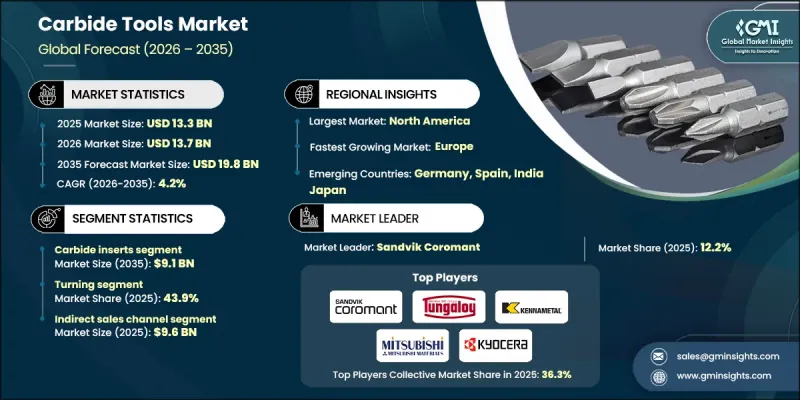
The Global Carbide Tools Market was valued at USD 13.3 billion in 2025 and is estimated to grow at a CAGR of 4.2% to reach USD 19.8 billion by 2035.
Growth across the market is tied to rising adoption of automation, robotics, and digitally controlled machining systems within industrial production. Manufacturers increasingly rely on high-precision carbide tools to meet tighter tolerances, improve repeatability, and support high-speed operations in advanced machining environments. Automotive, aerospace, and other precision-focused industries continue to prioritize carbide tooling to improve productivity while maintaining consistent quality. Ongoing advancements in surface treatment and coating technologies are further strengthening market demand by improving tool durability, heat resistance, and operational lifespan. In parallel, expanding production of lightweight and advanced materials is encouraging greater investment in specialized tooling solutions capable of handling complex machining requirements. As industrial facilities modernize and pursue higher efficiency levels, carbide tools remain essential components within evolving manufacturing strategies.
| Market Scope | |
|---|---|
| Start Year | 2025 |
| Forecast Year | 2026-2035 |
| Start Value | $13.3 Billion |
| Forecast Value | $19.8 Billion |
| CAGR | 4.2% |
The carbide inserts segment generated USD 6.1 billion in 2025 and is projected to reach USD 9.1 billion by 2035. Carbide inserts represent the largest share of the product landscape due to their superior durability, resistance to wear, and ability to perform under high-temperature conditions. These characteristics enable faster machining speeds, improved dimensional accuracy, and longer service life, making inserts a preferred choice for demanding production environments focused on throughput and consistency.
The turning applications segment accounted for 43.9% share in 2025. This segment continues to lead due to widespread use across industries requiring precise material removal and consistent surface finishes. Turning operations play a central role in producing complex components where accuracy and repeatability are critical. Supportive policies aimed at strengthening advanced manufacturing capabilities further contribute to the rising demand for turning-related tooling solutions.
U.S. Carbide Tools Market accounted for 78.1% share in 2025. Strong demand is supported by a well-established manufacturing base across automotive, aerospace, and defense sectors that rely heavily on precision machining. Increased domestic investment in industrial production and infrastructure continues to stimulate metalworking activity, reinforcing steady adoption of advanced carbide tooling across the region.
Key companies operating in the carbide tools market include Sandvik Coromant, Kennametal Inc., Mitsubishi Materials Corporation, Seco Tools, Walter AG, Kyocera Corporation, Iscar Ltd., Sumitomo Electric Industries Ltd., Ceratizit Group, OSG Corporation, Guhring KG, Tungaloy Corporation, Hitachi Tool Engineering, Ltd., YG-1 Co, and ZCC Cutting Tools. Companies in the Global Carbide Tools Market focus on multiple strategies to strengthen market position and sustain competitiveness. Continuous investment in research and development supports innovation in tool geometry, materials engineering, and performance optimization. Many players expand coating and surface treatment capabilities to extend tool life and improve machining efficiency. Strategic partnerships with machine tool manufacturers and industrial customers enable customized solutions and long-term contracts. Geographic expansion through new production facilities and distribution networks improves regional accessibility. Portfolio diversification across application-specific tools allows companies to serve a wider range of industries.
Table of Contents
Chapter 1 Methodology & Scope
- 1.1 Market scope and definition
- 1.2 Research design
- 1.2.1 Research approach
- 1.2.2 Data collection methods
- 1.3 Data mining sources
- 1.3.1 Global
- 1.3.2 Regional/Country
- 1.4 Base estimates and calculations
- 1.4.1 Base year calculation
- 1.4.2 Key trends for market estimation
- 1.5 Primary research and validation
- 1.5.1 Primary sources
- 1.6 Forecast model
- 1.7 Research assumptions and limitations
Chapter 2 Executive Summary
- 2.1 Industry 360° synopsis
- 2.2 Key market trends
- 2.2.1 Regional
- 2.2.2 Product Type
- 2.2.3 Coating Type
- 2.2.4 Application
- 2.2.5 End Use
- 2.2.6 Distribution Channel
- 2.3 CXO perspectives: Strategic imperatives
- 2.3.1 Key decision points for industry executives
- 2.3.2 Critical success factors for market players
- 2.4 Future outlook and strategic recommendations
Chapter 3 Industry Insights
- 3.1 Industry ecosystem analysis
- 3.1.1 Supplier landscape
- 3.1.2 Profit margin
- 3.1.3 Value addition at each stage
- 3.1.4 Factor affecting the value chain
- 3.2 Industry impact forces
- 3.2.1 Growth drivers
- 3.2.1.1 Rising demand for precision machining
- 3.2.1.2 Growth in metalworking and manufacturing activities
- 3.2.1.3 Technological advancements in tool coatings
- 3.2.2 Industry pitfalls & challenges
- 3.2.2.1 High initial installation and maintenance costs
- 3.2.2.2 Limited awareness and expertise in carbide tools maintenance
- 3.2.3 Opportunities
- 3.2.3.1 Integration with CNC and automated systems
- 3.2.3.2 Emerging markets and electric vehicle production
- 3.2.1 Growth drivers
- 3.3 Growth potential analysis
- 3.4 Future market trends
- 3.5 Technology and innovation landscape
- 3.5.1 Current technological trends
- 3.5.2 Emerging technologies
- 3.6 Price trends
- 3.6.1 By product type
- 3.6.2 By region
- 3.7 Regulatory landscape
- 3.7.1 Standards and compliance requirements
- 3.7.2 Regional regulatory frameworks
- 3.7.3 Certification standards
- 3.8 Trade statistics
- 3.8.1 Major importing countries
- 3.8.2 Major exporting countries
- 3.9 Gap analysis
- 3.10 Risk assessment and mitigation
- 3.11 Porter's analysis
- 3.12 PESTEL analysis
Chapter 4 Competitive Landscape, 2025
- 4.1 Introduction
- 4.2 Company market share analysis
- 4.2.1 By region
- 4.2.1.1 North America
- 4.2.1.2 Europe
- 4.2.1.3 Asia Pacific
- 4.2.1.4 Latin America
- 4.2.1.5 Middle East and Africa
- 4.2.1 By region
- 4.3 Company matrix analysis
- 4.4 Competitive analysis of major market players
- 4.5 Competitive positioning matrix
- 4.6 Key developments
- 4.6.1 Mergers & acquisitions
- 4.6.2 Partnerships & collaborations
- 4.6.3 New product launches
- 4.6.4 Expansion plans
Chapter 5 Market Estimates & Forecast, By Product Type, 2022-2035 (USD Billion) (Thousand Units)
- 5.1 Key trends
- 5.2 Carbide Inserts
- 5.3 Carbide Cutting Tools
- 5.4 Carbide Tool Holders
- 5.5 Carbide Wear Parts
Chapter 6 Market Estimates & Forecast, By Coating Type, 2022-2035 (USD Billion) (Thousand Units)
- 6.1 Key trends
- 6.2 PVD (Physical Vapor Deposition) Coated
- 6.3 CVD (Chemical Vapor Deposition) Coated
- 6.4 TiN (Titanium Nitride) Coated
- 6.5 Uncoated
- 6.6 Others (Titanium Aluminum Nitride Coated, etc)
Chapter 7 Market Estimates & Forecast, By Application, 2022-2035 (USD Billion) (Thousand Units)
- 7.1 Key trends
- 7.2 Turning
- 7.3 Milling
- 7.4 Drilling
- 7.5 Boring
- 7.6 Threading
- 7.7 Others (Grooving inserts, etc)
Chapter 8 Market Estimates & Forecast, By End Use, 2022-2035 (USD Billion) (Thousand Units)
- 8.1 Key trends
- 8.2 Automotive
- 8.3 Aerospace & Defense
- 8.4 Construction
- 8.5 Machinery Manufacturing
- 8.6 Oil & Gas
- 8.7 Power Generation
- 8.8 Others (Mining, Medical Equipment Manufacturing, etc.)
Chapter 9 Market Estimates & Forecast, By Distribution Channel, 2022-2035 (USD Billion) (Thousand Units)
- 9.1 Key trends
- 9.2 Direct
- 9.3 Indirect
Chapter 10 Market Estimates & Forecast, By Region, 2022-2035 (USD Billion) (Thousand Units)
- 10.1 Key trends
- 10.2 North America
- 10.2.1 U.S.
- 10.2.2 Canada
- 10.3 Europe
- 10.3.1 Germany
- 10.3.2 France
- 10.3.3 UK
- 10.3.4 Italy
- 10.3.5 Spain
- 10.4 Asia Pacific
- 10.4.1 China
- 10.4.2 India
- 10.4.3 Japan
- 10.4.4 South Korea
- 10.4.5 Australia
- 10.5 Latin America
- 10.5.1 Brazil
- 10.5.2 Mexico
- 10.5.3 Argentina
- 10.6 MEA
- 10.6.1 South Africa
- 10.6.2 Saudi Arabia
- 10.6.3 UAE
Chapter 11 Company Profiles
- 11.1 Ceratizit Group
- 11.2 Guhring KG
- 11.3 Hitachi Tool Engineering, Ltd.
- 11.4 Iscar Ltd.
- 11.5 Kennametal Inc.
- 11.6 Kyocera Corporation
- 11.7 Mitsubishi Materials Corporation
- 11.8 OSG Corporation
- 11.9 Sandvik Coromant
- 11.10 Seco Tools
- 11.11 Sumitomo Electric Industries Ltd.
- 11.12 Tungaloy Corporation
- 11.13 YG-1 Co
- 11.14 Walter AG
- 11.15 ZCC Cutting Tools

