
PUBLISHER: Global Market Insights Inc. | PRODUCT CODE: 1936664

PUBLISHER: Global Market Insights Inc. | PRODUCT CODE: 1936664
Automotive Airbags Market Opportunity, Growth Drivers, Industry Trend Analysis, and Forecast 2026 - 2035
The Global Automotive Airbags Market was valued at USD 66.4 billion in 2025 and is estimated to grow at a CAGR of 7.1% to reach USD 131.5 billion by 2035.
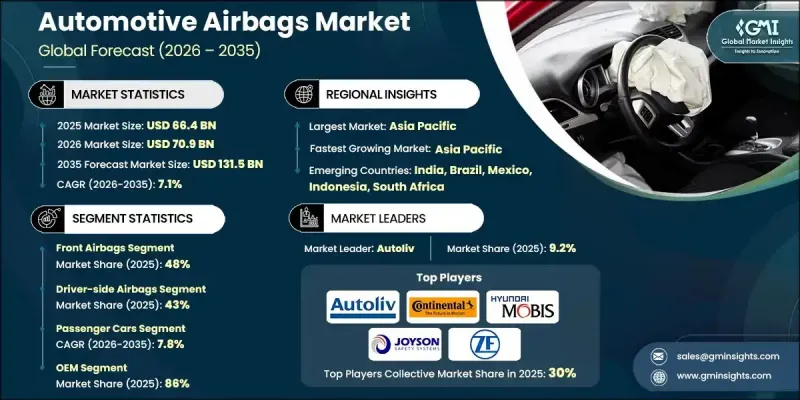
Governments and safety organizations worldwide mandate airbags as standard equipment in passenger and commercial vehicles, and regulations have progressively emphasized the need for multiple airbag types per vehicle, including side and curtain airbags. This shift has compelled automotive manufacturers (OEMs) to design more sophisticated airbag systems, resulting in higher penetration and unit volume demand globally. Rising consumer awareness of road safety, vehicle safety ratings, and the risks associated with driving is influencing purchase decisions, with buyers increasingly prioritizing vehicles offering advanced occupant protection. New Car Assessment Programs (NCAP) and evolving crash test protocols are driving OEMs to integrate additional airbags to improve safety scores. Enhanced frontal, side, and rollover collision protection requires innovative airbag deployment strategies, ensuring optimal protection and higher safety ratings in modern vehicles.
| Market Scope | |
|---|---|
| Start Year | 2025 |
| Forecast Year | 2026-2035 |
| Start Value | $66.4 Billion |
| Forecast Value | $131.5 Billion |
| CAGR | 7.1% |
The front airbags segment held a 48% share in 2025 and is expected to grow at a CAGR of 6.2% through 2035. Designed to protect the driver and front-seat passenger, these airbags deploy from the steering wheel and dashboard, absorbing impact forces and preventing the body from striking interior surfaces during a collision.
The passenger car segment accounted for 75% share in 2025 and is projected to grow at a CAGR of 7.8% from 2026 to 2035. Modern passenger vehicles are increasingly adopting advanced driver airbags integrated with sensors and ADAS, optimizing deployment timing and force to enhance safety, particularly in compact and electric vehicles where cabin layouts are evolving rapidly.
US Automotive Airbags Market reached USD 15.6 billion in 2025. Strict testing standards by the National Highway Traffic Safety Administration (NHTSA) and the Insurance Institute for Highway Safety (IIHS) are accelerating the adoption of multi-stage, smart airbag systems. These innovations are being implemented across both passenger and commercial vehicles to elevate safety benchmarks and meet regulatory requirements.
Prominent companies operating in the Global Automotive Airbags Market include Joyson Safety Systems, Toyota Boshoku, ZF Friedrichshafen (TRW Automotive), Autoliv, Nippon Seiki, Continental, Hyundai Mobis, Toyoda Gosei, and Daicel. Market participants are strengthening their foothold by investing heavily in R&D to develop multi-stage and intelligent airbag systems that optimize deployment based on occupant size, position, and collision severity. Strategic partnerships with automakers ensure early integration into new vehicle platforms. Companies are expanding production facilities and enhancing global supply chains to meet rising demand. Innovation in sensor technology, ADAS compatibility, and lightweight airbag materials helps manufacturers differentiate products, while regulatory compliance and rigorous crash-test certification reinforce credibility. Additionally, firms are leveraging collaborations and co-development agreements to accelerate technology adoption and improve competitive positioning across passenger and commercial vehicle segments.
Table of Contents
Chapter 1 Methodology
- 1.1 Research approach
- 1.2 Quality commitments
- 1.3 GMI AI policy & data integrity commitment
- 1.4 Research trail & confidence scoring
- 1.4.1 Research trail components
- 1.4.2 Scoring components
- 1.5 Data collection
- 1.5.1 Partial list of primary sources
- 1.6 Data mining sources
- 1.6.1 Paid sources
- 1.7 Base estimates and calculations
- 1.7.1 Base year calculation
- 1.8 Forecast model
- 1.9 Research transparency addendum
Chapter 2 Executive Summary
- 2.1 Industry 3600 synopsis
- 2.2 Key market trends
- 2.2.1 Regional
- 2.2.2 Airbag
- 2.2.3 Deployment
- 2.2.4 Vehicle
- 2.2.5 Fabric
- 2.2.6 Sales channel
- 2.3 TAM analysis, 2026-2035
- 2.4 CXO perspectives: Strategic imperatives
- 2.4.1 Executive decision points
- 2.4.2 Critical success factors
- 2.5 Future outlook
- 2.6 Strategic recommendations
Chapter 3 Industry Insights
- 3.1 Industry ecosystem analysis
- 3.1.1 Supplier landscape
- 3.1.2 Profit margin
- 3.1.3 Cost structure
- 3.1.4 Value addition at each stage
- 3.1.5 Factor affecting the value chain
- 3.1.6 Disruptions
- 3.2 Industry impact forces
- 3.2.1 Growth drivers
- 3.2.1.1 Stringent vehicle safety regulations
- 3.2.1.2 Rising consumer awareness of occupant safety
- 3.2.1.3 Growth in global vehicle production
- 3.2.1.4 Increasing crash test and NCAP standards
- 3.2.2 Industry pitfalls and challenges
- 3.2.2.1 High product liability and recall risks
- 3.2.2.2 Pricing pressure from automotive OEMs
- 3.2.3 Market opportunities
- 3.2.3.1 Expansion in emerging automotive markets
- 3.2.3.2 Growth of electric and autonomous vehicles
- 3.2.3.3 Development of pedestrian protection airbags
- 3.2.3.4 Increasing aftermarket replacement demand
- 3.2.1 Growth drivers
- 3.3 Growth potential analysis
- 3.4 Regulatory landscape
- 3.4.1 North America
- 3.4.1.1 U.S. Department of Transportation (DOT) Standards
- 3.4.1.2 Occupational Safety and Health Administration (OSHA) Guidelines
- 3.4.1.3 U.S. Environmental Protection Agency (EPA)
- 3.4.2 Europe
- 3.4.2.1 EN ISO Container Standards
- 3.4.2.2 European Union Customs and Safety Regulations
- 3.4.2.3 BS EN / CEN Standards
- 3.4.2.4 National Standards (UNE, DIN, etc.)
- 3.4.3 Asia Pacific
- 3.4.3.1 China GB (Guobiao) Standards
- 3.4.3.2 Japan JIS Requirements
- 3.4.3.3 Korea KS Certification
- 3.4.3.4 Indian BIS Standards
- 3.4.3.5 Thai Industrial Standards Institute (TISI)
- 3.4.4 Latin America
- 3.4.4.1 INMETRO (National Institute of Metrology)
- 3.4.4.2 INTI certification (Instituto Nacional de Tecnologia Industrial)
- 3.4.4.3 NOM standards (Norma Official Mexicana)
- 3.4.5 Middle East & Africa
- 3.4.5.1 ESMA / Emirates Conformity Assessment Scheme (ECAS)
- 3.4.5.2 GCC technical regulations
- 3.4.5.3 SABS certification
- 3.4.1 North America
- 3.5 Porter's analysis
- 3.6 PESTEL analysis
- 3.7 Technology and innovation landscape
- 3.7.1 Current technological trends
- 3.7.2 Emerging technologies
- 3.8 Pricing analysis
- 3.8.1 Pricing by product
- 3.8.2 Pricing by region
- 3.9 Production statistics
- 3.9.1 Production hubs
- 3.9.2 Consumption hubs
- 3.9.3 Export and import
- 3.10 Cost breakdown analysis
- 3.11 Patent analysis
- 3.12 Sustainability and environmental aspects
- 3.12.1 Sustainable practices
- 3.12.2 Waste reduction strategies
- 3.12.3 Energy efficiency in production
- 3.12.4 Eco-friendly initiatives
- 3.12.5 Carbon footprint considerations
Chapter 4 Competitive Landscape, 2025
- 4.1 Introduction
- 4.2 Company market share analysis
- 4.2.1 North America
- 4.2.2 Europe
- 4.2.3 Asia Pacific
- 4.2.4 LATAM
- 4.2.5 MEA
- 4.3 Competitive analysis of major market players
- 4.4 Competitive positioning matrix
- 4.5 Strategic outlook matrix
- 4.6 Key developments
- 4.6.1 Mergers & acquisitions
- 4.6.2 Partnerships & collaborations
- 4.6.3 New product launches
- 4.6.4 Expansion plans and funding
Chapter 5 Market Estimates & Forecast, By Airbag, 2022 - 2035 ($Mn, Units)
- 5.1 Key trends
- 5.2 Front airbags
- 5.3 Side airbags
- 5.4 Curtain airbags
- 5.5 Knee airbags
- 5.6 Rear passenger airbags
- 5.7 Others (e.g., pedestrian protection airbags)
Chapter 6 Market Estimates & Forecast, By Deployment, 2022 - 2035 ($Mn, Units)
- 6.1 Key trends
- 6.2 Driver-side airbags
- 6.3 Passenger-side airbags
- 6.4 Multi-stage airbags
Chapter 7 Market Estimates & Forecast, By Vehicle, 2022 - 2035 ($Mn, Units)
- 7.1 Key trends
- 7.2 Passenger cars
- 7.2.1 Hatchback
- 7.2.2 Sedan
- 7.2.3 SUV
- 7.3 Commercial vehicle
- 7.3.1 LCV (Light commercial vehicle)
- 7.3.2 MCV (Medium commercial vehicle)
- 7.3.3 HCV (Heavy commercial vehicle)
Chapter 8 Market Estimates & Forecast, By Fabric, 2022 - 2035 ($Mn, Units)
- 8.1 Key trends
- 8.2 Nylon fabric
- 8.3 Polyester fabric
Chapter 9 Market Estimates & Forecast, By Sales Channel, 2022 - 2035 ($Mn, Units)
- 9.1 Key trends
- 9.2 OEM
- 9.3 Aftermarket
Chapter 10 Market Estimates & Forecast, By Region, 2022 - 2035 ($Mn, Units)
- 10.1 Key trends
- 10.2 North America
- 10.2.1 US
- 10.2.2 Canada
- 10.3 Europe
- 10.3.1 Germany
- 10.3.2 UK
- 10.3.3 France
- 10.3.4 Italy
- 10.3.5 Spain
- 10.3.6 Nordics
- 10.3.7 Russia
- 10.3.8 Poland
- 10.3.9 Romania
- 10.4 Asia Pacific
- 10.4.1 China
- 10.4.2 India
- 10.4.3 Japan
- 10.4.4 South Korea
- 10.4.5 ANZ
- 10.4.6 Vietnam
- 10.4.7 Indonesia
- 10.5 Latin America
- 10.5.1 Brazil
- 10.5.2 Mexico
- 10.5.3 Argentina
- 10.6 MEA
- 10.6.1 South Africa
- 10.6.2 Saudi Arabia
- 10.6.3 UAE
Chapter 11 Company Profiles
- 11.1 Global companies
- 11.1.1 Autoliv
- 11.1.2 Autoneum (select airbag systems segment)
- 11.1.3 Continental
- 11.1.4 Daicel
- 11.1.5 Hyundai Mobis
- 11.1.6 Joyson Safety Systems
- 11.1.7 Nippon Seiki
- 11.1.8 Toyoda Gosei
- 11.1.9 Toyota Boshoku
- 11.1.10 ZF Friedrichshafen (TRW Automotive)
- 11.2 Regional players
- 11.2.1 Aisin Seiki
- 11.2.2 Bharat Seats
- 11.2.3 Coagent Automotive
- 11.2.4 Delphi Technologies
- 11.2.5 Hangzhou Silian Airbag
- 11.2.6 Hyunmi Safety Systems
- 11.2.7 Juki
- 11.2.8 Minda
- 11.3 Emerging players
- 11.3.1 Calsonic Kansei
- 11.3.2 Lite-On Automotive Airbags
- 11.3.3 Mando
- 11.3.4 Shandong Lilang Automotive Safety
- 11.3.5 Toray Advanced Materials
- 11.3.6 Zhejiang Geely Auto Airbag Division

