PUBLISHER: Global Market Insights Inc. | PRODUCT CODE: 1936665

PUBLISHER: Global Market Insights Inc. | PRODUCT CODE: 1936665
Ultrasonic Sensors Market Opportunity, Growth Drivers, Industry Trend Analysis, and Forecast 2026 - 2035
The Global Ultrasonic Sensors Market was valued at USD 7.2 billion in 2025 and is estimated to grow at a CAGR of 9% to reach USD 16.9 billion by 2035.
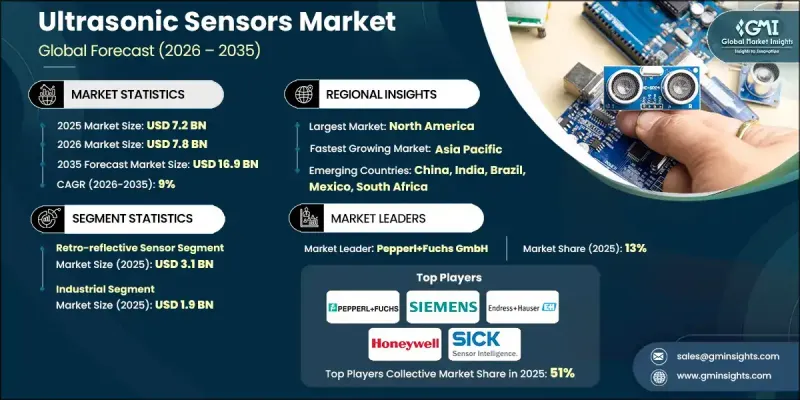
Market growth is driven by the increasing integration of electronically controlled safety features and advanced driver assistance technologies in modern vehicles. Ultrasonic sensors play a critical role in short-range object detection, enabling safer vehicle maneuvering and supporting proximity-based awareness functions that are becoming increasingly essential as vehicles move toward higher levels of automation. Beyond automotive applications, the rising adoption of digital manufacturing practices is significantly boosting demand across industrial environments. Ultrasonic sensing technology is widely valued for its ability to deliver consistent performance under challenging operating conditions. Growing deployment across automated production lines, smart factories, and material handling systems is further supporting market expansion. The healthcare sector is also contributing to demand growth, as ultrasonic sensing enables non-invasive monitoring and precise fluid detection, improving both equipment reliability and patient safety. As industries continue to prioritize accuracy, automation, and operational efficiency, ultrasonic sensors are becoming an indispensable component across a wide range of applications.
| Market Scope | |
|---|---|
| Start Year | 2025 |
| Forecast Year | 2026-2035 |
| Start Value | $7.2 Billion |
| Forecast Value | $16.9 Billion |
| CAGR | 9% |
The retro-reflective sensor segment generated USD 3.1 billion in 2025, making it the leading segment in the market. Demand for these sensors continues to increase due to their ability to provide dependable long-distance detection with high accuracy across varied environments. Their design supports stable measurement of object presence and distance, even in conditions where other sensing technologies may be less effective.
The industrial segment accounted for USD 1.9 billion in 2025. Growth in this segment is supported by widespread use of ultrasonic sensors in automation systems, robotics, material flow management, and workplace safety solutions. These sensors offer reliable, non-contact measurement capabilities and maintain accuracy in environments affected by dust, moisture, or temperature variations.
North America Ultrasonic Sensors Market generated USD 3 billion in 2025. Strong adoption across automotive manufacturing, industrial automation, healthcare systems, and intelligent infrastructure continues to drive regional growth. Strict safety standards, advanced production capabilities, and early implementation of digital manufacturing practices further reinforce market demand. Rising focus on vehicle safety technologies also continues to accelerate adoption across the region.
Key companies operating in the Global Ultrasonic Sensors Market include Siemens AG, ABB Ltd., Honeywell International Inc., Robert Bosch GmbH, Continental AG, Omron Corporation, Pepperl+Fuchs GmbH, ifm electronic GmbH, Keyence Corporation, Baumer Holding AG, Banner Engineering Corp., Endress+Hauser Group Services AG, Murata Manufacturing Co., Ltd., Texas Instruments Incorporated, Rockwell Automation, Inc., SICK AG, TURCK Inc., Krohne Messtechnik GmbH, Senix Corporation, and MaxBotix Inc. Companies in the ultrasonic sensors market strengthen their market position by focusing on innovation, reliability, and application-specific customization. Many players invest in improving sensor accuracy, range, and durability to meet evolving industrial and automotive requirements. Expanding compatibility with digital communication protocols supports seamless integration into smart systems. Strategic partnerships with automation providers and OEMs help broaden market reach.
Table of Contents
Chapter 1 Methodology and Scope
- 1.1 Market scope and definition
- 1.2 Research design
- 1.2.1 Research approach
- 1.2.2 Data collection methods
- 1.3 Data mining sources
- 1.3.1 Global
- 1.3.2 Regional/Country
- 1.4 Base estimates and calculations
- 1.4.1 Base year calculation
- 1.4.2 Key trends for market estimation
- 1.5 Primary research and validation
- 1.5.1 Primary sources
- 1.6 Forecast model
- 1.7 Research assumptions and limitations
Chapter 2 Executive Summary
- 2.1 Industry 360° synopsis
- 2.2 Key market trends
- 2.2.1 Type Trends
- 2.2.2 Structure Type Trends
- 2.2.3 Sensors Trends
- 2.2.4 Operating Frequency Trends
- 2.2.5 Application Trends
- 2.2.6 End-Use Trends
- 2.2.7 Regional Trends
- 2.3 CXO perspectives: Strategic imperatives
- 2.3.1 Key decision points for industry executives
- 2.3.2 Critical success factors for market players
- 2.4 Future outlook and strategic recommendations
Chapter 3 Industry Insights
- 3.1 Industry ecosystem analysis
- 3.1.1 Supplier Landscape
- 3.1.2 Profit Margin
- 3.1.3 Cost structure
- 3.1.4 Value addition at each stage
- 3.1.5 Factor affecting the value chain
- 3.1.6 Disruptions
- 3.2 Industry impact forces
- 3.2.1 Growth drivers
- 3.2.1.1 Increasing Adoption of Automotive Safety and ADAS Technologies
- 3.2.1.2 Expansion of Industrial Automation and Industry 4.0 Applications
- 3.2.1.3 Growing Utilization in Healthcare and Medical Devices
- 3.2.1.4 Advancements in Miniaturization and Smart Sensing Capabilities
- 3.2.1.5 Penetration into Emerging Sectors such as Smart Homes and Agriculture
- 3.2.2 Industry pitfalls and challenges
- 3.2.2.1 Limited Range and Environmental Sensitivity
- 3.2.2.2 High Integration and Manufacturing Costs for Advanced Sensors
- 3.2.3 Market opportunities
- 3.2.3.1 Integration with IoT and Smart Systems
- 3.2.3.2 Expansion into Emerging Sectors such as Agriculture and Environmental Monitoring
- 3.2.1 Growth drivers
- 3.3 Growth potential analysis
- 3.4 Regulatory landscape
- 3.4.1 North America
- 3.4.2 Europe
- 3.4.3 Asia Pacific
- 3.4.4 Latin America
- 3.4.5 Middle East and Africa
- 3.5 Porter's analysis
- 3.6 PESTEL analysis
- 3.7 Technology and Innovation landscape
- 3.7.1 Current technological trends
- 3.7.2 Emerging technologies
- 3.8 Emerging Business Models
- 3.9 Compliance Requirements
- 3.10 Sustainability Measures
- 3.11 Consumer Sentiment Analysis
- 3.12 Patent and IP analysis
- 3.13 Geopolitical and trade dynamics
Chapter 4 Competitive Landscape, 2024
- 4.1 Introduction
- 4.2 Company market share analysis
- 4.2.1 By region
- 4.2.1.1 North America
- 4.2.1.2 Europe
- 4.2.1.3 Asia Pacific
- 4.2.1.4 Latin America
- 4.2.1.5 Middle East & Africa
- 4.2.2 Market Concentration Analysis
- 4.2.1 By region
- 4.3 Competitive Benchmarking of key Players
- 4.3.1 Financial Performance Comparison
- 4.3.1.1 Revenue
- 4.3.1.2 Profit Margin
- 4.3.1.3 R&D
- 4.3.2 Product Portfolio Comparison
- 4.3.2.1 Product Range Breadth
- 4.3.2.2 Technology
- 4.3.2.3 Innovation
- 4.3.3 Geographic Presence Comparison
- 4.3.3.1 Global Footprint Analysis
- 4.3.3.2 Service Network Coverage
- 4.3.3.3 Market Penetration by Region
- 4.3.4 Competitive Positioning Matrix
- 4.3.4.1 Leaders
- 4.3.4.2 Challengers
- 4.3.4.3 Followers
- 4.3.4.4 Niche Players
- 4.3.5 Strategic outlook matrix
- 4.3.1 Financial Performance Comparison
- 4.4 Key developments, 2021-2024
- 4.4.1 Mergers and Acquisitions
- 4.4.2 Partnerships and Collaborations
- 4.4.3 Technological Advancements
- 4.4.4 Expansion and Investment Strategies
- 4.4.5 Sustainability Initiatives
- 4.4.6 Digital Transformation Initiatives
- 4.5 Emerging/ Startup Competitors Landscape
Chapter 5 Market Estimates and Forecast, By Type, 2022 - 2035 ($ Bn)
- 5.1 Key trends
- 5.2 Retro-reflective sensor
- 5.3 Through-beam sensor
- 5.4 Others
Chapter 6 Market Estimates and Forecast, By Operating Frequency, 2022 - 2035 ($ Bn)
- 6.1 Key trends
- 6.2 Low Frequency (17-30 kHz)
- 6.3 Medium Frequency (30-50 kHz)
- 6.4 High Frequency (50-90 kHz)
Chapter 7 Market Estimates and Forecast, By Application, 2022 - 2035 ($ Bn)
- 7.1 Key trends
- 7.2 Level Measurement
- 7.3 Flow Measurement
- 7.4 Distance/Proximity Detection
- 7.5 Non-Destructive Testing (NDT)
- 7.6 Medical Diagnostics
- 7.7 Others
Chapter 8 Market Estimates and Forecast, By End Use, 2022 - 2035 ($ Bn)
- 8.1 Key trends
- 8.2 Automotive
- 8.3 Consumer electronics
- 8.4 Industrial
- 8.5 Healthcare
- 8.6 Aerospace & defense
- 8.7 Others
Chapter 9 Market Estimates and Forecast, By Region, 2022 - 2035 ($ Bn)
- 9.1 Key trends
- 9.2 North America
- 9.2.1 U.S.
- 9.2.2 Canada
- 9.3 Europe
- 9.3.1 Germany
- 9.3.2 UK
- 9.3.3 France
- 9.3.4 Italy
- 9.3.5 Spain
- 9.3.6 Netherlands
- 9.4 Asia Pacific
- 9.4.1 China
- 9.4.2 India
- 9.4.3 Japan
- 9.4.4 Australia
- 9.4.5 South Korea
- 9.5 Latin America
- 9.5.1 Brazil
- 9.5.2 Mexico
- 9.5.3 Argentina
- 9.6 Middle East and Africa
- 9.6.1 South Africa
- 9.6.2 Saudi Arabia
- 9.6.3 UAE
Chapter 10 Company Profiles
- 10.1 ABB Ltd.
- 10.2 Baumer Holding AG
- 10.3 Banner Engineering Corp.
- 10.4 Continental AG
- 10.5 Endress+Hauser Group Services AG
- 10.6 ifm electronic GmbH
- 10.7 Honeywell International Inc.
- 10.8 Keyence Corporation
- 10.9 Krohne Messtechnik GmbH
- 10.10 MaxBotix Inc.
- 10.11 Murata Manufacturing Co., Ltd.
- 10.12 Omron Corporation
- 10.13 Pepperl+Fuchs GmbH
- 10.14 Robert Bosch GmbH
- 10.15 Rockwell Automation, Inc. (Allen-Bradley)
- 10.16 Senix Corporation
- 10.17 SICK AG
- 10.18 Siemens AG
- 10.19 Texas Instruments Incorporated
- 10.20 TURCK Inc.

