PUBLISHER: Global Market Insights Inc. | PRODUCT CODE: 1936675

PUBLISHER: Global Market Insights Inc. | PRODUCT CODE: 1936675
Rehabilitation Equipment Market Opportunity, Growth Drivers, Industry Trend Analysis, and Forecast 2026 - 2035
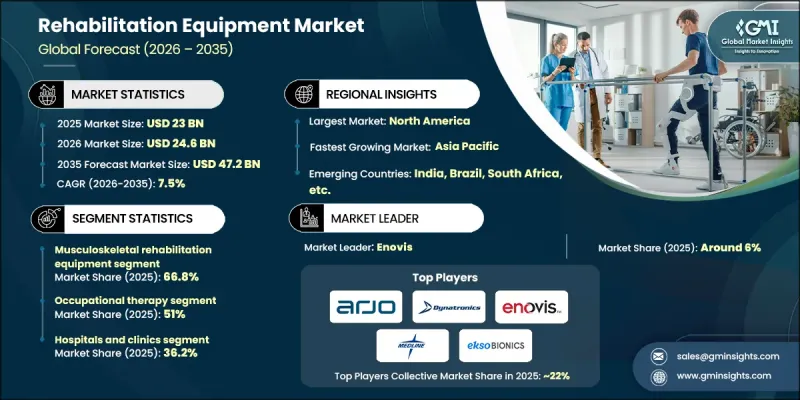
The Global Rehabilitation Equipment Market was valued at USD 23 billion in 2025 and is estimated to grow at a CAGR of 7.5% to reach USD 47.2 billion by 2035.
Market growth is driven by the rising prevalence of physical impairments, increasing utilization of rehabilitation therapies, rapid technological innovation, and the expanding aging population, alongside a growing burden of chronic conditions. A substantial global patient base requiring long-term mobility support and physical recovery solutions continues to stimulate demand for rehabilitation equipment. As functional limitations become more common across populations, the need for tools that support strength restoration, pain management, and independent mobility continues to rise. The market also benefits from increasing awareness of early rehabilitation interventions and the importance of structured recovery programs. In parallel, a higher incidence of injury-related conditions has intensified the need for continuous rehabilitation support, creating sustained demand for advanced rehabilitation products across healthcare settings. The rehabilitation industry is undergoing a significant transformation fueled by the integration of advanced technologies that enhance therapy accuracy, adaptability, and accessibility. The adoption of digitally enabled systems has improved treatment personalization and expanded access to rehabilitation services across institutional and outpatient environments.
| Market Scope | |
|---|---|
| Start Year | 2025 |
| Forecast Year | 2026-2035 |
| Start Value | $23 Billion |
| Forecast Value | $47.2 Billion |
| CAGR | 7.5% |
The musculoskeletal rehabilitation equipment segment accounted for 66.8% share in 2025. Segment growth is supported by increasing demand for recovery solutions addressing movement limitations and post-treatment rehabilitation needs. Rising occurrences of mobility-related conditions continue to drive utilization of specialized equipment designed to restore physical function, improve strength, and support recovery processes following medical interventions.
The occupational therapy segment held a 51% share in 2025, reflecting its central role in restoring functional independence. Equipment used in occupational therapy supports individuals in regaining daily activity capabilities and adapting to functional limitations. Growing demand for customized rehabilitation solutions continues to strengthen this segment as functional recovery remains a key healthcare priority.
North America Rehabilitation Equipment Market accounted for 36.8% share in 2025. Market expansion is supported by a well-established healthcare infrastructure, increasing adoption of early rehabilitation practices, and strong demand for advanced therapeutic solutions. Continuous technological progress supports broader deployment across both hospital-based and outpatient care settings.
Key companies operating in the Global Rehabilitation Equipment Market include Medline, Arjo, Zimmer MedizinSysteme, Enovis, OMRON Healthcare, Ekso Bionics, ReWalk Robotics, Dynatronics, STORZ MEDICAL, BTL, Tyromotion, Bioness, Richmar, BioXtreme, Caremax Rehabilitation Equipment, and MicroPort. These companies maintain competitive positions through diversified product portfolios and global distribution capabilities. To strengthen their foothold, rehabilitation equipment manufacturers prioritize continuous product innovation and integration of advanced technologies that enhance therapy outcomes and usability. Companies invest heavily in research and development to improve device efficiency, adaptability, and patient engagement. Strategic partnerships with healthcare providers and rehabilitation centers help expand clinical adoption and long-term demand. Geographic expansion into emerging healthcare markets supports revenue diversification, while training programs and clinician education initiatives drive product utilization.
Table of Contents
Chapter 1 Methodology and Scope
- 1.1 Market scope and definition
- 1.2 Research design
- 1.2.1 Research approach
- 1.2.2 Data collection methods
- 1.3 Data mining sources
- 1.3.1 Global
- 1.3.2 Regional/Country
- 1.4 Base estimates and calculations
- 1.4.1 Base year calculation
- 1.4.2 Key trends for market estimation
- 1.5 Primary research and validation
- 1.5.1 Primary sources
- 1.6 Forecast model
- 1.7 Research assumptions and limitations
Chapter 2 Executive Summary
- 2.1 Industry 3600 synopsis
- 2.2 Key market trends
- 2.2.1 Regional trends
- 2.2.2 Product trends
- 2.2.3 Application trends
- 2.2.4 End use trends
- 2.3 CXO perspectives: Strategic imperatives
- 2.3.1 Key decision points for industry executives
- 2.3.2 Critical success factors for market players
- 2.4 Future outlook and strategic recommendations
Chapter 3 Industry Insights
- 3.1 Industry ecosystem analysis
- 3.2 Industry impact forces
- 3.2.1 Growth drivers
- 3.2.1.1 Growing incidences of musculoskeletal disorders
- 3.2.1.2 Technological advancements
- 3.2.1.3 Increasing geriatric population along with rising prevalence of chronic diseases
- 3.2.1.4 Rising demand for rehabilitation therapies
- 3.2.2 Industry pitfalls and challenges
- 3.2.2.1 High cost of rehab therapies
- 3.2.2.2 Lack of awareness and access to rehabilitation services
- 3.2.3 Opportunities
- 3.2.3.1 Rapid expansion of robotic-assisted rehabilitation devices
- 3.2.3.2 Integration of wearable sensors for personalized rehab tracking
- 3.2.1 Growth drivers
- 3.3 Growth potential analysis
- 3.4 Regulatory landscape
- 3.4.1 North America
- 3.4.2 Europe
- 3.4.3 Asia Pacific
- 3.4.4 LAMEA
- 3.5 Technology and innovation landscape
- 3.5.1 Current technological trends
- 3.5.2 Emerging technologies
- 3.6 Value chain analysis
- 3.7 Reimbursement scenario
- 3.8 Investment trends and funding landscape
- 3.9 Consumer behavioral insights
- 3.10 Policy landscape
- 3.11 Porter's analysis
- 3.12 PESTEL analysis
- 3.13 Gap analysis
- 3.14 Future market trends
Chapter 4 Competitive Landscape, 2025
- 4.1 Introduction
- 4.2 Company matrix analysis
- 4.3 Company market share analysis
- 4.3.1 Global
- 4.3.2 North America
- 4.3.3 Europe
- 4.3.4 Asia Pacific
- 4.3.5 LAMEA
- 4.4 Competitive analysis of major market players
- 4.5 Competitive positioning matrix
- 4.6 Key developments
- 4.6.1 Mergers & acquisitions
- 4.6.2 Partnerships & collaborations
- 4.6.3 New product launches
- 4.6.4 Expansion plans
Chapter 5 Market Estimates and Forecast, By Product, 2022 - 2035 ($ Mn)
- 5.1 Key trends
- 5.2 Musculoskeletal rehabilitation equipment
- 5.2.1 Laser therapy
- 5.2.2 Ultrasound
- 5.2.3 Electrotherapy
- 5.2.4 Other musculoskeletal equipment
- 5.3 Neurological rehabilitation equipment
- 5.3.1 Neurorobotic devices
- 5.3.1.1 Upper limb devices
- 5.3.1.2 Lower limb devices
- 5.3.1.3 Lower arm devices (Hands)
- 5.3.1.4 Gait training devices
- 5.3.1.5 Exoskeleton devices
- 5.3.2 Non-invasive stimulators
- 5.3.3 Wearable devices
- 5.3.4 Brain computer interface
- 5.3.5 Neuro-rehabilitation assessment equipment
- 5.3.6 Consumer neuro-rehabilitation equipment
- 5.3.1 Neurorobotic devices
- 5.4 Cardiopulmonary rehabilitation equipment
- 5.4.1 Elliptical trainer
- 5.4.2 Stabilization ball
- 5.4.3 Stationary bicycle
- 5.4.4 Treadmill
- 5.4.5 Rower
- 5.4.6 Heart rate monitor
- 5.4.7 Blood pressure monitor
- 5.4.8 Other cardiopulmonary equipment
Chapter 6 Market Estimates and Forecast, By Application, 2022 - 2035 ($ Mn)
- 6.1 Key trends
- 6.2 Occupational therapy
- 6.3 Physiotherapy
- 6.4 Other applications
Chapter 7 Market Estimates and Forecast, By End Use, 2022 - 2035 ($ Mn)
- 7.1 Key trends
- 7.2 Hospitals and clinics
- 7.3 Rehabilitation centers
- 7.4 Homecare settings
- 7.5 Physiotherapy centers
Chapter 8 Market Estimates and Forecast, By Region, 2022 - 2035 ($ Mn)
- 8.1 Key trends
- 8.2 North America
- 8.2.1 U.S.
- 8.2.2 Canada
- 8.3 Europe
- 8.3.1 Germany
- 8.3.2 UK
- 8.3.3 France
- 8.3.4 Spain
- 8.3.5 Italy
- 8.4 Asia Pacific
- 8.4.1 China
- 8.4.2 Japan
- 8.4.3 India
- 8.4.4 Australia
- 8.4.5 South Korea
- 8.5 Latin America
- 8.5.1 Brazil
- 8.5.2 Mexico
- 8.5.3 Argentina
- 8.6 MEA
- 8.6.1 South Africa
- 8.6.2 Saudi Arabia
- 8.6.3 UAE
Chapter 9 Company Profiles
- 9.1 Arjo
- 9.2 Bioness
- 9.3 BioXtreme
- 9.4 BTL
- 9.5 Caremax Rehabilitation Equipment
- 9.6 Dynatronics
- 9.7 Enovis
- 9.8 Ekso Bionics
- 9.9 Medline
- 9.10 MicroPort
- 9.11 OMRON Healthcare
- 9.12 ReWalk Robotics
- 9.13 Richmar
- 9.14 STORZ MEDICAL
- 9.15 Tyromotion
- 9.16 Zimmer MedizinSysteme

