
PUBLISHER: Global Market Insights Inc. | PRODUCT CODE: 1959275

PUBLISHER: Global Market Insights Inc. | PRODUCT CODE: 1959275
Faba Bean Ingredients Market Opportunity, Growth Drivers, Industry Trend Analysis, and Forecast 2026 - 2035
The Global Faba Bean Ingredients Market was valued at USD 2.2 billion in 2025 and is estimated to grow at a CAGR of 6.7% to reach USD 4.2 billion by 2035.
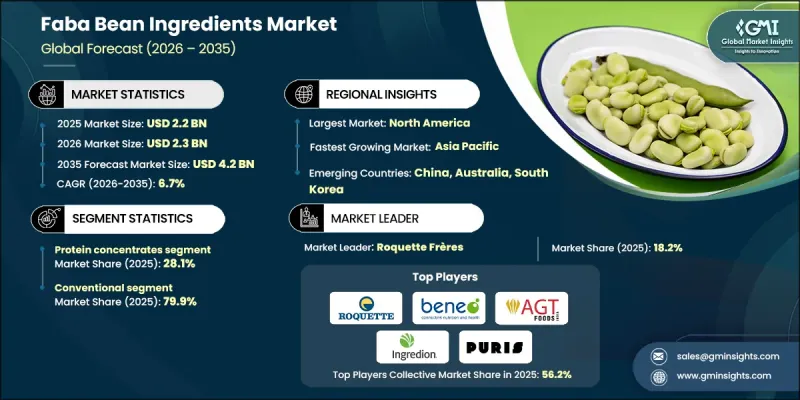
Faba bean ingredients originate from the Vicia faba crop, a legume valued for its high protein concentration, rich fiber content, and strong nutritional profile. These characteristics make the ingredient suitable across food manufacturing, animal nutrition, and aquaculture formulations. Growth across the global faba bean ingredients market remains driven by a shift toward sustainable protein sources, heightened awareness of nutrition, and declining reliance on animal-derived alternatives. Faba beans naturally support soil health by fixing nitrogen, which helps limit fertilizer usage and strengthens their sustainability appeal. Their allergen-free profile further improves adoption when compared with soy or dairy proteins. North America continues to account for a significant share due to strong processing capabilities, mature supply networks, and favorable regulatory conditions that support innovation. Meanwhile, Asia-Pacific records the fastest expansion as investments in plant-based processing accelerate and consumer interest in health-conscious and eco-friendly products rises.
| Market Scope | |
|---|---|
| Start Year | 2025 |
| Forecast Year | 2026-2035 |
| Start Value | $2.2 Billion |
| Forecast Value | $4.2 Billion |
| CAGR | 6.7% |
The protein concentrates segment accounted for 28.1% share in 2025 and is forecast to grow at a CAGR of 6.7% through 2035. These ingredients lead the category due to their balanced nutrition, cost efficiency, and versatility across food formulations. Protein concentrates retain a high level of native protein while offering functional advantages that improve texture, binding, and stability. Their suitability for plant-based food formulations and nutrition-focused products supports strong demand. Compared with isolates, concentrates require less complex processing, allowing manufacturers to manage costs more effectively and maintain scalability.
The conventional faba bean ingredients segment held 79.9% share in 2025, supported by established cultivation practices and widespread availability. Traditional farming methods, combined with large-scale processing infrastructure, enable consistent supply and lower production costs, which benefits both manufacturers and end users. These factors continue to reinforce the dominance of conventional products across global markets. At the same time, organic faba bean ingredients are gaining traction within a smaller but rapidly expanding segment, as consumers increasingly prioritize transparency, sustainable agriculture, and clean-label sourcing.
North American Faba Bean Ingredients Market is expected to register a CAGR of 6.6% between 2026 and 2035. Growth across the region reflects expanding usage of plant-derived ingredients in food, cosmetic, and pharmaceutical applications. Rising concern over the environmental footprint of synthetic inputs, along with growing acceptance of sustainable raw materials, continues to influence purchasing and formulation decisions across industries.
Key companies active across the Global Faba Bean Ingredients Market include Roquette Freres, Ingredion Incorporated, AGT Food & Ingredients, Bunge, BENEO GmbH, Puris Foods, Vestkorn Milling AS, Scoular Company, Royal Ingredients Group, and Seedea. These players compete through capacity expansion, product innovation, and partnerships across food and nutrition supply chains. Companies operating in the faba bean ingredients market focus on several strategic initiatives to strengthen their market position. Many invest in advanced processing technologies to improve protein functionality, texture, and flavor while maintaining nutritional integrity. Strategic collaborations with food manufacturers and ingredient distributors help expand market reach and secure long-term supply agreements. Firms also prioritize sustainability by improving sourcing practices, reducing processing emissions, and supporting regenerative agriculture.
Table of Contents
Chapter 1 Methodology & Scope
- 1.1 Market scope and definition
- 1.2 Research design
- 1.2.1 Research approach
- 1.2.2 Data collection methods
- 1.3 Data mining sources
- 1.3.1 Global
- 1.3.2 Regional/Country
- 1.4 Base estimates and calculations
- 1.4.1 Base year calculation
- 1.4.2 Key trends for market estimation
- 1.5 Primary research and validation
- 1.5.1 Primary sources
- 1.6 Forecast model
- 1.7 Research assumptions and limitations
Chapter 2 Executive Summary
- 2.1 Industry 360° synopsis
- 2.2 Key market trends
- 2.2.1 Regional
- 2.2.2 Ingredient type
- 2.2.3 Nature
- 2.2.4 Application
- 2.2.5 Distribution channel
- 2.3 TAM Analysis, 2026-2035
- 2.4 CXO perspectives: Strategic imperatives
- 2.4.1 Executive decision points
- 2.4.2 Critical success factors
- 2.5 Future Outlook and Strategic Recommendations
Chapter 3 Industry Insights
- 3.1 Industry ecosystem analysis
- 3.1.1 Supplier landscape
- 3.1.2 Profit margin
- 3.1.3 Value addition at each stage
- 3.1.4 Factor affecting the value chain
- 3.1.5 Disruptions
- 3.2 Industry impact forces
- 3.2.1 Growth drivers
- 3.2.1.1 Rising consumer demand for plant-based proteins
- 3.2.1.2 Sustainability & environmental benefits (nitrogen fixation, lower carbon footprint)
- 3.2.1.3 Allergen-free alternative to soy & dairy proteins
- 3.2.2 Industry pitfalls and challenges
- 3.2.2.1 Antinutritional factors (vicine, convicine) limiting consumption
- 3.2.2.2 Off-flavors & beany taste challenges
- 3.2.3 Market opportunities
- 3.2.3.1 Organic faba bean ingredient premium segment
- 3.2.3.2 Animal feed & aquaculture protein demand
- 3.2.1 Growth drivers
- 3.3 Growth potential analysis
- 3.4 Regulatory landscape
- 3.4.1 North America
- 3.4.2 Europe
- 3.4.3 Asia Pacific
- 3.4.4 Latin America
- 3.4.5 Middle East & Africa
- 3.5 Porter’s analysis
- 3.6 PESTEL analysis
- 3.7 Price trends
- 3.7.1 By region
- 3.7.2 By ingredient type
- 3.8 Future market trends
- 3.9 Technology and innovation landscape
- 3.9.1 Current technological trends
- 3.9.2 Emerging technologies
- 3.10 Patent Landscape
- 3.11 Trade statistics (HS code)
- 3.11.1 Major importing countries
- 3.11.2 Major exporting countries
- 3.12 Sustainability and environmental aspects
- 3.12.1 Sustainable practices
- 3.12.2 Waste reduction strategies
- 3.12.3 Energy efficiency in production
- 3.12.4 Eco-friendly initiatives
- 3.13 Carbon footprint consideration
Chapter 4 Competitive Landscape, 2025
- 4.1 Introduction
- 4.2 Company market share analysis
- 4.2.1 By region
- 4.2.1.1 North America
- 4.2.1.2 Europe
- 4.2.1.3 Asia Pacific
- 4.2.1.4 LATAM
- 4.2.1.5 MEA
- 4.2.1 By region
- 4.3 Company matrix analysis
- 4.4 Competitive analysis of major market players
- 4.5 Competitive positioning matrix
- 4.6 Key developments
- 4.6.1 Mergers & acquisitions
- 4.6.2 Partnerships & collaborations
- 4.6.3 New Product Launches
- 4.6.4 Expansion Plans
Chapter 5 Market Estimates and Forecast, By Ingredient Type, 2022-2035 (USD Billion) (Kilo Tons)
- 5.1 Key trends
- 5.2 Protein concentrates
- 5.3 Protein isolates
- 5.4 Faba bean flour
- 5.5 Faba bean starch
- 5.6 Faba bean fiber
- 5.7 Others
Chapter 6 Market Estimates and Forecast, By Nature, 2022-2035 (USD Billion) (Kilo Tons)
- 6.1 Key trends
- 6.2 Organic
- 6.3 Conventional
Chapter 7 Market Estimates and Forecast, By Application, 2022-2035 (USD Billion) (Kilo Tons)
- 7.1 Key trends
- 7.2 Bakery & cereals
- 7.2.1 Bread & baked goods
- 7.2.2 Pasta & noodles
- 7.2.3 Breakfast cereals
- 7.2.4 Others
- 7.3 Meat alternatives & plant-based proteins
- 7.3.1 Burgers & patties
- 7.3.2 Sausages & hot dogs
- 7.3.3 Nuggets & strips
- 7.3.4 Others
- 7.4 Dairy alternatives
- 7.4.1 Plant-based milk
- 7.4.2 Plant-based yogurt
- 7.4.3 Plant-based cheese
- 7.4.4 Plant-based ice cream
- 7.4.5 Others
- 7.5 Beverages
- 7.5.1 Protein shakes & RTD beverages
- 7.5.2 Smoothies
- 7.5.3 Nutritional drinks
- 7.5.4 Others
- 7.6 Snacks & confectionery
- 7.6.1 Protein bars & energy bars
- 7.6.2 Extruded snacks & chips
- 7.6.3 Confectionery products
- 7.6.4 Others
- 7.7 Animal feed & pet food
- 7.8 Others
Chapter 8 Market Estimates and Forecast, By Distribution Channel, 2022-2035 (USD Billion) (Kilo Tons)
- 8.1 Key trends
- 8.2 Supermarkets & hypermarkets
- 8.3 Convenience stores
- 8.4 Specialty stores
- 8.5 Online retailers
Chapter 9 Market Estimates and Forecast, By Region, 2022-2035 (USD Billion) (Kilo Tons)
- 9.1 Key trends
- 9.2 North America
- 9.2.1 U.S.
- 9.2.2 Canada
- 9.3 Europe
- 9.3.1 Germany
- 9.3.2 UK
- 9.3.3 France
- 9.3.4 Spain
- 9.3.5 Italy
- 9.3.6 Rest of Europe
- 9.4 Asia Pacific
- 9.4.1 China
- 9.4.2 India
- 9.4.3 Japan
- 9.4.4 Australia
- 9.4.5 South Korea
- 9.4.6 Rest of Asia Pacific
- 9.5 Latin America
- 9.5.1 Brazil
- 9.5.2 Mexico
- 9.5.3 Argentina
- 9.5.4 Rest of Latin America
- 9.6 Middle East and Africa
- 9.6.1 Saudi Arabia
- 9.6.2 South Africa
- 9.6.3 UAE
- 9.6.4 Rest of Middle East and Africa
Chapter 10 Company Profiles
- 10.1 AGT Food & Ingredients
- 10.2 BENEO GmbH
- 10.3 Bunge
- 10.4 Ingredion Incorporated
- 10.5 Puris Foods
- 10.6 Roquette Freres
- 10.7 Royal Ingredients Group
- 10.8 Scoular Company
- 10.9 Seedea
- 10.10 Vestkorn Milling AS

