
PUBLISHER: Global Market Insights Inc. | PRODUCT CODE: 1959276

PUBLISHER: Global Market Insights Inc. | PRODUCT CODE: 1959276
Asia Pacific Acoustic Panel Market Opportunity, Growth Drivers, Industry Trend Analysis, and Forecast 2026 - 2035
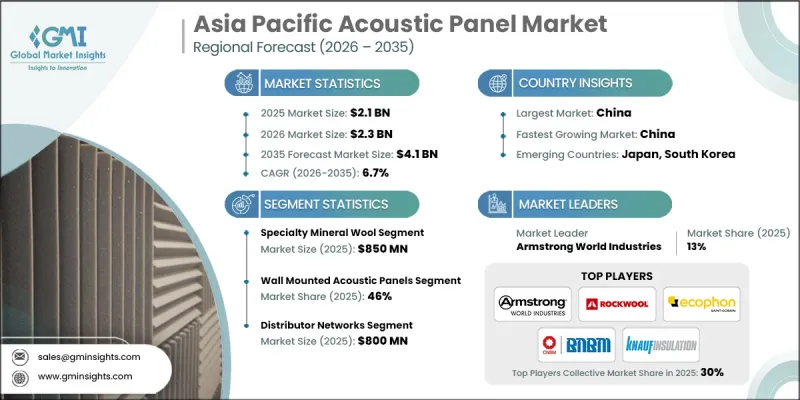
Asia Pacific Acoustic Panel Market was valued at USD 2.1 billion in 2025 and is estimated to grow at a CAGR of 6.7% to reach USD 4.1 billion by 2035.
Rapid urban expansion across the region continues to reshape building design priorities as population density increases and vertical development accelerates. Higher concentration of occupants within shared spaces has intensified noise-related challenges, prompting a stronger emphasis on sound management solutions. Developers, planners, and regulatory bodies across the Asia Pacific increasingly recognize acoustic comfort as a core component of occupant well-being and building performance. Modern construction now integrates acoustic treatments as a standard requirement rather than an optional feature, driven by evolving regulations and heightened awareness of indoor environmental quality. Acoustic panels play a critical role in limiting reverberation, controlling sound transmission, and enhancing overall clarity within enclosed environments. Ongoing investments in large-scale infrastructure and urban redevelopment projects further support demand, particularly as acoustic systems are often incorporated during advanced stages of construction to meet performance benchmarks and compliance standards.
| Market Scope | |
|---|---|
| Start Year | 2025 |
| Forecast Year | 2026-2035 |
| Start Value | $2.1 Billion |
| Forecast Value | $4.1 Billion |
| CAGR | 6.7% |
In 2025, the specialty mineral wool segment reached USD 0.85 billion. This category consists of high-performance acoustic and insulation materials engineered from processed mineral fibers designed to deliver superior sound absorption, thermal resistance, fire safety, and vibration control. Advanced production techniques enhance fiber structure, density, and bonding strength, resulting in products that maintain long-term dimensional stability and durability under demanding conditions. These attributes make specialty mineral wool a preferred solution where acoustic reliability and safety performance are critical.
The wall-mounted acoustic panels segment accounted for 46% share in 2025. These panels are engineered to absorb sound energy and minimize noise reflection by intercepting sound waves before they interact with rigid surfaces. Their slim construction allows installation without structural alterations, supporting widespread adoption across diverse building formats. Demand remains strong due to their efficiency, space-saving design, and ability to significantly improve acoustic performance in both compact and large interior environments.
China Acoustic Panel Market held 34% share, generating USD 0.73 billion in 2025. The country's leadership position reflects sustained urbanization, continuous infrastructure investment, and a high volume of new construction activity. Dense population centers and growing expectations around indoor comfort have encouraged broader integration of acoustic solutions. Design professionals and developers increasingly prioritize noise control as part of standard building specifications, reinforcing steady demand across the Chinese market.
Key companies active across the region include Saint-Gobain (Ecophon), Rockwool International, Armstrong World Industries, USG Boral, Knauf Insulation, Autex Acoustics, Owens Corning, Daiken, CSR Bradford, LX Hausys, Beijing New Building Material (BNBM), Nichias, Dongwha Enterprise, KCC, and MMT Acoustix. Companies operating in the Asia Pacific Acoustic Panel Market adopt a range of strategies to strengthen market presence and long-term positioning. Manufacturers focus on product innovation to enhance acoustic efficiency, fire resistance, and sustainability performance while meeting evolving regulatory standards. Capacity expansion within high-growth countries allows firms to reduce lead times and improve regional supply reliability. Strategic partnerships with construction stakeholders support early-stage product integration within large projects. Many players invest in lightweight and modular designs to simplify installation and reduce labor costs. Sustainability initiatives, including recycled content usage and low-emission manufacturing, further improve brand positioning.
Table of Contents
Chapter 1 Methodology and Scope
- 1.1 Market scope and definition
- 1.2 Research design
- 1.2.1 Research approach
- 1.2.2 Data collection methods
- 1.3 Data mining sources
- 1.3.1 Country
- 1.4 Base estimates and calculations
- 1.4.1 Base year calculation
- 1.4.2 Key trends for market estimation
- 1.5 Primary research and validation
- 1.5.1 Primary sources
- 1.6 Forecast model
- 1.7 Research assumptions and limitations
Chapter 2 Executive Summary
- 2.1 Industry 360° synopsis
- 2.2 Key market trends
- 2.2.1 Country
- 2.2.2 Product
- 2.2.3 Installation
- 2.2.4 Application
- 2.2.5 Distribution channel
- 2.3 CXO perspectives: Strategic imperatives
- 2.3.1 Key decision points for industry executives
- 2.3.2 Critical success factors for market players
- 2.4 Future outlook and strategic recommendations
Chapter 3 Industry Insights
- 3.1 Industry ecosystem analysis
- 3.1.1 Supplier landscape
- 3.1.2 Profit margin
- 3.1.3 Value addition at each stage
- 3.1.4 Factor affecting the value chain
- 3.2 Industry impact forces
- 3.2.1 Growth drivers
- 3.2.1.1 Rapid urbanization & infrastructure expansion
- 3.2.1.2 Growth in home studios & digital content creation
- 3.2.1.3 Rising awareness of acoustic comfort
- 3.2.2 Industry pitfalls & challenges
- 3.2.2.1 High cost sensitivity
- 3.2.2.2 Supply & cost volatility of raw materials
- 3.2.3 Opportunities
- 3.2.3.1 Sustainable & eco-friendly panel solutions
- 3.2.3.2 Customizable & aesthetic acoustic panels
- 3.2.1 Growth drivers
- 3.3 Growth potential analysis
- 3.4 Future market trends
- 3.5 Technology and innovation landscape
- 3.5.1 Current technological trends
- 3.5.2 Emerging technologies
- 3.6 Price trends
- 3.6.1 By country
- 3.6.2 By product
- 3.7 Regulatory landscape
- 3.7.1 Standards and compliance requirements
- 3.7.2 Regional regulatory frameworks
- 3.7.3 Certification standards
- 3.8 Porter’s analysis
- 3.9 PESTEL analysis
Chapter 4 Competitive Landscape, 2025
- 4.1 Introduction
- 4.2 Company market share analysis
- 4.2.1 By country
- 4.2.1.1 China
- 4.2.1.2 India
- 4.2.1.3 Japan
- 4.2.1.4 South Korea
- 4.2.1.5 Australia
- 4.2.1.6 Rest of APAC
- 4.2.1 By country
- 4.3 Company matrix analysis
- 4.4 Competitive analysis of major market players
- 4.5 Competitive positioning matrix
- 4.6 Key developments
- 4.6.1 Mergers & acquisitions
- 4.6.2 Partnerships & collaborations
- 4.6.3 New product launches
- 4.6.4 Expansion plans
Chapter 5 Market Estimates and Forecast, By Product, 2022 - 2035 (USD Billion) (Thousand Square Meters)
- 5.1 Key trends
- 5.2 Wooden acoustic panel
- 5.2.1 Perforated wood panels
- 5.2.2 Wood fiber composite panels
- 5.3 Mineral wool acoustic panel
- 5.3.1 High-performance mineral wool (nrc >0.85)
- 5.3.2 Standard performance mineral wool (nrc 0.65-0.85)
- 5.4 Specialty mineral wool (fire-rated, moisture-resistant)
- 5.4.1 Fabric acoustic panel
- 5.4.2 Custom decorative systems
- 5.4.3 Standard fabric-wrapped panels
- 5.5 Polyester acoustic panel
- 5.6 Smart and iot-enabled acoustic panels
Chapter 6 Market Estimates and Forecast, By Installation, 2022 - 2035 (USD Billion) (Thousand Square Meters)
- 6.1 Key trends
- 6.2 Wall-mounted acoustic panels
- 6.2.1 Direct-mount systems
- 6.2.2 Floating panel systems
- 6.3 Ceiling acoustic panels
- 6.3.1 Drop-in ceiling tiles
- 6.3.2 Direct-mount ceiling panels
- 6.4 Suspended and specialty systems
- 6.4.1 Hanging baffles and clouds
- 6.4.2 Curved and sculptural systems
- 6.5 Modular and integrated systems
- 6.5.1 Demountable partition systems
- 6.5.2 Integrated furniture solutions
Chapter 7 Market Estimates and Forecast, By Application, 2022 - 2035 (USD Billion) (Thousand Square Meters)
- 7.1 Key trends
- 7.2 Healthcare and medical facilities
- 7.2.1 Hospitals and medical centers
- 7.2.2 Diagnostic centers and laboratories
- 7.2.3 Elderly care and rehabilitation facilities
- 7.3 Education and learning environments
- 7.3.1 K-12 schools and classrooms
- 7.3.2 Higher education and universities
- 7.3.3 Libraries and study centers
- 7.4 Commercial and corporate
- 7.4.1 Office buildings and workspaces
- 7.4.2 Call centers and customer service
- 7.4.3 Meeting and conference facilities
- 7.5 Hospitality and entertainment
- 7.5.1 Hotels and resorts
- 7.5.2 Restaurants and dining
- 7.5.3 Entertainment venues and theaters
- 7.6 Industrial and manufacturing
- 7.6.1 Manufacturing facilities
- 7.6.2 Data centers and server rooms
- 7.6.3 Research and development facilities
- 7.7 Transportation infrastructure
- 7.7.1 Airports and transit hubs
- 7.7.2 Automotive and railway applications
Chapter 8 Market Estimates and Forecast, By Distribution Channel, 2022 - 2035 (USD Billion) (Thousand Square Meters)
- 8.1 Key trends
- 8.2 Direct sales
- 8.3 Distributor networks
- 8.4 Specialty retailers
- 8.5 Online and digital channels
Chapter 9 Market Estimates and Forecast, By Country, 2022 - 2035 (USD Billion) (Thousand Square Meters)
- 9.1 Key trends
- 9.2 China
- 9.3 India
- 9.4 Japan
- 9.5 South Korea
- 9.6 Australia
Chapter 10 Company Profiles
- 10.1 Armstrong World Industries
- 10.2 Autex Acoustics
- 10.3 Beijing New Building Material (BNBM)
- 10.4 CSR Bradford
- 10.5 Daiken
- 10.6 Dongwha Enterprise
- 10.7 KCC
- 10.8 Knauf Insulation
- 10.9 LX Hausys
- 10.10 MMT Acoustix
- 10.11 Nichias
- 10.12 Owens Corning
- 10.13 Rockwool International
- 10.14 Saint-Gobain (Ecophon)
- 10.15 USG Boral

