PUBLISHER: Global Market Insights Inc. | PRODUCT CODE: 1959284

PUBLISHER: Global Market Insights Inc. | PRODUCT CODE: 1959284
Wireless Soundbar Market Opportunity, Growth Drivers, Industry Trend Analysis, and Forecast 2026 - 2035
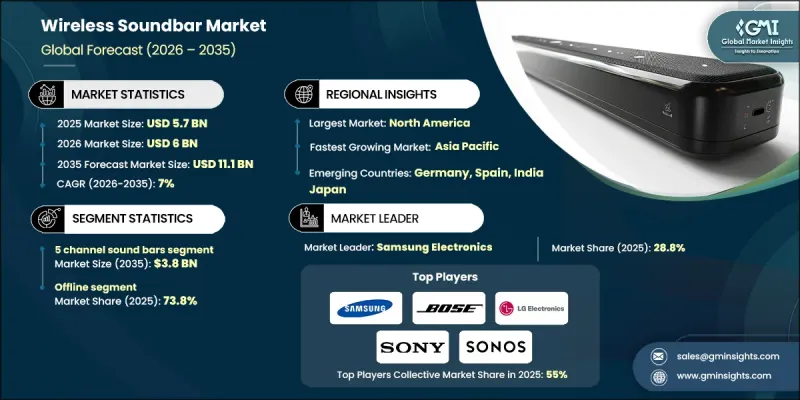
The Global Wireless Soundbar Market was valued at USD 5.7 billion in 2025 and is estimated to grow at a CAGR of 7% to reach USD 11.1 billion by 2035.
Continuous advancements in wireless connectivity and audio processing technologies have significantly improved sound quality while eliminating the need for complex wiring. Consumers benefit from flexible installation, cleaner living spaces, and seamless connectivity with multiple source devices. Government-led investments in digital infrastructure and initiatives that promote smart living environments are further supporting adoption. Manufacturers are actively responding to these trends by introducing feature-rich soundbars that integrate smoothly with connected home ecosystems. Growing use of digital streaming platforms has heightened expectations for immersive audio experiences at home, which continues to push demand for premium wireless soundbars. Together, technological innovation, supportive infrastructure development, and evolving consumer preferences are reinforcing sustained growth in this market.
| Market Scope | |
|---|---|
| Start Year | 2025 |
| Forecast Year | 2026-2035 |
| Start Value | $5.7 Billion |
| Forecast Value | $11.1 Billion |
| CAGR | 7% |
The 5-channel soundbar segment generated USD 1.9 billion in 2025 and is forecast to reach USD 3.8 billion by 2035. This segment is gaining traction as it delivers a more immersive listening experience without the complexity of traditional multi-speaker systems. Balanced channel output and enhanced surround sound capabilities appeal to consumers seeking improved audio performance for in-home viewing. The ongoing shift toward home-based entertainment consumption continues to support demand for these configurations.
The offline distribution channels segment accounted for 73.8% share in 2025. Physical retail continues to play a critical role as consumers prefer to experience audio quality firsthand before purchasing. In-store demonstrations allow buyers to assess performance, clarity, and volume in real time. Personalized assistance and immediate product availability further strengthen the appeal of offline sales, particularly for higher-value audio equipment.
U.S. Wireless Soundbar Market held 88.4% share in 2025. Market leadership is driven by early adoption of advanced audio technologies, widespread use of smart home devices, and strong consumer spending on home entertainment. High disposable incomes and growing demand for immersive audio setups continue to support robust sales. Expanding integration with connected home systems further accelerates household adoption.
Key companies operating in the Global Wireless Soundbar Market include Samsung Electronics, Sony, LG Electronics, Bose, Sonos, Yamaha, Sennheiser, Panasonic, Philips, TCL Technology Group, VIZIO, Polk Audio, Klipsch, Pioneer, and Bowers & Wilkins. Companies in the wireless soundbar market focus on innovation, ecosystem integration, and brand differentiation to strengthen their market position. Manufacturers invest heavily in audio engineering, wireless connectivity, and immersive sound technologies to enhance user experience. Compatibility with smart home platforms and voice-enabled systems is a key priority. Strategic pricing across entry-level and premium segments helps capture diverse consumer groups. Expanding retail partnerships and direct-to-consumer channels improve visibility and accessibility. Design aesthetics, compact form factors, and ease of installation further influence purchasing decisions and support long-term brand loyalty.
Table of Contents
Chapter 1 Methodology & Scope
- 1.1 Market scope and definition
- 1.2 Research design
- 1.2.1 Research approach
- 1.2.2 Data collection methods
- 1.3 Data mining sources
- 1.3.1 Global
- 1.3.2 Regional/Country
- 1.4 Base estimates and calculations
- 1.4.1 Base year calculation
- 1.4.2 Key trends for market estimation
- 1.5 Primary research and validation
- 1.5.1 Primary sources
- 1.6 Forecast model
- 1.7 Research assumptions and limitations
Chapter 2 Executive Summary
- 2.1 Industry 360° synopsis
- 2.2 Key market trends
- 2.2.1 Regional
- 2.2.2 Product Type
- 2.2.3 Connectivity
- 2.2.4 Installation Type
- 2.2.5 Price
- 2.2.6 Speaker Wattage
- 2.2.7 Size
- 2.2.8 Application
- 2.2.9 Distribution Channel
- 2.3 CXO perspectives: Strategic imperatives
- 2.3.1 Key decision points for industry executives
- 2.3.2 Critical success factors for market players
- 2.4 Future outlook and strategic recommendations
Chapter 3 Industry Insights
- 3.1 Industry ecosystem analysis
- 3.1.1 Supplier landscape
- 3.1.2 Profit margin
- 3.1.3 Value addition at each stage
- 3.1.4 Factor affecting the value chain
- 3.2 Industry impact forces
- 3.2.1 Growth drivers
- 3.2.1.1 Increasing demand for home entertainment systems
- 3.2.1.2 Technological advancements and integration of smart features
- 3.2.1.3 Growing adoption of flat panel TVs
- 3.2.2 Industry pitfalls & challenges
- 3.2.2.1 High cost of premium soundbars
- 3.2.2.2 Compatibility issues with older devices
- 3.2.3 Opportunities
- 3.2.3.1 Growth potential in gaming & immersive entertainment
- 3.2.3.2 Expansion of smart and functional wireless soundbar
- 3.2.1 Growth drivers
- 3.3 Growth potential analysis
- 3.4 Future market trends
- 3.5 Technology and innovation landscape
- 3.5.1 Current technological trends
- 3.5.2 Emerging technologies
- 3.6 Price trends
- 3.6.1 By product type
- 3.6.2 By region
- 3.7 Regulatory landscape
- 3.7.1 Standards and compliance requirements
- 3.7.2 Regional regulatory frameworks
- 3.7.3 Certification standards
- 3.8 Trade statistics (HS Code- 8518)
- 3.8.1 Major importing countries
- 3.8.2 Major exporting countries
- 3.9 Gap analysis
- 3.10 Risk assessment and mitigation
- 3.11 Porter’s analysis
- 3.12 PESTEL analysis
- 3.13 Consumer behaviour analysis
- 3.13.1 Purchasing patterns
- 3.13.2 Preference analysis
- 3.13.3 Regional variations in consumer behaviour
- 3.13.4 Impact of e-commerce on buying decisions
Chapter 4 Competitive Landscape, 2025
- 4.1 Introduction
- 4.2 Company market share analysis
- 4.2.1 By region
- 4.2.1.1 North America
- 4.2.1.2 Europe
- 4.2.1.3 Asia Pacific
- 4.2.1.4 Latin America
- 4.2.1.5 Middle East and Africa
- 4.2.1 By region
- 4.3 Company matrix analysis
- 4.4 Competitive analysis of major market players
- 4.5 Competitive positioning matrix
- 4.6 Key developments
- 4.6.1 Mergers & acquisitions
- 4.6.2 Partnerships & collaborations
- 4.6.3 New product launches
- 4.6.4 Expansion plans
Chapter 5 Market Estimates & Forecast, By Product Type, 2022-2035 (USD Billion) (Thousand Units)
- 5.1 Key trends
- 5.2 2 channel sound bars
- 5.3 3 channel sound bars
- 5.4 5 channel sound bars
- 5.5 7 channel sound bars
Chapter 6 Market Estimates & Forecast, By Connectivity, 2022-2035 (USD Billion) (Thousand Units)
- 6.1 Key trends
- 6.2 Bluetooth
- 6.3 Wi-fi
Chapter 7 Market Estimates & Forecast, By Installation Type, 2022-2035 (USD Billion) (Thousand Units)
- 7.1 Key trends
- 7.2 Wall mounted
- 7.3 Tabletop
- 7.4 Free standing
Chapter 8 Market Estimates & Forecast, By Price, 2022-2035 (USD Billion) (Thousand Units)
- 8.1 Key trends
- 8.2 Low
- 8.3 Medium
- 8.4 High
Chapter 9 Market Estimates & Forecast, By Wattage, 2022-2035 (USD Billion) (Thousand Units)
- 9.1 Key trends
- 9.2 Up to 99 watts
- 9.3 100-199 watts
- 9.4 200-499 watts
- 9.5 500-799 watts
- 9.6 Above 800 watts
Chapter 10 Market Estimates & Forecast, By Size, 2022-2035 (USD Billion) (Thousand Units)
- 10.1 Key trends
- 10.2 Under 30 inches
- 10.3 30-60 inches
- 10.4 Above 60 inches
Chapter 11 Market Estimates & Forecast, By Application, 2022-2035 (USD Billion) (Thousand Units)
- 11.1 Key trends
- 11.2 Residential
- 11.3 Commercial
Chapter 12 Market Estimates & Forecast, By Distribution Channel, 2022-2035 (USD Billion) (Thousand Units)
- 12.1 Key trends
- 12.2 Online
- 12.2.1 E-Commerce
- 12.2.2 Company website
- 12.3 Offline
- 12.3.1 Supermarkets/Hypermarkets
- 12.3.2 Specialty Stores
- 12.3.3 Others (Individual stores, Departmental stores, etc.)
Chapter 13 Market Estimates & Forecast, By Region, 2022-2035 (USD Billion) (Thousand Units)
- 13.1 Key trends
- 13.2 North America
- 13.2.1 U.S.
- 13.2.2 Canada
- 13.3 Europe
- 13.3.1 Germany
- 13.3.2 France
- 13.3.3 UK
- 13.3.4 Italy
- 13.3.5 Spain
- 13.4 Asia Pacific
- 13.4.1 China
- 13.4.2 India
- 13.4.3 Japan
- 13.4.4 South Korea
- 13.4.5 Australia
- 13.5 Latin America
- 13.5.1 Brazil
- 13.5.2 Mexico
- 13.5.3 Argentina
- 13.6 MEA
- 13.6.1 South Africa
- 13.6.2 Saudi Arabia
- 13.6.3 UAE
Chapter 14 Company Profiles
- 14.1 Bose
- 14.2 Bowers & Wilkins
- 14.3 Klipsch
- 14.4 LG Electronics
- 14.5 Panasonic
- 14.6 Philips
- 14.7 Pioneer
- 14.8 Polk Audio (Sound United)
- 14.9 Samsung Electronics
- 14.10 Sennheiser
- 14.11 Sonos
- 14.12 Sony
- 14.13 TCL Technology Group
- 14.14 VIZIO
- 14.15 Yamaha

