
PUBLISHER: Global Market Insights Inc. | PRODUCT CODE: 1959288

PUBLISHER: Global Market Insights Inc. | PRODUCT CODE: 1959288
V2X Data Quality Assurance Market Opportunity, Growth Drivers, Industry Trend Analysis, and Forecast 2026 - 2035
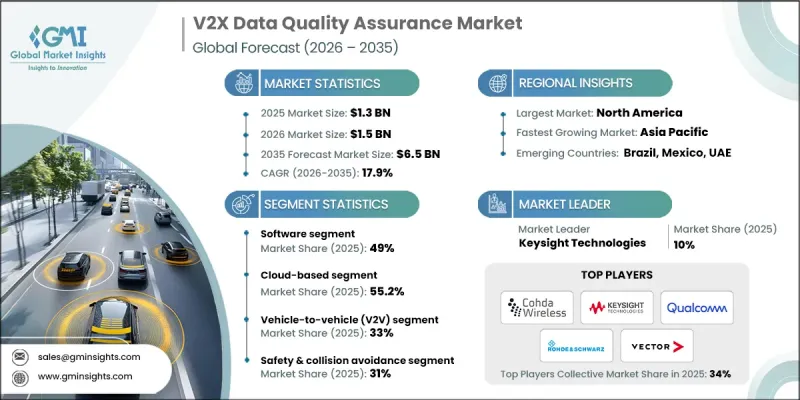
The Global V2X Data Quality Assurance Market was valued at USD 1.3 billion in 2025 and is estimated to grow at a CAGR of 17.9% to reach USD 6.5 billion by 2035.
The growth reflects accelerating transformation across automotive ecosystems and transportation infrastructure, fueled by connected mobility, autonomous driving advancements, and digital roadway integration. Industry participants are navigating structural shifts driven by evolving communication standards, cybersecurity mandates, regulatory alignment, smart infrastructure investments, and advanced validation requirements. As vehicle-to-everything communication becomes foundational to intelligent transportation systems, demand for robust testing, verification, and monitoring frameworks continues to expand. Market expansion is further supported by the transition to next-generation wireless technologies and the increasing complexity of interoperable vehicle, roadside, and cloud-based systems. Continuous validation of message accuracy, latency, authentication, and reliability is essential to maintain operational integrity. As deployment scales globally, stakeholders are prioritizing resilient architectures and standardized compliance frameworks to ensure safe, secure, and high-performance V2X ecosystems through 2035.
| Market Scope | |
|---|---|
| Start Year | 2025 |
| Forecast Year | 2026-2035 |
| Start Value | $1.3 Billion |
| Forecast Value | $6.5 Billion |
| CAGR | 17.9% |
A critical component of the V2X data quality assurance industry is the Security Credential Management System, a public key infrastructure framework defined by the US Department of Transportation and required across V2X implementations. This architecture enables encrypted communication supported by certificate-based authentication, designed to protect anonymity while safeguarding data integrity and authenticity. The framework also supports the identification and removal of compromised or non-compliant devices, reinforcing a continuous feedback-driven quality assurance loop within connected mobility networks.
The software segment accounted for 49% share in 2025 and is forecast to grow at a CAGR of 19% from 2026 to 2035. This dominance underscores the essential role of software-driven validation tools in managing the technical complexity of V2X ecosystems. Core offerings include protocol analysis solutions, network simulation environments, automated test frameworks, compliance validation platforms, and real-time monitoring systems. Open-source intelligent transportation software initiatives introduced by federal agencies have further strengthened the ecosystem. Quality assurance platforms must verify diverse message formats standardized under SAE J2735, ensuring reliability across safety, traffic management, traveler information, and roadside communication exchanges.
The cloud-based deployment models segment held 55.2% share in 2025 and is expanding at the fastest CAGR of 18.8% through 2035. Cloud-enabled platforms are gaining adoption among automotive suppliers, mobility startups, and regional transportation agencies due to lower upfront investment requirements, scalability, rapid deployment, and streamlined software updates. By shifting validation environments to cloud infrastructure, organizations can access sophisticated testing tools without building capital-intensive facilities. Remote and distributed validation capabilities allow vehicles and infrastructure systems operating in different geographic regions to connect seamlessly to centralized quality assurance environments.
North America V2X Data Quality Assurance Market generated USD 353.5 million in 2025 and is projected to grow at a CAGR of 17.5% from 2026 to 2035. The US benefits from strong connected vehicle adoption rates, advanced digital roadway infrastructure, and a mature automotive and technology ecosystem supporting interoperability testing and message validation tools. Large-scale connected vehicle deployments across multiple states require continuous performance monitoring and structured quality validation to maintain operational safety and communication reliability.
Key companies operating in the Global V2X Data Quality Assurance Market include Anritsu, Rohde & Schwarz, Vector Informatik, Keysight Technologies, NI (National Instruments), VIAVI Solutions, IPG Automotive, Cohda Wireless, Qualcomm Technologies, and Robert Bosch. Companies in the V2X Data Quality Assurance Market are strengthening their market position through strategic technology partnerships, advanced R&D investments, and expansion of cloud-native testing platforms. Leading players are focusing on interoperability validation solutions aligned with evolving 5G NR-V2X and future 6G standards. Many firms are integrating AI-driven analytics into quality monitoring platforms to enhance anomaly detection and predictive diagnostics. Strategic collaborations with automotive OEMs, infrastructure providers, and telecom operators are accelerating ecosystem integration.
Table of Contents
Chapter 1 Methodology
- 1.1 Research approach
- 1.2 Quality commitments
- 1.3 Research trail and confidence scoring
- 1.3.1 Research trail components
- 1.3.2 Scoring components
- 1.4 Data collection
- 1.4.1 Partial list of primary sources
- 1.5 Data mining sources
- 1.5.1 Paid sources
- 1.6 Best estimates and calculations
- 1.6.1 Base year calculation for any one approach
- 1.7 Forecast model
- 1.8 Research transparency addendum
Chapter 2 Executive Summary
- 2.1 Industry 360° synopsis, 2022 - 2035
- 2.2 Key market trends
- 2.2.1 Regional
- 2.2.2 Component
- 2.2.3 Deployment Mode
- 2.2.4 Connectivity
- 2.2.5 Application
- 2.2.6 End Use
- 2.3 TAM Analysis, 2026-2035
- 2.4 CXO perspectives: Strategic imperatives
- 2.4.1 Executive decision points
- 2.4.2 Critical success factors
- 2.5 Future outlook and strategic recommendations
Chapter 3 Industry Insights
- 3.1 Industry ecosystem analysis
- 3.1.1 Supplier landscape
- 3.1.2 Profit margin analysis
- 3.1.3 Cost structure
- 3.1.4 Value addition at each stage
- 3.1.5 Factor affecting the value chain
- 3.1.6 Disruptions
- 3.2 Industry impact forces
- 3.2.1 Growth drivers
- 3.2.1.1 Increasing adoption of connected and autonomous vehicles
- 3.2.1.2 Government mandates for V2X safety standards
- 3.2.1.3 Rising need for real-time data validation in safety-critical applications
- 3.2.1.4 Growth of smart transportation infrastructure
- 3.2.1.5 Demand for cybersecurity in V2X communications
- 3.2.2 Industry pitfalls and challenges
- 3.2.2.1 High implementation and infrastructure costs
- 3.2.2.2 Complexity of multi-standard V2X environments (DSRC vs C-V2X)
- 3.2.2.3 Lack of unified global standards
- 3.2.2.4 Interoperability challenges across OEMs
- 3.2.3 Market opportunities
- 3.2.3.1 Emerging 5G-V2X and 6G-V2X technologies
- 3.2.3.2 Smart city and ITS infrastructure expansion
- 3.2.3.3 Growing aftermarket services demand
- 3.2.3.4 AI-driven predictive data quality solutions
- 3.2.3.5 V2X-enabled electric vehicle charging (V2G) quality assurance
- 3.2.1 Growth drivers
- 3.3 Growth potential analysis
- 3.4 Regulatory landscape
- 3.4.1 North America
- 3.4.1.1 US- Federal V2X rules & spectrum allocation
- 3.4.1.2 Canada - safety framework for connected & automated vehicles (CASF)
- 3.4.2 Europe
- 3.4.2.1 Germany- EU ITS & national initiatives
- 3.4.2.2 UK- Post Brexit V2X flexibility
- 3.4.2.3 France- National V2X testing & ITS strategy
- 3.4.2.4 Italy- ITS pilots & smart infrastructure
- 3.4.3 Asia Pacific
- 3.4.3.1 China- MIIT C-V2X mandates & standards
- 3.4.3.2 India- Emerging V2X & automotive connectivity regulations
- 3.4.3.3 Japan- ITS connect & spectrum policy
- 3.4.3.4 Australia- Technology neutral ITS policies
- 3.4.4 LATAM
- 3.4.4.1 Mexico- NOM vehicle safety standards
- 3.4.4.2 Argentina- National traffic law 24.449
- 3.4.5 MEA
- 3.4.5.1 South Africa- National road traffic act (1996)
- 3.4.5.2 Saudi Arabia- Traffic law & vision 2030 transport initiatives
- 3.4.1 North America
- 3.5 Porter's analysis
- 3.6 PESTEL analysis
- 3.7 Technology and innovation landscape
- 3.7.1 Current technological trends
- 3.7.1.1 Plausibility-based detection mechanisms
- 3.7.1.2 Machine learning approaches (MLP, SVM, deep learning)
- 3.7.1.3 AI and machine learning for data quality
- 3.7.1.4 Blockchain for V2X data integrity
- 3.7.2 Emerging technologies
- 3.7.2.1 Edge computing for real-time validation
- 3.7.2.2 Quantum-safe cryptography development
- 3.7.2.3 Digital twin and simulation technologies
- 3.7.2.4 5G network slicing for V2X quality
- 3.7.1 Current technological trends
- 3.8 Patent analysis
- 3.9 Pricing analysis
- 3.9.1 Software licensing pricing models
- 3.9.2 Hardware equipment pricing trends
- 3.9.3 Professional services pricing structure
- 3.10 Use cases & success stories
- 3.11 Sustainability and environmental aspects
- 3.11.1 Sustainable practices
- 3.11.2 Waste reduction strategies
- 3.11.3 Energy efficiency in production
- 3.11.4 Eco-friendly Initiatives
- 3.11.5 Carbon footprint considerations
- 3.12 Best practices and implementation guidelines
- 3.12.1 Quality assurance framework design
- 3.12.2 Deployment best practices
- 3.12.3 Data quality management best practices
- 3.12.4 Security best practices
- 3.12.5 Performance optimization best practices
- 3.12.6 Regulatory compliance best practices
- 3.13 Deployment scenarios and models
- 3.13.1 Urban deployment scenarios
- 3.13.2 Highway deployment scenarios
- 3.13.3 Rural and remote deployment scenarios
- 3.13.4 Mixed technology deployment scenarios
- 3.13.5 Special environment scenarios
- 3.14 Product and service benchmarking
- 3.14.1 Software feature comparison matrix
- 3.14.2 Hardware technical specifications benchmarking
- 3.14.3 Service portfolio and SLA comparison
- 3.14.4 Pricing and total cost of ownership analysis
- 3.15 Future outlook and opportunities
Chapter 4 Competitive Landscape, 2025
- 4.1 Introduction
- 4.2 Company market share analysis
- 4.2.1 North America
- 4.2.2 Europe
- 4.2.3 Asia Pacific
- 4.2.4 LATAM
- 4.2.5 MEA
- 4.3 Competitive analysis of major market players
- 4.4 Competitive positioning matrix
- 4.5 Strategic outlook matrix
- 4.6 Key developments
- 4.6.1 Mergers & acquisitions
- 4.6.2 Partnerships & collaborations
- 4.6.3 New product launches
- 4.6.4 Expansion plans and funding
Chapter 5 Market Estimates & Forecast, By Component, 2022 - 2035 ($Bn)
- 5.1 Key trends
- 5.2 Software
- 5.2.1 Data validation & cleansing
- 5.2.2 Analytics & anomaly detection
- 5.2.3 Real-time monitoring & analytics
- 5.2.4 Simulation & testing platforms
- 5.2.5 Compliance & reporting software
- 5.3 Hardware
- 5.3.1 Sensors
- 5.3.2 Communication modules
- 5.3.3 Edge/processing units
- 5.3.4 On-board units (OBUs)
- 5.3.5 Roadside units (RSUs)
- 5.4 Services
- 5.4.1 Consulting
- 5.4.2 System integration
- 5.4.3 Implementation & deployment
- 5.4.4 Maintenance & support
- 5.4.5 Training & documentation
Chapter 6 Market Estimates & Forecast, By Deployment Mode, 2022 - 2035 ($Bn)
- 6.1 Key trends
- 6.2 On premises
- 6.3 Cloud-based
Chapter 7 Market Estimates & Forecast, By Connectivity, 2022 - 2035 ($Bn)
- 7.1 Key trends
- 7.2 Vehicle-to-vehicle (V2V)
- 7.3 Vehicle-to-infrastructure (V2I)
- 7.4 Vehicle-to-pedestrian (V2P)
- 7.5 Vehicle-to-network (V2N)
- 7.6 Others
Chapter 8 Market Estimates & Forecast, By Application, 2022 - 2035 ($Bn)
- 8.1 Key trends
- 8.2 Safety & collision avoidance
- 8.3 Traffic management & optimization
- 8.4 Autonomous driving & ADAS
- 8.5 Fleet management
- 8.6 Others
Chapter 9 Market Estimates & Forecast, By End Use, 2022 - 2035 ($Bn)
- 9.1 Key trends
- 9.2 Automotive OEMs
- 9.3 Government Agencies
- 9.4 Fleet Operators
- 9.5 Others
Chapter 10 Market Estimates & Forecast, By Region, 2022 - 2035 ($Bn)
- 10.1 Key trends
- 10.2 North America
- 10.2.1 US
- 10.2.2 Canada
- 10.3 Europe
- 10.3.1 Germany
- 10.3.2 UK
- 10.3.3 France
- 10.3.4 Italy
- 10.3.5 Spain
- 10.3.6 Russia
- 10.3.7 Netherlands
- 10.3.8 Sweden
- 10.3.9 Denmark
- 10.3.10 Poland
- 10.4 Asia Pacific
- 10.4.1 China
- 10.4.2 India
- 10.4.3 Japan
- 10.4.4 Australia
- 10.4.5 South Korea
- 10.4.6 Singapore
- 10.4.7 Thailand
- 10.4.8 Indonesia
- 10.4.9 Vietnam
- 10.5 Latin America
- 10.5.1 Brazil
- 10.5.2 Mexico
- 10.5.3 Argentina
- 10.5.4 Colombia
- 10.6 MEA
- 10.6.1 South Africa
- 10.6.2 Saudi Arabia
- 10.6.3 UAE
- 10.6.4 Israel
Chapter 11 Company Profiles
- 11.1 Global Players
- 11.1.1 Anritsu
- 11.1.2 Cohda Wireless
- 11.1.3 IPG Automotive
- 11.1.4 Keysight Technologies
- 11.1.5 NI (National Instruments)
- 11.1.6 Qualcomm Technologies
- 11.1.7 Robert Bosch
- 11.1.8 Rohde & Schwarz
- 11.1.9 Vector Informatik
- 11.1.10 VIAVI Solutions
- 11.2 Regional Players
- 11.2.1 Autotalks
- 11.2.2 Commsignia
- 11.2.3 Continental
- 11.2.4 DEKRA
- 11.2.5 Denso
- 11.2.6 NOFFZ Technologies
- 11.2.7 NXP Semiconductors
- 11.2.8 Savari
- 11.2.9 SEA Datentechnik
- 11.2.10 Valeo Telematik
- 11.3 Emerging Technology Innovators
- 11.3.1 ADAS iiT
- 11.3.2 Allion Labs
- 11.3.3 msg
- 11.3.4 Neusoft
- 11.3.5 u-blox

