PUBLISHER: Global Market Insights Inc. | PRODUCT CODE: 1959303

PUBLISHER: Global Market Insights Inc. | PRODUCT CODE: 1959303
Postbiotic Ingredients in Functional Foods Market Opportunity, Growth Drivers, Industry Trend Analysis, and Forecast 2026 - 2035
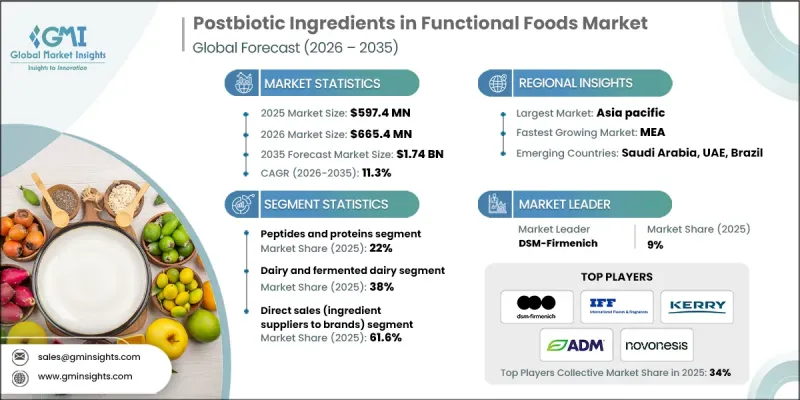
The Global Postbiotic Ingredients in Functional Foods Market was valued at USD 597.4 million in 2025 and is estimated to grow at a CAGR of 11.3% to reach USD 1.74 billion by 2035.
Growth is driven by rising consumer awareness of gut health and microbiome science, alongside increasing demand for stable and easy-to-formulate functional ingredients. Postbiotic ingredients offer food manufacturers the ability to deliver microbiome-related benefits without the formulation challenges linked to maintaining live cultures during processing and shelf life. As a result, brands are increasingly turning to postbiotics as a lower-risk alternative to probiotics while maintaining strong positioning around digestive health and immune support. Regulatory clarity in key regions, combined with the convergence of nutrition and convenience-driven food formats, is accelerating product innovation. Broader interest in fermented and gut-friendly products has further strengthened demand, with manufacturers developing microbiome-supportive formulations across multiple categories. Heat-stable postbiotic ingredients are gaining traction, particularly in applications where traditional live cultures face stability limitations. Quantifiable consumer interest in digestive wellness continues to support long-term market expansion.
| Market Scope | |
|---|---|
| Start Year | 2025 |
| Forecast Year | 2026-2035 |
| Start Value | $597.4 Million |
| Forecast Value | $1.74 Billion |
| CAGR | 11.3% |
The peptides and proteins segment accounted for 22% share in 2025 and is expected to grow at a CAGR of 12.2% through 2035. Ingredient suppliers are moving beyond single-component offerings toward multifunctional blends that combine peptides, enzymes, cell fractions, vitamins, and additional bioactive compounds. These solutions are positioned as standardized, label-friendly ingredients that deliver consistent potency, improved flavor profiles, and greater manufacturing efficiency. Commercial strategies increasingly emphasize cross-category compatibility, enabling use across dairy, beverage, and snack formulations while supporting differentiated functional claims backed by stability validation and documentation.
The dairy and fermented dairy applications segment held 38% share in 2025 and is forecast to grow at a CAGR of 10.9% by 2035. This segment remains central due to its natural alignment with fermentation-based health narratives and established consumption habits. Manufacturers are incorporating postbiotic ingredients into a wide range of dairy-based products to enhance formulation stability and ensure consistent functional positioning without compromising sensory expectations. The ability to reinforce digestive health messaging while maintaining traditional taste profiles continues to strengthen adoption within this category.
North America Postbiotic Ingredients in Functional Foods Market accounted for USD 156.9 million in 2025 and is projected to reach USD 460.4 million by 2035, supported by strong innovation in mainstream gut-health functional foods. The United States leads regional growth through a well-developed ecosystem of functional food brands and ingredient suppliers. Market expansion benefits from the crossover of dietary supplement concepts into food and beverage applications, widespread retail availability of digestive wellness products, and high consumer acceptance of convenient, on-the-go functional formats.
Key companies operating in the Global Postbiotic Ingredients in Functional Foods Market include DSM-Firmenich, IFF (International Flavors & Fragrances), ADM, Kerry Group, BASF, Novonesis, Cargill, Givaudan, Evonik, and DuPont (IFF legacy Danisco). Companies in the Postbiotic Ingredients in Functional Foods Market are strengthening their competitive position through targeted research and development, strategic partnerships with food manufacturers, and portfolio diversification. Many players are investing in clinically supported formulations to substantiate claims related to digestive and immune health. Expanding multifunctional ingredient blends enhances cross-category application flexibility and improves formulation efficiency for brand owners. Firms are also prioritizing regulatory alignment and clean-label positioning to meet evolving consumer expectations. Strategic acquisitions and collaborations are enabling companies to broaden their geographic reach and accelerate innovation pipelines.
Table of Contents
Chapter 1 Methodology & Scope
- 1.1 Market scope and definition
- 1.2 Research design
- 1.2.1 Research approach
- 1.2.2 Data collection methods
- 1.3 Data mining sources
- 1.3.1 Global
- 1.3.2 Regional/Country
- 1.4 Base estimates and calculations
- 1.4.1 Base year calculation
- 1.4.2 Key trends for market estimation
- 1.5 Primary research and validation
- 1.5.1 Primary sources
- 1.6 Forecast model
- 1.7 Research assumptions and limitations
Chapter 2 Executive Summary
- 2.1 Industry 360° synopsis
- 2.2 Key market trends
- 2.2.1 Regional
- 2.2.2 ingredient type
- 2.2.3 Food type
- 2.2.4 Distribution channel
- 2.3 TAM Analysis, 2026-2035
- 2.4 CXO perspectives: Strategic imperatives
- 2.4.1 Executive decision points
- 2.4.2 Critical success factors
- 2.5 Future Outlook and Strategic Recommendations
Chapter 3 Industry Insights
- 3.1 Industry ecosystem analysis
- 3.1.1 Supplier landscape
- 3.1.2 Profit margin
- 3.1.3 Value addition at each stage
- 3.1.4 Factor affecting the value chain
- 3.1.5 Disruptions
- 3.2 Industry impact forces
- 3.2.1 Growth drivers
- 3.2.2 Industry pitfalls and challenges
- 3.2.3 Market opportunities
- 3.3 Growth potential analysis
- 3.4 Regulatory landscape
- 3.4.1 North America
- 3.4.2 Europe
- 3.4.3 Asia Pacific
- 3.4.4 Latin America
- 3.4.5 Middle East & Africa
- 3.5 Porter’s analysis
- 3.6 PESTEL analysis
- 3.7 Price trends
- 3.7.1 By region
- 3.7.2 By Product type
- 3.8 Future market trends
- 3.9 Technology and Innovation landscape
- 3.9.1 Current technological trends
- 3.9.2 Emerging technologies
- 3.10 Patent Landscape
- 3.11 Trade statistics (HS code)
( Note: the trade statistics will be provided for key countries only)
- 3.11.1 Major importing countries
- 3.11.2 Major exporting countries
- 3.12 Sustainability and environmental aspects
- 3.12.1 Sustainable practices
- 3.12.2 Waste reduction strategies
- 3.12.3 Energy efficiency in production
- 3.12.4 Eco-friendly initiatives
- 3.13 Carbon footprint consideration
Chapter 4 Competitive Landscape, 2025
- 4.1 Introduction
- 4.2 Company market share analysis
- 4.2.1 By region
- 4.2.1.1 North America
- 4.2.1.2 Europe
- 4.2.1.3 Asia Pacific
- 4.2.1.4 LATAM
- 4.2.1.5 MEA
- 4.2.1 By region
- 4.3 Company matrix analysis
- 4.4 Competitive analysis of major market players
- 4.5 Competitive positioning matrix
- 4.6 Key developments
- 4.6.1 Mergers & acquisitions
- 4.6.2 Partnerships & collaborations
- 4.6.3 New Product Launches
- 4.6.4 Expansion Plans
Chapter 5 Market Estimates and Forecast, By ingredient type, 2022-2035 (USD Million) (Kilo Tons)
- 5.1 Key trends
- 5.2 Short-chain fatty acids
- 5.3 Cell wall components
- 5.4 Exopolysaccharides
- 5.5 Enzymes
- 5.6 Peptides and proteins
- 5.7 Vitamins and bioactives
- 5.8 Others
Chapter 6 Market Estimates and Forecast, By Food type, 2022-2035 (USD Million) (Kilo Tons)
- 6.1 Key trends
- 6.2 Dairy and fermented dairy
- 6.2.1 Yogurt
- 6.2.2 Kefir
- 6.2.3 Cultured milk drinks
- 6.2.4 Cheese and fermented dairy desserts
- 6.3 Non-dairy beverages
- 6.3.1 Functional water
- 6.3.2 Juices and juice drinks
- 6.3.3 Ready-to-drink tea/coffee
- 6.3.4 Plant-based fermented drinks
- 6.4 Bakery and cereals
- 6.4.1 Bread and buns
- 6.4.2 Breakfast cereals and granola
- 6.4.3 Nutrition bars
- 6.5 Confectionery
- 6.5.1 Gummies and jellies
- 6.5.2 Chocolate
- 6.5.3 Candies and lozenges
- 6.6 Infant and child nutrition
- 6.6.1 Infant formula
- 6.6.2 Follow-on formula
- 6.6.3 Toddler foods
- 6.7 Medical and clinical nutrition
- 6.8 Others
Chapter 7 Market Estimates and Forecast, By Distribution channel, 2022-2035 (USD Million) (Kilo Tons)
- 7.1 Key trends
- 7.2 Direct sales (ingredient suppliers to brands)
- 7.3 Distributors/agents
- 7.4 Online B2B platforms
Chapter 8 Market Estimates and Forecast, By Region, 2022-2035 (USD Million) (Kilo Tons)
- 8.1 Key trends
- 8.2 North America
- 8.2.1 U.S.
- 8.2.2 Canada
- 8.3 Europe
- 8.3.1 Germany
- 8.3.2 UK
- 8.3.3 France
- 8.3.4 Spain
- 8.3.5 Italy
- 8.3.6 Rest of Europe
- 8.4 Asia Pacific
- 8.4.1 China
- 8.4.2 India
- 8.4.3 Japan
- 8.4.4 Australia
- 8.4.5 South Korea
- 8.4.6 Rest of Asia Pacific
- 8.5 Latin America
- 8.5.1 Brazil
- 8.5.2 Mexico
- 8.5.3 Argentina
- 8.5.4 Rest of Latin America
- 8.6 Middle East and Africa
- 8.6.1 Saudi Arabia
- 8.6.2 South Africa
- 8.6.3 UAE
- 8.6.4 Rest of Middle East and Africa
Chapter 9 Company Profiles
- 9.1 IFF (International Flavors & Fragrances)
- 9.2 DSM-Firmenich
- 9.3 ADM
- 9.4 Kerry Group
- 9.5 BASF
- 9.6 Evonik
- 9.7 Novonesis
- 9.8 DuPont (IFF legacy Danisco)
- 9.9 Cargill
- 9.10 Givaudan

