
PUBLISHER: Global Market Insights Inc. | PRODUCT CODE: 1959307

PUBLISHER: Global Market Insights Inc. | PRODUCT CODE: 1959307
Acoustic Emission Monitoring System Market Opportunity, Growth Drivers, Industry Trend Analysis, and Forecast 2026 - 2035
The Global Acoustic Emission Monitoring System Market was valued at USD 532.1 million in 2025 and is estimated to grow at a CAGR of 8.8% to reach USD 1.22 billion by 2035.
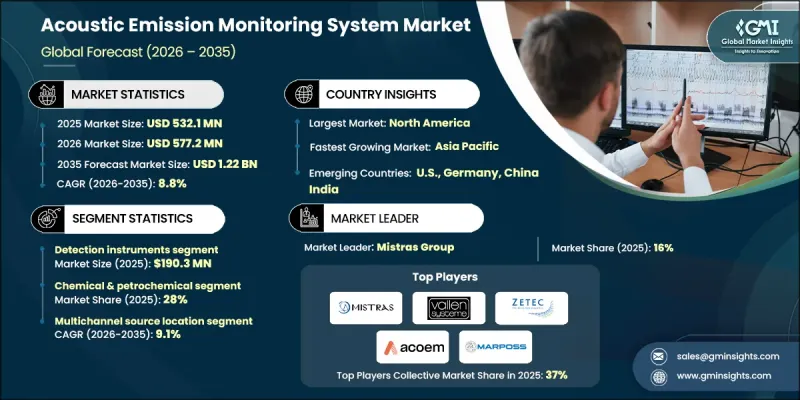
The market is expanding as industries increasingly adopt advanced monitoring solutions to ensure operational efficiency and structural integrity. Acoustic emission monitoring systems are becoming essential in sectors such as manufacturing, energy, aerospace, and construction, where real-time detection of structural anomalies is critical. Heightened safety regulations and compliance standards for infrastructure and industrial equipment are further driving the adoption of these technologies. Innovations in sensor design, data acquisition, and analytical software are improving system accuracy, enabling predictive maintenance and reducing unplanned downtime. The oil and gas sector is a major contributor to market growth, as operators require continuous monitoring of pipelines, storage units, and critical assets to prevent leaks and failures. Texas, a hub for energy investment, exemplifies regional adoption with billions directed toward renewable energy, storage, and infrastructure modernization. Overall, the convergence of technology, safety mandates, and industrial demand underpins robust market expansion across North America.
| Market Scope | |
|---|---|
| Start Year | 2025 |
| Forecast Year | 2026-2035 |
| Start Value | $532.1 Million |
| Forecast Value | $1.22 Billion |
| CAGR | 8.8% |
The detection instruments segment generated USD 190.3 million in 2025 and is projected to grow at a CAGR of 9.1% through 2035. These instruments are central to acoustic emission testing systems and are increasingly used for analyzing and diagnosing complex industrial equipment. Industries including oil and gas, construction, and power generation rely heavily on detection instruments to maintain operational safety and efficiency. Continuous technological advancements in instrument sensitivity and analytics have further strengthened their market position.
The multichannel source location segment is expected to grow at a CAGR of 9.1% from 2026 to 2035. Its ability to detect multiple acoustic emission sources simultaneously makes it highly valuable in complex industrial environments. Aerospace, automotive, and energy sectors are leveraging multichannel systems for accurate monitoring of intricate structures. Advanced computational algorithms are enhancing source identification, improving precision and reliability, which supports predictive maintenance and operational safety in critical infrastructure applications.
United States Acoustic Emission Monitoring System Market held 80% share, generating USD 172.3 million in 2025. The growth is fueled by the extensive adoption of advanced monitoring solutions across the oil and gas, aerospace, and manufacturing industries. Rising emphasis on predictive maintenance, efficiency, and adherence to stringent safety regulations is boosting market penetration. Strong presence of key market players and continuous investment in research and development are accelerating technological innovation and expanding market opportunities across the country.
Major players operating in the Global Acoustic Emission Monitoring System Market include Innerspec Technologies, Miratech, Zetec, GAOTek, Olympus, Mistras Group, Baker Hughes, RST Instruments, Qawrums, Liangui Technology, Marposs, Acoem, Hexagon Composites, NDT Systems, and Vallen Systeme. These companies compete through technology integration, product innovation, and comprehensive service offerings. Companies in the acoustic emission monitoring system market are strengthening their foothold through continuous investment in sensor innovation, advanced data analytics, and multichannel monitoring platforms. Strategic collaborations with industrial operators and engineering service providers enhance system deployment and integration. Firms are expanding after-sales services, including predictive maintenance support, technical training, and customized solutions for sector-specific applications. Market leaders are also focusing on software upgrades, cloud connectivity, and remote monitoring capabilities to improve operational efficiency.
Table of Contents
Chapter 1 Methodology and scope
- 1.1 Market scope and definition
- 1.2 Research design
- 1.2.1 Research approach
- 1.2.2 Data collection methods
- 1.3 Data mining sources
- 1.3.1 Global
- 1.3.2 Regional/country
- 1.4 Base estimates and calculations
- 1.4.1 Base year calculation
- 1.4.2 Key trends for market estimation
- 1.5 Primary research and validation
- 1.5.1 Primary sources
- 1.6 Forecast model
- 1.7 Research assumptions and limitations
Chapter 2 Executive summary
- 2.1 Industry 360° synopsis
- 2.2 Key market trends
- 2.2.1 Regional
- 2.2.2 Equipment Type
- 2.2.3 Testing Technology
- 2.2.4 Application
- 2.2.5 End Use Industry
- 2.2.6 Distribution Channel
- 2.3 CXO perspectives: strategic imperatives
- 2.3.1 Key decision points for industry executives
- 2.3.2 Critical success factors for market players
- 2.4 Future outlook and strategic recommendations
Chapter 3 Industry insights
- 3.1 Industry ecosystem analysis
- 3.1.1 Supplier landscape
- 3.1.2 Profit margin
- 3.1.3 Value addition at each stage
- 3.1.4 Factor affecting the value chain
- 3.2 Industry impact forces
- 3.2.1 Growth drivers
- 3.2.2 Industry pitfalls & challenges
- 3.2.3 Opportunities
- 3.3 Growth potential analysis
- 3.4 Future market trends
- 3.5 Technology and innovation landscape
- 3.5.1 Current technological trends
- 3.5.2 Emerging technologies
- 3.6 Price trends
- 3.6.1 By region
- 3.6.2 By Equipment Type
- 3.7 Regulatory landscape
- 3.7.1 Standards and compliance requirements
- 3.7.2 Regional regulatory frameworks
- 3.7.3 Certification standards
- 3.8 Porter’s analysis
- 3.9 PESTEL analysis
Chapter 4 Competitive landscape, 2025
- 4.1 Introduction
- 4.2 Company market share analysis
- 4.2.1 By region
- 4.2.1.1 North America
- 4.2.1.2 Europe
- 4.2.1.3 Asia Pacific
- 4.2.1.4 Latin America
- 4.2.1.5 MEA
- 4.2.1 By region
- 4.3 Company matrix analysis
- 4.4 Competitive analysis of major market players
- 4.5 Competitive positioning matrix
- 4.6 Key developments
- 4.6.1 Mergers & acquisitions
- 4.6.2 Partnerships & collaborations
- 4.6.3 New product launches
- 4.6.4 Expansion plans
Chapter 5 Market Estimates & Forecast, By Equipment Type, 2022 - 2035 ($Million, Thousand Units)
- 5.1 Key trends
- 5.2 Sensors
- 5.3 Amplifiers
- 5.4 Detection Instruments
- 5.5 Calibrators
- 5.6 Others (connectors, mounting accessories etc.)
Chapter 6 Market Estimates & Forecast, By Testing Technology, 2022 - 2035 ($Million, Thousand Units)
- 6.1 Key trends
- 6.2 Multichannel source location
- 6.3 Computed source location
- 6.4 Zone location
- 6.5 Others (point location etc.)
Chapter 7 Market Estimates & Forecast, By Application, 2022 - 2035 ($Million, Thousand Units)
- 7.1 Key trends
- 7.2 Pressure vessels
- 7.3 Storage tanks
- 7.4 Pipelines & piping systems
- 7.5 Aerospace structures
- 7.6 Civil infrastructure
- 7.7 Others (manufacturing equipment etc.)
Chapter 8 Market Estimates & Forecast, By End User Industry, 2022 - 2035 ($Million, Thousand Units)
- 8.1 Key trends
- 8.2 Oil & gas
- 8.3 Aerospace & defense
- 8.4 Energy & power
- 8.5 Construction & infrastructure
- 8.6 Chemical & petrochemical
- 8.7 Others (marine etc.)
Chapter 9 Market Estimates & Forecast, By Distribution Channel, 2022 - 2035 ($Million, Thousand Units)
- 9.1 Key trends
- 9.2 Direct sales
- 9.3 Indirect sales
Chapter 10 Market Estimates & Forecast, By Region, 2022 - 2035 ($Million, Thousand Units)
- 10.1 Key trends
- 10.2 North America
- 10.2.1 U.S.
- 10.2.2 Canada
- 10.3 Europe
- 10.3.1 Germany
- 10.3.2 UK
- 10.3.3 France
- 10.3.4 Spain
- 10.3.5 Italy
- 10.3.6 Netherlands
- 10.4 Asia Pacific
- 10.4.1 China
- 10.4.2 Japan
- 10.4.3 India
- 10.4.4 Australia
- 10.4.5 South Korea
- 10.5 Latin America
- 10.5.1 Brazil
- 10.5.2 Mexico
- 10.5.3 Argentina
- 10.6 MEA
- 10.6.1 South Africa
- 10.6.2 Saudi Arabia
- 10.6.3 UAE
Chapter 11 Company Profiles
- 11.1 Acoem
- 11.2 Baker Hughes
- 11.3 GAOTek
- 11.4 Hexagon Composites
- 11.5 Innerspec Technologies
- 11.6 Liangui Technology
- 11.7 Marposs
- 11.8 Miratech
- 11.9 Mistras Group
- 11.10 NDT Systems
- 11.11 Olympus
- 11.12 Qawrums
- 11.13 RST Instruments
- 11.14 Vallen Systeme
- 11.15 Zetec

