
PUBLISHER: Global Market Insights Inc. | PRODUCT CODE: 1959341

PUBLISHER: Global Market Insights Inc. | PRODUCT CODE: 1959341
Connected Car Security Market Opportunity, Growth Drivers, Industry Trend Analysis, and Forecast 2026 - 2035
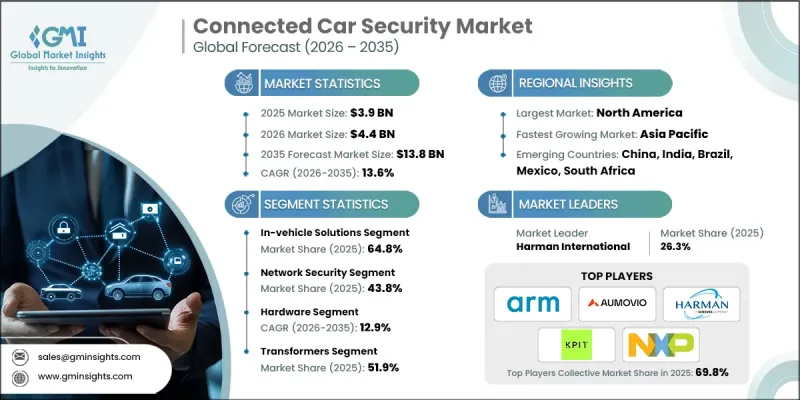
The Global Connected Car Security Market was valued at USD 3.9 billion in 2025 and is estimated to grow at a CAGR of 13.6% to reach USD 13.8 billion by 2035.
The rapid adoption of connected car technologies has created an urgent need for robust cybersecurity across vehicle ecosystems, fleet management platforms, and cloud-connected services. Automakers and enterprises are increasingly embedding security features directly into vehicle electronic architectures, backend servers, and cloud platforms to reduce operational risks and reliance on manual monitoring. Continuous advancements in edge AI processors, V2X communications, and vehicle software platforms are enhancing the performance, scalability, and responsiveness of security solutions. Real-time intrusion detection, secure data exchange, and over-the-air updates are becoming standard to protect large vehicle fleets. Strategic alliances, mergers, and collaborations among automotive OEMs, cybersecurity providers, and cloud operators are accelerating the integration of security into the vehicle lifecycle, fleet operations, and mobility services. Connected car security is evolving from conventional monitoring to AI-powered, proactive threat analysis systems that safeguard software-defined vehicles and mobility platforms.
| Market Scope | |
|---|---|
| Start Year | 2025 |
| Forecast Year | 2026-2035 |
| Start Value | $3.9 Billion |
| Forecast Value | $13.8 Billion |
| CAGR | 13.6% |
The In-vehicle solutions segment held 64.8% share in 2025 and is expected to grow at a CAGR of 12.1% through 2035. These solutions provide embedded security across electronic control units, domain controllers, telematics modules, and infotainment systems, enabling real-time monitoring, intrusion prevention, and secure communications. OEMs prioritize in-vehicle security to meet regulatory and safety standards while ensuring vehicle systems are resilient to cyberattacks.
The network security segment accounted for 43.8% share in 2025 and is projected to grow at a CAGR of 12.8% from 2026 to 2035. Network security safeguards vehicle communication networks, in-vehicle data buses, and cloud connections against cyber threats, providing robust protocols, real-time monitoring, and breach mitigation. It remains a critical requirement for OEMs, fleet operators, and mobility service providers to maintain system integrity.
US Connected Car Security Market generated USD 1.4 billion in 2025, and continues to grow as automakers, fleet operators, and technology firms invest in advanced cybersecurity platforms. Companies deploy integrated hardware and software solutions to protect telematics, V2X communications, and in-vehicle networks, ensuring compliance with safety and regulatory requirements for both internal combustion and electric vehicles.
Leading players in the Global Connected Car Security Market include ARM, AUMOVIO, BlackBerry, Harman International, Intertek, Keysight Technologies, KPIT Technologies, NXP Semiconductors, Secunet Security Networks, and Thales. Companies in the Global Connected Car Security Market are strengthening their foothold by investing in AI-powered intrusion detection, over-the-air threat management, and secure vehicle software stacks. They are forming strategic partnerships with OEMs, mobility service providers, and cloud vendors to integrate security across vehicle lifecycles and connected platforms. Firms are prioritizing R&D for edge AI, V2X protection, and secure telematics modules while expanding global deployment of security solutions. Emphasis is placed on compliance with automotive cybersecurity regulations, predictive threat intelligence, and real-time network monitoring.
Table of Contents
Chapter 1 Methodology
- 1.1 Research approach
- 1.2 Quality commitments
- 1.2.1 GMI AI policy & data integrity commitment
- 1.3 Research trail & confidence scoring
- 1.3.1 Research trail components
- 1.3.2 Scoring components
- 1.4 Data collection
- 1.4.1 Partial list of primary sources
- 1.5 Data mining sources
- 1.5.1 Paid sources
- 1.6 Base estimates and calculations
- 1.6.1 Base year calculation
- 1.7 Forecast model
- 1.8 Research transparency addendum
Chapter 2 Executive Summary
- 2.1 Industry 360° synopsis
- 2.2 Key market trends
- 2.2.1 Regional
- 2.2.2 Security
- 2.2.3 Form
- 2.2.4 Solution
- 2.2.5 Vehicle
- 2.2.6 Propulsion
- 2.2.7 Application
- 2.3 TAM analysis, 2026-2035
- 2.4 CXO perspectives: Strategic imperatives
- 2.4.1 Executive decision points
- 2.4.2 Critical success factors
- 2.5 Future outlook
- 2.6 Strategic recommendations
Chapter 3 Industry Insights
- 3.1 Industry ecosystem analysis
- 3.1.1 Supplier landscape
- 3.1.2 Profit margin
- 3.1.3 Cost structure
- 3.1.4 Value addition at each stage
- 3.1.5 Factor affecting the value chain
- 3.1.6 Disruptions
- 3.2 Industry impact forces
- 3.2.1 Growth drivers
- 3.2.1.1 Rising adoption of connected and software-defined vehicles
- 3.2.1.2 Increasing cybersecurity threats targeting automotive systems
- 3.2.1.3 Regulatory mandates and safety standards
- 3.2.1.4 Growth of electric, autonomous, and shared mobility vehicles
- 3.2.2 Industry pitfalls and challenges
- 3.2.2.1 Complexity of securing heterogeneous vehicle architectures
- 3.2.2.2 Data privacy and cross-border regulatory compliance issues
- 3.2.3 Market opportunities
- 3.2.3.1 Integration of security into vehicle software platforms and OTA ecosystems
- 3.2.3.2 Expansion of V2X, 5G, and cloud-based vehicle services
- 3.2.3.3 Rising adoption of hardware-based security solutions
- 3.2.3.4 Growing focus on autonomous driving and ADAS security
- 3.2.1 Growth drivers
- 3.3 Growth potential analysis
- 3.4 Regulatory landscape
- 3.4.1 North America
- 3.4.1.1 National Highway Traffic Safety Administration (NHTSA)
- 3.4.1.2 U.S. Department of Commerce / Bureau of Industry and Security (BIS)
- 3.4.1.3 Federal Trade Commission (FTC)
- 3.4.2 Europe
- 3.4.2.1 UNECE WP.29 Regulations (UN R155 & R156)
- 3.4.2.2 EN / ISO Automotive Standards
- 3.4.3 Asia Pacific
- 3.4.3.1 China National Standards for Vehicle Cybersecurity
- 3.4.3.2 India Automotive Standards (AIS 189 & AIS 190)
- 3.4.4 Latin America
- 3.4.4.1 Brazil: LGPD (Lei Geral de Protecao de Dados)
- 3.4.4.2 Mexico: NOM Standards
- 3.4.5 Middle East & Africa
- 3.4.5.1 UAE & Gulf States: IoT & V2X Security Policy
- 3.4.5.2 Saudi Arabia: SDAIA Automotive AI Framework
- 3.4.5.3 African Union (AU): Data Policy Framework
- 3.4.1 North America
- 3.5 Porter’s analysis
- 3.6 PESTEL analysis
- 3.7 Technology and innovation landscape
- 3.7.1 Current technological trends
- 3.7.2 Emerging technologies
- 3.8 Pricing trend analysis
- 3.9 Patent analysis
- 3.10 Sustainability and environmental aspects
- 3.10.1 Sustainable practices
- 3.10.2 Energy efficiency in production
- 3.10.3 Carbon footprint considerations
- 3.11 Data Governance, Cybersecurity, and Model Risk
- 3.11.1 Data Privacy and Compliance
- 3.11.2 Model Security
- 3.11.3 Operational and Systemic Risks
- 3.12 Security Architecture
- 3.12.1 Multi-layer Security Models
- 3.12.2 Vehicle-to-Everything (V2X) Security
Chapter 4 Competitive Landscape, 2025
- 4.1 Introduction
- 4.2 Company market share analysis
- 4.2.1 North America
- 4.2.2 Europe
- 4.2.3 Asia Pacific
- 4.2.4 LATAM
- 4.2.5 MEA
- 4.3 Competitive analysis of major market players
- 4.4 Competitive positioning matrix
- 4.5 Strategic outlook matrix
- 4.6 Key developments
- 4.6.1 Mergers & acquisitions
- 4.6.2 Partnerships & collaborations
- 4.6.3 New product launches
- 4.6.4 Expansion plans and funding
Chapter 5 Market Estimates & Forecast, By Security, 2022 - 2035 ($Mn)
- 5.1 Key trends
- 5.2 Endpoint security
- 5.3 Application security
- 5.4 Network security
- 5.5 Cloud security
Chapter 6 Market Estimates & Forecast, By Form, 2022 - 2035 ($Mn)
- 6.1 Key trends
- 6.2 In-Vehicle Solutions
- 6.3 External Cloud Services
Chapter 7 Market Estimates & Forecast, By Solution, 2022 - 2035 ($Mn)
- 7.1 Key trends
- 7.2 Software
- 7.3 Hardware
- 7.3.1 Hardware security modules (HSM)
- 7.3.2 Secure microcontrollers
- 7.3.3 Trusted platform modules (TPM)
- 7.3.4 Secure gateways
- 7.3.5 Others
Chapter 8 Market Estimates & Forecast, By Vehicle, 2022 - 2035 ($Mn)
- 8.1 Key trends
- 8.2 Hatchback
- 8.3 Sedan
- 8.4 SUV
Chapter 9 Market Estimates & Forecast, By Propulsion, 2022 - 2035 ($Mn)
- 9.1 Key trends
- 9.2 Internal combustion engine (ICE)
- 9.3 Electric vehicle
- 9.3.1 Battery electric vehicle (BEV)
- 9.3.2 Plug-in hybrid electric vehicle (PHEV)
- 9.3.3 Hybrid electric vehicle (HEV)
- 9.3.4 Fuel cell electric vehicle (FCEV)
Chapter 10 Market Estimates & Forecast, By Application, 2022 - 2035 ($Mn)
- 10.1 Key trends
- 10.2 Telematics control units (TCUS)
- 10.3 Infotainment systems
- 10.4 Adas & autonomous driving systems
- 10.5 Communication modules
- 10.6 Others
Chapter 11 Market Estimates & Forecast, By Region, 2022 - 2035 ($Mn)
- 11.1 Key trends
- 11.2 North America
- 11.2.1 US
- 11.2.2 Canada
- 11.3 Europe
- 11.3.1 Germany
- 11.3.2 UK
- 11.3.3 France
- 11.3.4 Italy
- 11.3.5 Spain
- 11.3.6 Nordics
- 11.3.7 Russia
- 11.3.8 Norway
- 11.3.9 Denmark
- 11.3.10 Netherlands
- 11.3.11 Belgium
- 11.4 Asia Pacific
- 11.4.1 China
- 11.4.2 India
- 11.4.3 Japan
- 11.4.4 South Korea
- 11.4.5 ANZ
- 11.4.6 Vietnam
- 11.4.7 Indonesia
- 11.4.8 Singapore
- 11.4.9 Malaysia
- 11.4.10 Thailand
- 11.5 Latin America
- 11.5.1 Brazil
- 11.5.2 Mexico
- 11.5.3 Argentina
- 11.6 MEA
- 11.6.1 South Africa
- 11.6.2 Saudi Arabia
- 11.6.3 UAE
Chapter 12 Company Profiles
- 12.1 Global companies
- 12.1.1 BlackBerry
- 12.1.2 NXP Semiconductors
- 12.1.3 Harman International
- 12.1.4 Thales
- 12.1.5 ARM
- 12.1.6 Trend Micro
- 12.1.7 Keysight Technologies
- 12.1.8 Intertek
- 12.1.9 T-Systems International
- 12.1.10 KPIT Technologies
- 12.1.11 Tata Elxsi
- 12.2 Regional players
- 12.2.1 AUMOVIO
- 12.2.2 Vector Informatik
- 12.2.3 ETAS
- 12.2.4 ASTEMO
- 12.2.5 Autocrypt
- 12.2.6 Secunet Security Networks
- 12.2.7 Trustonic
- 12.2.8 Device Authority
- 12.2.9 WirelessCar
- 12.3 Emerging players
- 12.3.1 Upstream Security
- 12.3.2 Trillium Secure
- 12.3.3 Karamba Security
- 12.3.4 Intertrust Technologies
- 12.3.5 GuardKnox

