PUBLISHER: Global Market Insights Inc. | PRODUCT CODE: 1959545

PUBLISHER: Global Market Insights Inc. | PRODUCT CODE: 1959545
Cargo Scanning Equipment Market Opportunity, Growth Drivers, Industry Trend Analysis, and Forecast 2026 - 2035
The Global Cargo Scanning Equipment Market was valued at USD 4.05 billion in 2025 and is estimated to grow at a CAGR of 7.7% to reach USD 8.37 billion by 2035.
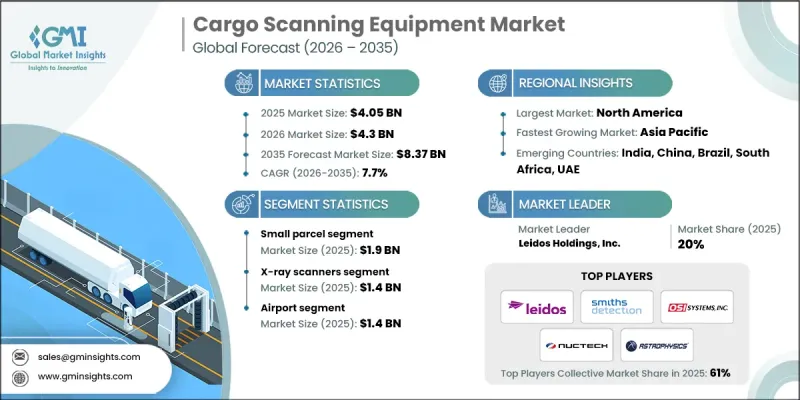
The market is driven by the rapid growth in global trade, surging containerized cargo volumes, and rising security concerns worldwide. Governments and transport authorities are increasingly enforcing stricter customs, border control, and port security regulations, pushing the adoption of advanced imaging technologies such as 3D X-ray and computed tomography (CT) scanners. Integration of artificial intelligence and automation in cargo inspection is further accelerating market growth by enhancing accuracy, reducing human error, and increasing throughput. As security threats evolve, authorities are investing heavily in next-generation scanning systems capable of detecting sophisticated concealment methods, protecting critical infrastructure, and ensuring public safety. The shift toward proactive risk management, supported by enhanced data analytics and real-time monitoring, continues to drive demand for technology-driven, high-performance cargo scanning solutions globally.
| Market Scope | |
|---|---|
| Start Year | 2025 |
| Forecast Year | 2026-2035 |
| Start Value | $4.05 Billion |
| Forecast Value | $8.37 Billion |
| CAGR | 7.7% |
The small parcel segment reached USD 1.9 billion in 2025. Rapid growth in e-commerce has created an urgent need for fast, non-intrusive screening of small packages to ensure timely deliveries while maintaining regulatory compliance. The rising risk of contraband, prohibited items, and illegal substances in small shipments has compelled logistics and postal service providers to adopt automated, high-throughput scanning systems. Equipment manufacturers are focusing on developing compact, high-speed scanning solutions optimized for last-mile distribution hubs and high-volume parcel sorting centers. These systems must provide reliable detection without slowing operational efficiency, while also ensuring minimal disruption to supply chain operations.
The X-ray scanners segment accounted for USD 1.4 billion in 2025. Airports, seaports, and customs authorities are increasingly deploying advanced X-ray scanners to perform rapid, non-intrusive inspections of diverse cargo types. Technological improvements in multi-view and 3D X-ray imaging have enhanced detection accuracy, reduced false positives, and increased operator efficiency. Manufacturers are investing in high-resolution X-ray systems equipped with automated threat detection capabilities, enabling seamless inspection of containers, pallets, and bulk cargo without compromising throughput or security standards.
North America Cargo Scanning Equipment Market held 33.9% share in 2025 due to high trade volumes, advanced port and border infrastructure, and strict regulatory frameworks. Customs and homeland security agencies employ comprehensive screening protocols across maritime ports, airports, and land borders, creating steady demand for automated, high throughput scanning equipment with superior threat detection capabilities. North American authorities are increasingly integrating AI-driven imaging and analytics to support risk-based cargo inspections, allowing faster clearance while maintaining robust security standards. The region continues to set benchmarks for innovation and efficiency in cargo screening operations.
Key players in the Global Cargo Scanning Equipment Market include Autoclear LLC, OSI Systems, Smiths Detection Group Ltd., Astrophysics, Inc., Gilardoni S.p.A., LINEV Systems, TODD Research, Leidos Holdings, Inc., CEIA, Braun & Co. Limited, Nuctech Company Limited, and Westminster Group Plc. Companies in the cargo scanning equipment market are pursuing several strategies to strengthen their market presence. Continuous innovation in imaging technologies, such as 3D and CT scanners with AI-assisted threat detection, is a core focus. Firms are forming strategic partnerships with ports, airports, and logistics providers to expand deployment and service networks. Investment in research and development enhances system reliability, speed, and accuracy to meet evolving regulatory requirements. Manufacturers are also emphasizing modular, scalable systems to accommodate different cargo sizes and inspection environments.
Table of Contents
Chapter 1 Methodology and Scope
- 1.1 Market scope and definition
- 1.2 Research design
- 1.2.1 Research approach
- 1.2.2 Data collection methods
- 1.3 Data mining sources
- 1.3.1 Global
- 1.3.2 Regional/Country
- 1.4 Base estimates and calculations
- 1.4.1 Base year calculation
- 1.4.2 Key trends for market estimation
- 1.5 Primary research and validation
- 1.5.1 Primary sources
- 1.6 Forecast model
- 1.7 Research assumptions and limitations
Chapter 2 Executive Summary
- 2.1 Industry 360° synopsis
- 2.2 Key market trends
- 2.2.1 Equipment type trends
- 2.2.2 Cargo size trends
- 2.2.3 End-use trends
- 2.2.4 Regional trends
- 2.3 TAM Analysis, 2026 - 2035 (USD Million)
- 2.4 CXO perspectives: Strategic imperatives
- 2.4.1 Executive decision points
- 2.4.2 Critical success factors
- 2.5 Future outlook and strategic recommendations
Chapter 3 Industry Insights
- 3.1 Industry ecosystem analysis
- 3.1.1 Supplier landscape
- 3.1.2 Profit margin
- 3.1.3 Cost structure
- 3.1.4 Value addition at each stage
- 3.1.5 Factor affecting the value chain
- 3.1.6 Disruptions
- 3.2 Industry impact forces
- 3.2.1 Growth drivers
- 3.2.1.1 Rising global trade and containerized cargo volumes
- 3.2.1.2 Increasing security threats and smuggling activities
- 3.2.1.3 Stricter customs, border control, and port security regulations
- 3.2.1.4 Adoption of advanced imaging technologies (CT, 3D x-ray)
- 3.2.1.5 Integration of AI and automation in cargo inspection
- 3.2.2 Pitfalls and challenges
- 3.2.2.1 High capital and maintenance costs of scanning systems
- 3.2.2.2 Operational complexity and skilled workforce requirements
- 3.2.1 Growth drivers
- 3.3 Growth potential analysis
- 3.4 Regulatory landscape
- 3.4.1 North America
- 3.4.2 Europe
- 3.4.3 Asia Pacific
- 3.4.4 Latin America
- 3.4.5 Middle East & Africa
- 3.5 Porter's analysis
- 3.6 PESTEL analysis
- 3.7 Technology and Innovation landscape
- 3.7.1 Current technological trends
- 3.7.2 Emerging technologies
- 3.8 Emerging Business Models
- 3.9 Compliance Requirements
- 3.10 Supply Chain Resilience
- 3.11 Geopolitical Analysis
- 3.12 Workforce Analysis
- 3.13 Digital Transformation
- 3.14 Mergers, Acquisitions, and Strategic Partnerships Landscape
- 3.15 Risk Assessment and Management
- 3.16 Major Contract Awards (2022 - 2025)
Chapter 4 Competitive Landscape, 2025
- 4.1 Introduction
- 4.2 Company market share analysis
- 4.2.1 By region
- 4.2.1.1 North America
- 4.2.1.2 Europe
- 4.2.1.3 Asia Pacific
- 4.2.1.4 Latin America
- 4.2.1.5 Middle East & Africa
- 4.2.2 Market concentration analysis
- 4.2.1 By region
- 4.3 Competitive benchmarking of key players
- 4.3.1 Product portfolio comparison
- 4.3.1.1 Product range breadth
- 4.3.1.2 Technology
- 4.3.1.3 Innovation
- 4.3.2 Geographic presence comparison
- 4.3.2.1 Global footprint analysis
- 4.3.2.2 Service network coverage
- 4.3.2.3 Market penetration by region
- 4.3.3 Competitive positioning matrix
- 4.3.3.1 Leaders
- 4.3.3.2 Challengers
- 4.3.3.3 Followers
- 4.3.3.4 Niche players
- 4.3.4 Strategic outlook matrix
- 4.3.1 Product portfolio comparison
- 4.4 Key developments, 2022-2025
- 4.4.1 Mergers and acquisitions
- 4.4.2 Partnerships and collaborations
- 4.4.3 Technological advancements
- 4.4.4 Expansion and investment strategies
- 4.4.5 Sustainability initiatives
- 4.4.6 Digital transformation initiatives
- 4.5 Emerging/ startup competitors landscape
Chapter 5 Market Estimates and Forecast, By Equipment Type, 2022 - 2035 (USD Million)
- 5.1 Key trends
- 5.2 Narcotics Trace Detectors
- 5.3 Non-computed Tomography
- 5.4 X-ray Scanners
- 5.5 Explosive Trace Detectors (ETDs)
- 5.6 Radiation Detectors
- 5.7 Others
Chapter 6 Market Estimates and Forecast, By Cargo Size, 2022 - 2035 (USD Million)
- 6.1 Key trends
- 6.2 Small Parcels
- 6.3 Break Pallet Cargo
- 6.4 Oversized Cargo
Chapter 7 Market Estimates and Forecast, By End-Use, 2022 - 2035 (USD Million)
- 7.1 Key Trends
- 7.2 Airports
- 7.3 Railway Station
- 7.4 Border Control
- 7.5 Logistics and Transportation
- 7.6 Industrial and Manufacturing facilities
- 7.7 Others
Chapter 8 Market Estimates and Forecast, By Region, 2022 - 2035 (USD Million)
- 8.1 Key trends
- 8.2 North America
- 8.2.1 U.S.
- 8.2.2 Canada
- 8.3 Europe
- 8.3.1 Germany
- 8.3.2 UK
- 8.3.3 France
- 8.3.4 Spain
- 8.3.5 Italy
- 8.3.6 Netherlands
- 8.4 Asia Pacific
- 8.4.1 China
- 8.4.2 India
- 8.4.3 Japan
- 8.4.4 Australia
- 8.4.5 South Korea
- 8.5 Latin America
- 8.5.1 Brazil
- 8.5.2 Mexico
- 8.5.3 Argentina
- 8.6 Middle East and Africa
- 8.6.1 Saudi Arabia
- 8.6.2 South Africa
- 8.6.3 UAE
Chapter 9 Company Profiles
- 9.1 Global Key Players
- 9.1.1 OSI Systems
- 9.1.2 Smiths Detection Group Ltd.
- 9.1.3 Leidos Holdings, Inc.
- 9.1.4 Nuctech Company Limited
- 9.2 Regional Key Players
- 9.2.1 North America
- 9.2.1.1 Astrophysics, Inc.
- 9.2.1.2 Autoclear LLC
- 9.2.1.3 TODD Research
- 9.2.2 Europe
- 9.2.2.1 CEIA
- 9.2.2.2 Gilardoni S.p.A.
- 9.2.2.3 Braun & Co. Limited
- 9.2.3 Asia Pacific
- 9.2.3.1 LINEV Systems
- 9.2.1 North America
- 9.3 Niche / Disruptors
- 9.3.1 Westminster Group Plc

