
PUBLISHER: Global Market Insights Inc. | PRODUCT CODE: 1959547

PUBLISHER: Global Market Insights Inc. | PRODUCT CODE: 1959547
Gesture Recognition Market Opportunity, Growth Drivers, Industry Trend Analysis, and Forecast 2026 - 2035
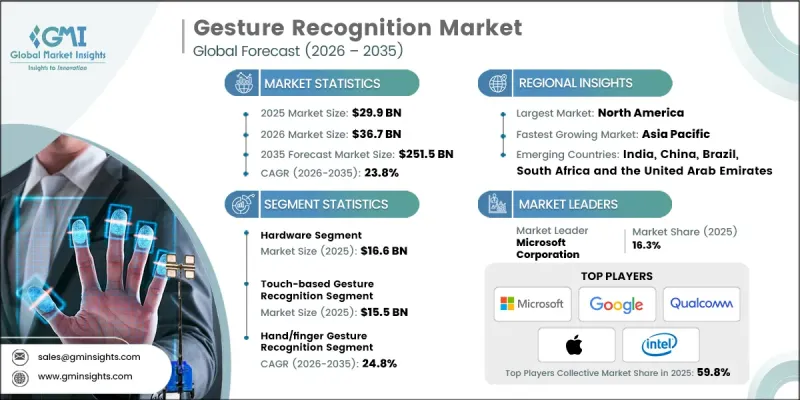
The Global Gesture Recognition Market was valued at USD 29.9 billion in 2025 and is estimated to grow at a CAGR of 23.8% to reach USD 251.5 billion in 2035.
Market growth is driven by the rising preference for touchless interaction, the growth of smart retail and digital stores, advancements in computer vision and artificial intelligence, and increased deployment of camera and surveillance infrastructure. Organizations and governments are prioritizing non-contact operations to enhance public health and safety, which accelerated demand during the COVID-19 pandemic. Gesture recognition technology supports touch-free kiosks, digital signage, and service counters, minimizing physical contact in public spaces. Governments are integrating these solutions into smart public infrastructure, while AI and automation are central to national digital transformation agendas, encouraging both research adoption and commercialization. Increasing use in sectors like healthcare, retail, education, and automotive is fueling demand for advanced gesture-based human-machine interfaces.
| Market Scope | |
|---|---|
| Start Year | 2025 |
| Forecast Year | 2026-2035 |
| Start Value | $29.9 Billion |
| Forecast Value | $251.5 Billion |
| CAGR | 23.8% |
The hardware segment reached USD 16.6 billion in 2025, fueled by the increasing demand for high-precision sensors, cameras, and motion detectors across gaming, augmented reality (AR), virtual reality (VR), and automotive applications. Vendors are focusing on developing durable and accurate hardware to meet rising expectations in consumer electronics and smart home technologies. As gesture recognition becomes more integrated into everyday devices, including smart appliances, wearables, and in-vehicle systems, hardware adoption is expected to rise sharply. Companies are investing in sensor miniaturization, rugged designs, and improved accuracy to serve the expanding AR/VR and automotive markets.
The touch-based gesture recognition segment accounted for USD 15.5 billion in 2025. Widespread adoption of touchscreen-enabled devices such as smartphones, tablets, kiosks, and industrial control panels is driving demand for precise and intuitive touch-based interaction systems. This technology enhances the usability of gaming consoles, ATMs, automotive dashboards, and consumer electronics, improving user experience and engagement. Manufacturers are concentrating on improving sensor responsiveness, durability, and cost-effectiveness while ensuring accuracy for both industrial and consumer applications. Touch-based interfaces are becoming a standard feature across devices, fueling adoption globally and increasing the integration of gesture recognition across digital ecosystems.
North America Gesture Recognition Market held 33.5% share in 2025. The region benefits from strong digital infrastructure, early AI adoption, and active collaboration between research institutions, technology providers, and commercial enterprises. Retailers, commercial spaces, and smart public infrastructure increasingly deploy gesture-based systems to improve engagement and operational efficiency. North America also emphasizes privacy-focused AI and edge computing, enabling solutions that comply with stringent regulatory requirements while maintaining high accuracy and performance. Government support for AI-driven technology development further accelerates the adoption and commercialization of gesture recognition solutions in both enterprise and consumer segments.
Leading players in the Global Gesture Recognition Market include Apple Inc., Crunchfish, Elliptic Labs, EyeSight Technologies, GestureTek, Google LLC, Infineon, Intel Corporation, Leap Motion (UltraHaptics), ManoMotion, Microchip Technology Inc., Microsoft Corporation, Pyreos, Qualcomm Technologies, Inc., SoftKinetic (Sony Depthsensing Solutions), and Synaptics Incorporated. Companies in the Global Gesture Recognition Market are strengthening their presence by investing heavily in R&D to enhance sensor precision, reduce latency, and improve AI-driven gesture interpretation. Strategic collaborations with AR/VR, automotive, and consumer electronics firms allow technology providers to integrate solutions across multiple platforms. Firms are also focusing on expanding distribution channels, entering emerging markets, and delivering customized solutions for specific industry needs. Continuous hardware optimization, software platform updates, and edge computing integration enhance performance while maintaining cost efficiency.
Table of Contents
Chapter 1 Methodology and Scope
- 1.1 Market scope and definition
- 1.2 Research design
- 1.2.1 Research approach
- 1.2.2 Data collection methods
- 1.3 Data mining sources
- 1.3.1 Global
- 1.3.2 Regional/Country
- 1.4 Base estimates and calculations
- 1.4.1 Base year calculation
- 1.4.2 Key trends for market estimation
- 1.5 Primary research and validation
- 1.5.1 Primary sources
- 1.6 Forecast model
- 1.7 Research assumptions and limitations
Chapter 2 Executive Summary
- 2.1 Industry 360° synopsis
- 2.2 Key market trends
- 2.2.1 Component trends
- 2.2.2 Technology trends
- 2.2.3 Type trends
- 2.2.4 Authentication type trends
- 2.2.5 Application trends
- 2.2.6 End-use industry trends
- 2.2.7 Regional trends
- 2.3 TAM Analysis, 2026 - 2035 (USD Million)
- 2.4 CXO perspectives: Strategic imperatives
Chapter 3 Industry Insights
- 3.1 Industry ecosystem analysis
- 3.1.1 Supplier landscape
- 3.1.2 Profit margin
- 3.1.3 Cost structure
- 3.1.4 Value addition at each stage
- 3.1.5 Factor affecting the value chain
- 3.1.6 Disruptions
- 3.2 Industry impact forces
- 3.2.1 Growth drivers
- 3.2.1.1 Rising demand for touchless interaction
- 3.2.1.2 Growth of smart retail and digital stores
- 3.2.1.3 Advancements in computer vision and artificial intelligence
- 3.2.1.4 Increased use of surveillance and camera infrastructure
- 3.2.1.5 Rising focus on customer behavior analytics
- 3.2.2 Pitfalls and challenges
- 3.2.2.1 Privacy and ethical concerns
- 3.2.2.2 High computational and implementation cost
- 3.2.1 Growth drivers
- 3.3 Growth potential analysis
- 3.4 Regulatory landscape
- 3.4.1 North America
- 3.4.2 Europe
- 3.4.3 Asia Pacific
- 3.4.4 Latin America
- 3.4.5 Middle East & Africa
- 3.5 Porter’s analysis
- 3.6 PESTEL analysis
- 3.7 Technology and Innovation landscape
- 3.7.1 Current technological trends
- 3.7.2 Emerging technologies
- 3.8 Emerging Business Models
- 3.9 Compliance Requirements
- 3.10 Supply Chain Resilience
- 3.11 Geopolitical Analysis
Chapter 4 Competitive Landscape, 2025
- 4.1 Introduction
- 4.2 Company market share analysis
- 4.2.1 By region
- 4.2.1.1 North America
- 4.2.1.2 Europe
- 4.2.1.3 Asia Pacific
- 4.2.1.4 Latin America
- 4.2.1.5 Middle East & Africa
- 4.2.2 Market concentration analysis
- 4.2.1 By region
- 4.3 Competitive benchmarking of key players
- 4.3.1 Product portfolio comparison
- 4.3.1.1 Product range breadth
- 4.3.1.2 Technology
- 4.3.1.3 Innovation
- 4.3.2 Geographic presence comparison
- 4.3.2.1 Global footprint analysis
- 4.3.2.2 Service network coverage
- 4.3.2.3 Market penetration by region
- 4.3.3 Competitive positioning matrix
- 4.3.3.1 Leaders
- 4.3.3.2 Challengers
- 4.3.3.3 Followers
- 4.3.3.4 Niche players
- 4.3.1 Product portfolio comparison
- 4.4 Key developments, 2022-2025
- 4.4.1 Mergers and acquisitions
- 4.4.2 Partnerships and collaborations
- 4.4.3 Technological advancements
- 4.4.4 Expansion and investment strategies
- 4.4.5 Sustainability initiatives
- 4.4.6 Digital transformation initiatives
- 4.5 Emerging/ startup competitors landscape
Chapter 5 Market Estimates and Forecast, By Component, 2022 - 2035 (USD Million)
- 5.1 Key trends
- 5.2 Hardware
- 5.2.1 Sensors
- 5.2.2 Cameras
- 5.2.3 Controllers
- 5.2.4 Others
- 5.3 Software
Chapter 6 Market Estimates and Forecast, By Technology, 2022 - 2035 (USD Million)
- 6.1 Key trends
- 6.2 Touch-based gesture recognition
- 6.2.1 Multi-touch system
- 6.2.2 Motion sensors
- 6.3 Touchless gesture recognition
- 6.3.1 Ultrasonic
- 6.3.2 Infrared
- 6.3.3 Capacitive/electric field
- 6.3.4 2D cameras
- 6.3.5 3D cameras
- 6.3.6 Voice recognition
- 6.3.7 Others
Chapter 7 Market Estimates and Forecast, By Type, 2022 - 2035 (USD Million)
- 7.1 Key Trends
- 7.2 Hand/finger gesture recognition
- 7.3 Facial gesture recognition
- 7.4 Voice gesture recognition
- 7.5 Eye movement gesture recognition
- 7.6 Body movement gesture recognition
Chapter 8 Market Estimates and Forecast, By Authentication, 2022 - 2035 (USD Million)
- 8.1 Key Trends
- 8.2 Single-factor authentication
- 8.3 Multi-factor authentication
Chapter 9 Market Estimates and Forecast, By End-Use Industry, 2022 - 2035 (USD Million)
- 9.1 Key Trends
- 9.2 Automotive
- 9.2.1 Lighting system
- 9.2.2 HUD
- 9.2.3 Biometric access
- 9.2.4 Others
- 9.3 Consumer electronics
- 9.3.1 Smartphone
- 9.3.2 Laptops & tablets
- 9.3.3 Gaming console
- 9.3.4 Smart TV
- 9.3.5 Set-top box
- 9.3.6 Head-mount display (HMD)
- 9.3.7 Others
- 9.4 Healthcare
- 9.4.1 Sign language
- 9.4.2 Lab & operating rooms
- 9.4.3 Diagnosis
- 9.4.4 Others
- 9.5 Advertisement & communication
- 9.6 Hospitality
- 9.7 Others
Chapter 10 Market Estimates and Forecast, By Region, 2022 - 2035 (USD Million)
- 10.1 Key trends
- 10.2 North America
- 10.2.1 U.S.
- 10.2.2 Canada
- 10.3 Europe
- 10.3.1 Germany
- 10.3.2 UK
- 10.3.3 France
- 10.3.4 Spain
- 10.3.5 Italy
- 10.3.6 Netherlands
- 10.4 Asia Pacific
- 10.4.1 China
- 10.4.2 India
- 10.4.3 Japan
- 10.4.4 Australia
- 10.4.5 South Korea
- 10.5 Latin America
- 10.5.1 Brazil
- 10.5.2 Mexico
- 10.5.3 Argentina
- 10.6 Middle East and Africa
- 10.6.1 Saudi Arabia
- 10.6.2 South Africa
- 10.6.3 UAE
Chapter 11 Company Profiles
- 11.1 Global Key Players
- 11.1.1 Apple Inc.
- 11.1.2 Google LLC
- 11.1.3 Microsoft Corporation
- 11.1.4 Intel Corporation
- 11.1.5 Qualcomm Technologies, Inc.
- 11.2 Regional Key Players
- 11.2.1 North America
- 11.2.1.1 Microchip Technology Inc.
- 11.2.1.2 Synaptics Incorporated
- 11.2.1.3 GestureTek
- 11.2.2 Europe
- 11.2.2.1 Crunchfish
- 11.2.2.2 Elliptic Labs
- 11.2.2.3 Pyreos
- 11.2.3 Asia Pacific
- 11.2.3.1 Infineon
- 11.2.3.2 EyeSight Technologies
- 11.2.3.3 SoftKinetic (Sony Depthsensing Solutions)
- 11.2.1 North America
- 11.3 Niche / Disruptors
- 11.3.1 Leap Motion (UltraHaptics)
- 11.3.2 ManoMotion

