
PUBLISHER: Global Market Insights Inc. | PRODUCT CODE: 1959548

PUBLISHER: Global Market Insights Inc. | PRODUCT CODE: 1959548
Crystal Oscillator Market Opportunity, Growth Drivers, Industry Trend Analysis, and Forecast 2026 - 2035
The Global Crystal Oscillator Market was valued at USD 3.2 billion in 2025 and is estimated to grow at a CAGR of 3.5% to reach USD 4.5 billion in 2035.
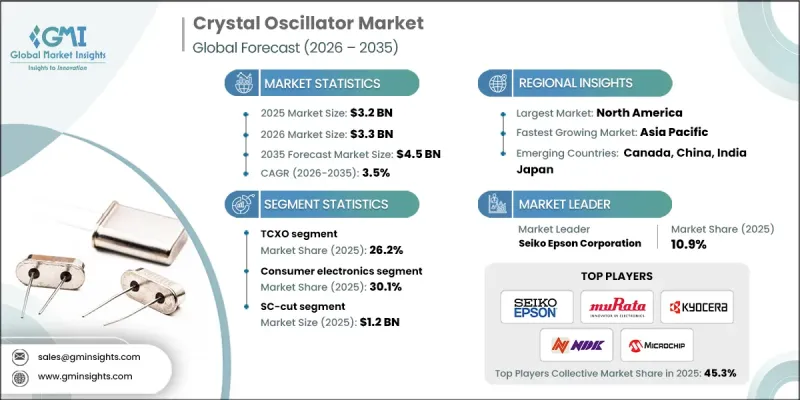
Market expansion is driven by the growing demand for high-frequency stability in RF circuits and the increasing deployment of temperature-compensated (TCXO) and oven-controlled crystal oscillators (OCXO) in telecommunications equipment. The automotive sector is also a significant contributor, as temperature-stable oscillators are increasingly integrated into electronic control units (ECUs) to support advanced driver-assistance systems (ADAS), infotainment, and powertrain management. The need for precise clock synchronization in base stations and low phase-noise oscillators in networking equipment is further propelling market growth. Advancements in ultra-miniaturized crystal packaging enable the development of thinner, lighter electronic devices, while the trend of replacing discrete crystals with integrated oscillator modules improves timing accuracy and design efficiency. This shift, initiated around 2019, is expected to continue through 2028 due to the growing demand for rapid time-to-market, favoring suppliers offering low-jitter, factory-calibrated solutions.
| Market Scope | |
|---|---|
| Start Year | 2025 |
| Forecast Year | 2026-2035 |
| Start Value | $3.2 Billion |
| Forecast Value | $4.5 Billion |
| CAGR | 3.5% |
The TCXO segment accounted for 26.2% share in 2025, owing to its ability to maintain consistent frequency despite temperature fluctuations. These oscillators are critical for telecom communication, RF modules, industrial automation, and automotive electronics requiring high accuracy and long-term reliability. TCXOs play a pivotal role in 4G/5G networks and connected vehicle applications, where frequency precision and operational stability are essential.
The automotive sector is projected to grow at a CAGR of 4.1% through 2026-2035. Crystal oscillators are increasingly integrated into advanced ECUs, ADAS modules, and infotainment systems, providing stable and reliable timing critical for automotive safety, connectivity, and autonomous functions. The rising adoption of electric and connected vehicles, alongside stringent automotive safety regulations, is accelerating demand for temperature-stable oscillators in this segment.
North America Crystal Oscillator Market held a 35.2% share in 2025. The region's growth is driven by demand for precise timing in telecommunications, industrial automation, and automotive electronics. North America is witnessing the rapid adoption of TCXO, VCXO, and OCXO technologies for 5G, IoT, and connected vehicle applications due to requirements for stable frequencies, low phase noise, and synchronized operations. Government investments in telecommunication infrastructure, smart grids, and automotive electronics continue to fuel market expansion.
Key players operating in the Global Crystal Oscillator Market include IQD Frequency Products, Kyocera Corporation, Abracon LLC, Mercury Inc., Daishinku Corp., Rakon Ltd, CTS Corporation, Seiko Epson Corporation, Microchip Technology Inc., TXC Corporation, Bliley Technologies, Inc., Murata Manufacturing Co. Ltd, SiTime Corporation, River Eletec Corporation, NEL Frequency Controls Inc., Nihon Dempa Kogyo (NDK) Co. Ltd, Greenray Industries Inc., Hosonic Electronic Co. Ltd, and Siward Crystal Technology Co. Ltd. Companies in the crystal oscillator market are strengthening their foothold through multiple strategies. They are heavily investing in R&D to develop ultra-miniaturized, low-jitter, and temperature-stable oscillator solutions. Expanding global manufacturing capabilities and diversifying production locations reduces costs and improves supply chain resilience. Firms are forming strategic partnerships with telecom providers, automotive OEMs, and industrial equipment manufacturers to secure long-term contracts. Companies are also focusing on product differentiation by offering integrated, factory-calibrated solutions that simplify design and accelerate time-to-market.
Table of Contents
Chapter 1 Methodology and Scope
- 1.1 Market scope and definition
- 1.2 Research design
- 1.2.1 Research approach
- 1.2.2 Data collection methods
- 1.3 Data mining sources
- 1.3.1 Global
- 1.3.2 Regional/Country
- 1.4 Base estimates and calculations
- 1.4.1 Base year calculation
- 1.4.2 Key trends for market estimation
- 1.5 Primary research and validation
- 1.5.1 Primary sources
- 1.6 Forecast model
- 1.7 Research assumptions and limitations
Chapter 2 Executive Summary
- 2.1 Industry 360° synopsis, 2022 - 2035
- 2.2 Key market trends
- 2.2.1 Type trends
- 2.2.2 Cut trends
- 2.2.3 Frequency trends
- 2.2.4 End-use industry trends
- 2.2.5 Regional trends
- 2.3 TAM Analysis, 2026-2035
- 2.4 CXO perspectives: Strategic imperatives
- 2.4.1 Executive decision points
- 2.4.2 critical success factors
- 2.5 Future outlook and strategic recommendations
Chapter 3 Industry Insights
- 3.1 Industry ecosystem analysis
- 3.1.1 Supplier Landscape
- 3.1.2 Profit Margin
- 3.1.3 Cost structure
- 3.1.4 Value addition at each stage
- 3.1.5 Factor affecting the value chain
- 3.1.6 Disruptions
- 3.2 Industry impact forces
- 3.2.1 Growth drivers
- 3.2.1.1 Demand for high-frequency stability in RF circuits
- 3.2.1.2 TCXO and OCXO adoption in telecom equipment
- 3.2.1.3 Automotive ECUs requiring temperature-stable oscillators
- 3.2.1.4 Network equipment demand for low phase-noise oscillators
- 3.2.1.5 Clock synchronization needs in base stations
- 3.2.2 Industry pitfalls and challenges
- 3.2.2.1 Miniaturization impacting frequency stability performance
- 3.2.2.2 Competition from MEMS-based timing solutions
- 3.2.3 Market opportunities
- 3.2.3.1 Growing low-power oscillator demand in IoT
- 3.2.3.2 High-reliability oscillators for aerospace navigation systems
- 3.2.1 Growth drivers
- 3.3 Growth potential analysis
- 3.4 Regulatory landscape
- 3.4.1 North America
- 3.4.2 Europe
- 3.4.3 Asia Pacific
- 3.4.4 Latin America
- 3.4.5 Middle East & Africa
- 3.5 Porter’s analysis
- 3.6 PESTEL analysis
- 3.7 Technology and Innovation landscape
- 3.7.1 Current technological trends
- 3.7.2 Emerging technologies
- 3.8 Price trends
- 3.8.1 By region
- 3.8.2 By product
- 3.9 Pricing Strategies
- 3.10 Emerging Business Models
- 3.11 Compliance Requirements
- 3.12 Patent and IP analysis
- 3.13 Geopolitical and trade dynamics
Chapter 4 Competitive Landscape, 2025
- 4.1 Introduction
- 4.2 Company market share analysis
- 4.2.1 By region
- 4.2.1.1 North America
- 4.2.1.2 Europe
- 4.2.1.3 Asia Pacific
- 4.2.1.4 Latin America
- 4.2.1.5 Middle East & Africa
- 4.2.2 Market concentration analysis
- 4.2.1 By region
- 4.3 Competitive benchmarking of key players
- 4.3.1 Financial performance comparison
- 4.3.1.1 Revenue
- 4.3.1.2 Profit margin
- 4.3.1.3 R&D
- 4.3.2 Product portfolio comparison
- 4.3.2.1 Product range breadth
- 4.3.2.2 Technology
- 4.3.2.3 Innovation
- 4.3.3 Geographic presence comparison
- 4.3.3.1 Global footprint analysis
- 4.3.3.2 Service network coverage
- 4.3.3.3 Market penetration by region
- 4.3.4 Competitive positioning matrix
- 4.3.4.1 Leaders
- 4.3.4.2 Challengers
- 4.3.4.3 Followers
- 4.3.4.4 Niche players
- 4.3.5 Strategic outlook matrix
- 4.3.1 Financial performance comparison
- 4.4 Key developments
- 4.4.1 Mergers and acquisitions
- 4.4.2 Partnerships and collaborations
- 4.4.3 Technological advancements
- 4.4.4 Expansion and investment strategies
- 4.4.5 Digital transformation initiatives
- 4.5 Emerging/ startup competitors landscape
Chapter 5 Market Estimates and Forecast, By Type, 2022 - 2035 (USD Million)
- 5.1 Key trends
- 5.2 Clock oscillators (XO)
- 5.3 Voltage controlled crystal oscillator (VCXO)
- 5.4 Temperature compensated crystal oscillator (TCXO)
- 5.5 Voltage controlled temperature compensated crystal oscillator (VCTCXO)
- 5.6 Oven controlled crystal oscillator (OCXO)
- 5.7 Others
Chapter 6 Market Estimates and Forecast, By Cut, 2022 - 2035 (USD Million)
- 6.1 Key trends
- 6.2 AT
- 6.3 BT
- 6.4 SC
- 6.5 CT
- 6.6 Others (IT, GT, XY)
Chapter 7 Market Estimates and Forecast, By Frequency, 2022 - 2035 (USD Million)
- 7.1 Key trends
- 7.2 Low
- 7.3 Medium
- 7.4 High
Chapter 8 Market Estimates and Forecast, By End-use Industry, 2022 - 2035 (USD Million)
- 8.1 Key trends
- 8.2 Consumer Electronics
- 8.3 Telecommunications
- 8.4 Automotive
- 8.5 Industrial
- 8.6 Aerospace and Defense
- 8.7 Others
Chapter 9 Market Estimates and Forecast, By Region, 2022 - 2035 (USD Million)
- 9.1 Key trends
- 9.2 North America
- 9.2.1 U.S.
- 9.2.2 Canada
- 9.3 Europe
- 9.3.1 Germany
- 9.3.2 UK
- 9.3.3 France
- 9.3.4 Russia
- 9.3.5 Italy
- 9.4 Asia Pacific
- 9.4.1 China
- 9.4.2 India
- 9.4.3 Japan
- 9.4.4 Australia
- 9.5 Latin America
- 9.5.1 Brazil
- 9.5.2 Mexico
- 9.5.3 Argentina
- 9.6 Middle East and Africa
- 9.6.1 South Africa
- 9.6.2 Saudi Arabia
- 9.6.3 UAE
Chapter 10 Company Profiles
- 10.1 Global Key Players
- 10.1.1 CTS Corporation
- 10.1.2 Seiko Epson Corporation
- 10.1.3 Murata Manufacturing Co. Ltd
- 10.1.4 Kyocera Corporation
- 10.1.5 Nihon Dempa Kogyo (NDK) Co. Ltd
- 10.1.6 TXC Corporation
- 10.2 Regional key players
- 10.2.1 North America
- 10.2.1.1 Abracon LLC
- 10.2.1.2 Bliley Technologies, Inc.
- 10.2.1.3 NEL Frequency Controls Inc.
- 10.2.1.4 Microchip Technology Inc.
- 10.2.1.5 SiTime Corporation
- 10.2.1.6 Mercury Inc.
- 10.2.2 Asia Pacific
- 10.2.2.1 Daishinku Corp.
- 10.2.2.2 Hosonic Electronic Co. Ltd
- 10.2.2.3 RIVER ELETEC CORPORATION
- 10.2.2.4 Siward Crystal Technology Co. Ltd
- 10.2.2.5 Rakon Ltd
- 10.2.3 Europe
- 10.2.3.1 Greenray Industries Inc.
- 10.2.3.2 IQD Frequency Products
- 10.2.1 North America

