PUBLISHER: Global Market Insights Inc. | PRODUCT CODE: 1959566

PUBLISHER: Global Market Insights Inc. | PRODUCT CODE: 1959566
Real World Evidence Solutions Market Opportunity, Growth Drivers, Industry Trend Analysis, and Forecast 2026 - 2035
The Global Real World Evidence Solutions Market was valued at USD 2.6 billion in 2025 and is estimated to grow at a CAGR of 16.3% to reach USD 11.9 billion by 2035.
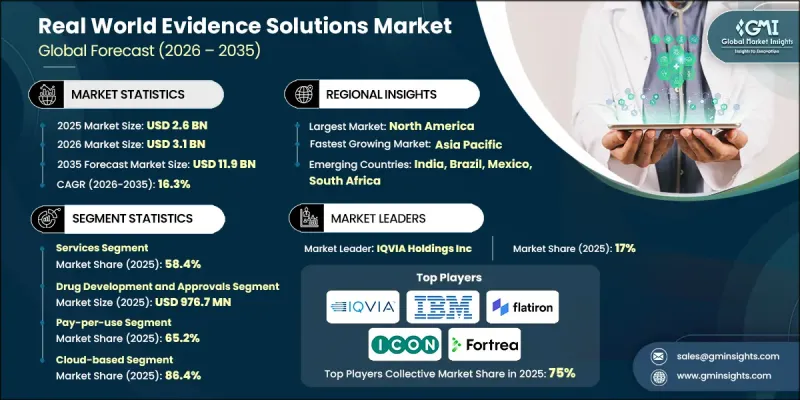
The robust growth trajectory is fueled by the increasing emphasis on accelerating drug development timelines while reducing overall research costs. Healthcare stakeholders are placing greater importance on real-time monitoring of drug and medical device safety and effectiveness, further strengthening demand for advanced RWE platforms. Growing reliance on real world evidence for reimbursement and coverage decisions is also contributing to market expansion. In addition, the broader adoption of advanced data analytics in clinical decision-making processes is transforming how healthcare organizations evaluate outcomes and treatment value. As healthcare systems shift toward data-driven strategies, real world evidence solutions are becoming essential tools for supporting regulatory submissions, optimizing product lifecycles, and improving patient care quality. Continuous innovation in cloud computing, artificial intelligence, and large-scale data integration technologies is enhancing the accessibility and analytical power of RWE platforms, positioning the market for sustained long-term growth.
| Market Scope | |
|---|---|
| Start Year | 2025 |
| Forecast Year | 2026-2035 |
| Start Value | $2.6 Billion |
| Forecast Value | $11.9 Billion |
| CAGR | 16.3% |
Real world evidence solutions serve a critical function in modern healthcare by enabling the analysis of data generated during routine clinical practice. These platforms process healthcare information collected from electronic health records, claims databases, patient registries, and digital health technologies to inform clinical, regulatory, and commercial decisions. RWE solutions are widely applied across drug development, clinical trial planning, post-market safety monitoring, regulatory documentation, and value-based care programs. The ongoing transition toward value-based reimbursement models is increasing the need for comprehensive outcome assessments beyond controlled clinical trial environments. Health technology assessment bodies and payers are progressively incorporating RWE into therapy performance evaluations conducted under real-world conditions. Advancements in analytics and data interoperability continue to improve the integration and interpretation of complex healthcare datasets.
The services segment accounted for 58.4% share in 2025, highlighting its central role within the global real world evidence solutions market. Service offerings provide essential expertise in study design, execution, and regulatory alignment for RWE initiatives. These services support healthcare and life sciences organizations in generating actionable insights across diverse regulatory and clinical settings. Data aggregation and management capabilities are particularly critical, as they enable the harmonization of multiple healthcare data streams while ensuring quality control, standardization, and compliance with regional regulations.
The drug development and approvals segment generated USD 976.7 million in 2025. Increasing complexity, high costs, and elevated risks associated with traditional development pathways are encouraging pharmaceutical companies to integrate real world evidence into clinical research strategies. RWE is being used to refine trial protocols, enhance patient selection processes, and improve operational efficiency through real-world data insights. Additionally, these solutions support long-term safety surveillance and effectiveness assessments beyond controlled trial settings.
North America Real World Evidence Solutions Market held 43.3% share in 2025, supported by advanced healthcare infrastructure, widespread implementation of electronic health record systems, and strong adoption of cloud-based and AI-enabled analytics platforms. High prevalence of chronic diseases further increases demand for continuous outcome monitoring and data-driven care models. Healthcare providers, payers, and life sciences companies in the region leverage RWE platforms to identify high-risk populations, support preventive strategies, and evaluate real-world treatment performance.
Prominent companies operating in the Global Real World Evidence Solutions Market include Aetion, Inc., Cytel Inc, Flatiron Health Inc, Fortrea Holdings Inc, IBM Corporation, ICON plc, IQVIA Holdings Inc., Medidata Solutions, Inc., Merative, Oracle Corporation, Parexel International Corporation, Syneos Health Inc, Tempus, TriNetX, Thermo Fisher Scientific, Inc, and UnitedHealth Group Incorporated. Companies competing in the Global Real World Evidence Solutions Market are strengthening their market presence through strategic collaborations, technology integration, and expansion of analytics capabilities. Leading players are investing in advanced artificial intelligence and machine learning platforms to enhance predictive insights and real-time data interpretation. Partnerships with healthcare providers, payers, and pharmaceutical firms are enabling broader access to diverse datasets. Firms are also prioritizing regulatory compliance expertise to support global study submissions. Cloud-based infrastructure development and scalable data platforms are improving interoperability and client accessibility.
Table of Contents
Chapter 1 Methodology and Scope
- 1.1 Market scope and definition
- 1.2 Research design
- 1.2.1 Research approach
- 1.2.2 Data collection methods
- 1.3 Data mining sources
- 1.3.1 Global
- 1.3.2 Regional/country
- 1.4 Base estimates and calculations
- 1.4.1 Base year calculation
- 1.4.2 Key trends for market estimation
- 1.5 Primary research and validation
- 1.5.1 Primary sources
- 1.6 Forecast model
- 1.7 Research assumptions and limitations
Chapter 2 Executive Summary
- 2.1 Industry 360° synopsis
- 2.2 Key market trends
- 2.2.1 Regional trends
- 2.2.2 Component trends
- 2.2.3 Application trends
- 2.2.4 Revenue model trends
- 2.2.5 Deployment model trends
- 2.2.6 End use trends
- 2.3 CXO perspectives: Strategic imperatives
- 2.3.1 Key decision points for industry executives
- 2.3.2 Critical success factors for market players
- 2.4 Future outlook and strategic recommendations
Chapter 3 Industry Insights
- 3.1 Industry ecosystem analysis
- 3.2 Industry impact forces
- 3.2.1 Growth drivers
- 3.2.1.1 Growing focus towards accelerating drug development and cost reduction
- 3.2.1.2 Growing demand for real-time safety and efficacy monitoring of drugs and medical devices
- 3.2.1.3 Increasing adoption of RWE solutions for informed reimbursement decision-making
- 3.2.1.4 Increasing adoption of data analytics services in clinical decision making.
- 3.2.2 Industry Pitfalls and Challenges:
- 3.2.2.1 Lack of standardization in integration and interoperability of real-world data
- 3.2.2.2 Shortage of skilled professionals
- 3.2.3 Market Opportunities
- 3.2.3.1 Emerging therapeutic areas expansion beyond oncology
- 3.2.3.2 Focus on patient-generated health data integration
- 3.2.1 Growth drivers
- 3.3 Growth potential analysis
- 3.4 Regulatory landscape
- 3.5 Technological advancements
- 3.5.1 Current technological trends
- 3.5.2 Emerging technologies
- 3.6 Future market trends
- 3.7 Porter's analysis
- 3.8 PESTEL analysis
Chapter 4 Competitive Landscape, 2025
- 4.1 Introduction
- 4.2 Company market share analysis
- 4.3 Company matrix analysis
- 4.4 Competitive analysis of major market players
- 4.5 Competitive positioning matrix
- 4.6 Key developments
- 4.6.1 Mergers and acquisitions
- 4.6.2 Partnerships and collaborations
- 4.6.3 New product launches
- 4.6.4 Expansion plans
Chapter 5 Market Estimates and Forecast, By Component, 2022 - 2035 ($ Mn)
- 5.1 Key trends
- 5.2 Services
- 5.2.1 Data collection and integration
- 5.2.2 Study design and execution
- 5.2.2.1 Prospective observational studies
- 5.2.2.2 Retrospective database studies
- 5.2.2.3 Site-centric studies
- 5.2.2.4 Registry-based studies
- 5.2.2.5 Hybrid studies
- 5.2.3 Regulatory and market access support
- 5.2.4 Evidence network
- 5.2.5 Other services
- 5.3 Data sets
- 5.3.1 Disparate data sets
- 5.3.1.1 Clinical settings data sets
- 5.3.1.2 Claims data sets
- 5.3.1.3 Pharmacy data sets
- 5.3.1.4 Patient powered data sets
- 5.3.1.5 Registry-based data sets
- 5.3.2 Integrated data sets
- 5.3.1 Disparate data sets
Chapter 6 Market Estimates and Forecast, By Application, 2022 - 2035 ($ Mn)
- 6.1 Key trends
- 6.2 Drug development and approvals
- 6.2.1 Oncology
- 6.2.2 Cardiovascular disease
- 6.2.3 Neurology
- 6.2.4 Immunology
- 6.2.5 Other therapeutic areas
- 6.3 Medical device development and approvals
- 6.4 Post-market surveillance
- 6.5 Market access and reimbursement/coverage decision-making
- 6.6 Clinical and regulatory decision-making
Chapter 7 Market Estimates and Forecast, By Revenue Model, 2022 - 2035 ($ Mn)
- 7.1 Key trends
- 7.2 Pay-per-use (value-based pricing)
- 7.3 Subscription
Chapter 8 Market Estimates and Forecast, By Deployment Model, 2022 - 2035 ($ Mn)
- 8.1 Key trends
- 8.2 On-premise
- 8.3 Cloud-based
Chapter 9 Market Estimates and Forecast, By End Use, 2022 - 2035 ($ Mn)
- 9.1 Key trends
- 9.2 Pharmaceutical and medical device companies
- 9.3 Healthcare payers
- 9.4 Healthcare providers
- 9.5 Other end users
Chapter 10 Market Estimates and Forecast, By Region, 2022 - 2035 ($ Mn)
- 10.1 Key trends
- 10.2 North America
- 10.2.1 U.S.
- 10.2.2 Canada
- 10.3 Europe
- 10.3.1 Germany
- 10.3.2 UK
- 10.3.3 France
- 10.3.4 Spain
- 10.3.5 Italy
- 10.3.6 Netherlands
- 10.4 Asia Pacific
- 10.4.1 China
- 10.4.2 India
- 10.4.3 Japan
- 10.4.4 Australia
- 10.4.5 South Korea
- 10.5 Latin America
- 10.5.1 Brazil
- 10.5.2 Mexico
- 10.5.3 Argentina
- 10.6 Middle East and Africa
- 10.6.1 Saudi Arabia
- 10.6.2 South Africa
- 10.6.3 UAE
Chapter 11 Company Profiles
- 11.1 Aetion, Inc.
- 11.2 Cytel Inc
- 11.3 Flatiron Health Inc
- 11.4 Fortrea Holdings Inc
- 11.5 IBM Corporation
- 11.6 ICON plc
- 11.7 IQVIA Holdings Inc.
- 11.8 Medidata Solutions, Inc.
- 11.9 Merative
- 11.10 Oracle Corporation
- 11.11 Parexel International Corporation
- 11.12 Syneos Health Inc
- 11.13 Tempus
- 11.14 TriNetX
- 11.15 Thermo Fisher Scientific, Inc

