PUBLISHER: Global Market Insights Inc. | PRODUCT CODE: 1959569

PUBLISHER: Global Market Insights Inc. | PRODUCT CODE: 1959569
Language Translation Device Market Opportunity, Growth Drivers, Industry Trend Analysis, and Forecast 2026 - 2035
The Global Language Translation Device Market was valued at USD 1.9 billion in 2025 and is estimated to grow at a CAGR of 13.5% to reach USD 6.5 billion by 2035.
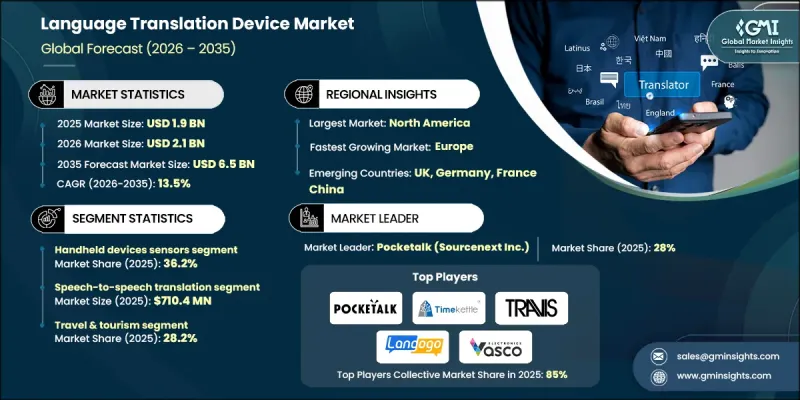
Growth is supported by expanding international travel, rising cross-border business activity, and the growing need for seamless multilingual communication across workplaces and customer-facing industries. The expansion of global e-commerce and multilingual customer support operations is further increasing demand for dedicated real-time translation hardware. Adoption is also rising in healthcare and emergency response environments where accurate communication is critical for safety, service quality, and regulatory compliance. Increasing preference for on-device and offline translation capabilities is improving reliability, data security, and performance in low-connectivity settings. Advances in artificial intelligence hardware are accelerating this shift by enabling faster processing and higher accuracy without cloud dependence. Translation devices are increasingly positioned as professional-grade tools rather than consumer accessories, with hands-free and wearable formats gaining popularity for continuous interaction in operational settings.
| Market Scope | |
|---|---|
| Start Year | 2025 |
| Forecast Year | 2026-2035 |
| Start Value | $1.9 Billion |
| Forecast Value | $6.5 Billion |
| CAGR | 13.5% |
The wearable translation devices segment will grow at a CAGR of 15.3% during 2026-2035. Demand is driven by the need for uninterrupted, hands-free communication in enterprise, healthcare, and field-based professional use. Wearable formats support natural conversation flow and improve efficiency in multilingual environments while supporting compliance with accessibility requirements.
The healthcare and medical communication applications segment is expected to grow at a CAGR of 15% through 2035. Healthcare providers increasingly rely on translation devices to improve patient engagement, reduce communication-related risks, and meet language access standards. Wearable solutions enable fast, accurate interaction with patients who have limited English proficiency, supporting better clinical outcomes.
North America Language Translation Device Market accounted for 37.5% share in 2025. Market leadership is driven by high adoption of AI-powered language tools, diverse multilingual populations, and strong demand from travel, healthcare, education, and enterprise sectors. Translation devices are increasingly integrated across industries to improve service delivery and internal communication.
Key companies operating in the Global Language Translation Device Market include Pocketalk (Sourcenext Inc.), Timekettle Technologies, Vasco Electronics LLC, Waverly Labs Inc., Travis GT B.V., Anfier Technology Co. Ltd., ECTACO Inc., Xiaomi Corporation, Langogo Technology Co., Ltd., Jarvisen (iFLYTEK), Mymanu (CEH Tech Ltd), Lingmo International Ltd., Poliglu Translator, Cheetah Mobile Inc., and Birgus (Shenzhen Birgus International). Companies in the language translation device market apply focused strategies to strengthen market position and long-term growth. Continuous investment in artificial intelligence improves translation accuracy, speed, and contextual understanding. Many players prioritize offline and on-device processing to enhance security and reliability. Product diversification across wearable and handheld formats expands addressable use cases. Strategic partnerships with enterprises and service providers support large-scale adoption. Localization of language databases increases relevance across regions. Competitive pricing models and subscription-based software updates improve customer retention.
Table of Contents
Chapter 1 Methodology and Scope
- 1.1 Market scope and definition
- 1.2 Research design
- 1.2.1 Research approach
- 1.2.2 Data collection methods
- 1.3 Data mining sources
- 1.3.1 Global
- 1.3.2 Regional/Country
- 1.4 Base estimates and calculations
- 1.4.1 Base year calculation
- 1.4.2 Key trends for market estimation
- 1.5 Primary research and validation
- 1.5.1 Primary sources
- 1.6 Forecast model
- 1.7 Research assumptions and limitations
Chapter 2 Executive Summary
- 2.1 Industry 360° synopsis, 2022 - 2035
- 2.2 Key market trends
- 2.2.1 Sensor type trends
- 2.2.2 Product type trends
- 2.2.3 Translation capability trends
- 2.2.4 Connectivity type trends
- 2.2.5 Technology trends
- 2.2.6 Application trends
- 2.2.7 Regional trends
- 2.3 TAM Analysis, 2026-2035
- 2.4 CXO perspectives: Strategic imperatives
- 2.4.1 Executive decision points
- 2.4.2 critical success factors
- 2.5 Future outlook and strategic recommendations
Chapter 3 Industry Insights
- 3.1 Industry ecosystem analysis
- 3.1.1 Supplier Landscape
- 3.1.2 Profit Margin
- 3.1.3 Cost structure
- 3.1.4 Value addition at each stage
- 3.1.5 Factor affecting the value chain
- 3.1.6 Disruptions
- 3.2 Industry impact forces
- 3.2.1 Growth drivers
- 3.2.1.1 Growth in international tourism and cross-border travel
- 3.2.1.2 Rising multilingual workplace communication requirements
- 3.2.1.3 Expansion of global e-commerce and customer support services
- 3.2.1.4 Increased adoption in healthcare and emergency response settings
- 3.2.1.5 Accuracy improvements in neural speech-to-speech engines
- 3.2.2 Industry pitfalls and challenges
- 3.2.2.1 Accuracy limitations in low-resource and regional languages
- 3.2.2.2 Competition from free smartphone translation applications
- 3.2.3 Market opportunities
- 3.2.3.1 Expansion of portable and wearable sensing devices
- 3.2.3.2 Wearable translators for hands-free professional applications
- 3.2.1 Growth drivers
- 3.3 Growth potential analysis
- 3.4 Regulatory landscape
- 3.4.1 North America
- 3.4.2 Europe
- 3.4.3 Asia Pacific
- 3.4.4 Latin America
- 3.4.5 Middle East & Africa
- 3.5 Porter's analysis
- 3.6 PESTEL analysis
- 3.7 Technology and Innovation landscape
- 3.7.1 Current technological trends
- 3.7.2 Emerging technologies
- 3.8 Price trends
- 3.8.1 By region
- 3.8.2 By product
- 3.9 Pricing Strategies
- 3.10 Emerging Business Models
- 3.11 Compliance Requirements
- 3.12 Patent and IP analysis
- 3.13 Geopolitical and trade dynamics
Chapter 4 Competitive Landscape, 2025
- 4.1 Introduction
- 4.2 Company market share analysis
- 4.2.1 By region
- 4.2.1.1 North America
- 4.2.1.2 Europe
- 4.2.1.3 Asia Pacific
- 4.2.1.4 Latin America
- 4.2.1.5 Middle East & Africa
- 4.2.2 Market concentration analysis
- 4.2.1 By region
- 4.3 Competitive benchmarking of key players
- 4.3.1 Financial performance comparison
- 4.3.1.1 Revenue
- 4.3.1.2 Profit margin
- 4.3.1.3 R&D
- 4.3.2 Product portfolio comparison
- 4.3.2.1 Product range breadth
- 4.3.2.2 Technology
- 4.3.2.3 Innovation
- 4.3.3 Geographic presence comparison
- 4.3.3.1 Global footprint analysis
- 4.3.3.2 Service network coverage
- 4.3.3.3 Market penetration by region
- 4.3.4 Competitive positioning matrix
- 4.3.4.1 Leaders
- 4.3.4.2 Challengers
- 4.3.4.3 Followers
- 4.3.4.4 Niche players
- 4.3.5 Strategic outlook matrix
- 4.3.1 Financial performance comparison
- 4.4 Key developments
- 4.4.1 Mergers and acquisitions
- 4.4.2 Partnerships and collaborations
- 4.4.3 Technological advancements
- 4.4.4 Expansion and investment strategies
- 4.4.5 Digital transformation initiatives
- 4.5 Emerging/ startup competitors landscape
Chapter 5 Market Estimates and Forecast, By Product Type, 2022 - 2035 (USD Million)
- 5.1 Key trends
- 5.2 Handheld translation devices
- 5.3 Pocket translators
- 5.4 Wearable translation devices
- 5.5 Specialized form factors
Chapter 6 Market Estimates and Forecast, By Translation Capability, 2022 - 2035 (USD Million)
- 6.1 Key trends
- 6.2 Speech-to-speech translation
- 6.3 Speech-to-text translation
- 6.4 Text-to-text translation
- 6.5 Image-to-text translation (OCR & camera)
Chapter 7 Market Estimates and Forecast, By Connectivity Type, 2022 - 2035 (USD Million)
- 7.1 Key trends
- 7.2 Online (cloud-based) translation devices
- 7.3 Offline translation devices
- 7.4 Hybrid (online + offline) devices
Chapter 8 Market Estimates and Forecast, By Technology, 2022 - 2035 (USD Million)
- 8.1 Key trends
- 8.2 AI & neural machine translation (NMT) devices
- 8.3 Rule-based translation devices
- 8.4 Hybrid translation systems
Chapter 9 Market Estimates and Forecast, By Application, 2022 - 2035 (USD Million)
- 9.1 Key trends
- 9.2 Travel & tourism
- 9.3 Business & corporate communication
- 9.4 Healthcare & medical communication
- 9.5 Education & training
- 9.6 Government & public services
- 9.7 Hospitality & customer service
- 9.8 Immigration & border control
- 9.9 Others
Chapter 10 Market Estimates and Forecast, By Region, 2022 - 2035 (USD Million)
- 10.1 Key trends
- 10.2 North America
- 10.2.1 U.S.
- 10.2.2 Canada
- 10.3 Europe
- 10.3.1 Germany
- 10.3.2 UK
- 10.3.3 France
- 10.3.4 Spain
- 10.3.5 Italy
- 10.3.6 Russia
- 10.4 Asia Pacific
- 10.4.1 China
- 10.4.2 India
- 10.4.3 Japan
- 10.4.4 Australia
- 10.4.5 South Korea
- 10.5 Latin America
- 10.5.1 Brazil
- 10.5.2 Mexico
- 10.5.3 Argentina
- 10.6 Middle East and Africa
- 10.6.1 South Africa
- 10.6.2 Saudi Arabia
- 10.6.3 UAE
Chapter 11 Company Profiles
- 11.1 Global Key Players
- 11.1.1 Pocketalk (Sourcenext Inc.)
- 11.1.2 Jarvisen (iFLYTEK)
- 11.1.3 Langogo Technology Co., Ltd.
- 11.1.4 Timekettle Technologies
- 11.1.5 Vasco Electronics LLC
- 11.1.6 Waverly Labs Inc.
- 11.2 Regional key players
- 11.2.1 North America
- 11.2.1.1 ECTACO Inc.
- 11.2.1.2 Cheetah Mobile Inc.
- 11.2.1.3 Travis GT B.V.
- 11.2.2 Asia Pacific
- 11.2.2.1 Lingmo International Ltd.
- 11.2.2.2 Xiaomi Corporation
- 11.2.2.3 Anfier Technology Co. Ltd.
- 11.2.3 Europe
- 11.2.3.1 Mymanu (CEH Tech Ltd)
- 11.2.3.2 Birgus (Shenzhen Birgus International)
- 11.2.1 North America
- 11.3 Niche Players/Disruptors
- 11.3.1 Poliglu Translator

