PUBLISHER: Global Market Insights Inc. | PRODUCT CODE: 1959577

PUBLISHER: Global Market Insights Inc. | PRODUCT CODE: 1959577
Infrared (IR) LED Market Opportunity, Growth Drivers, Industry Trend Analysis, and Forecast 2026 - 2035
The Global Infrared (IR) LED Market was valued at USD 1.3 billion in 2025 and is estimated to grow at a CAGR of 9.7% to reach USD 3.2 billion by 2035.
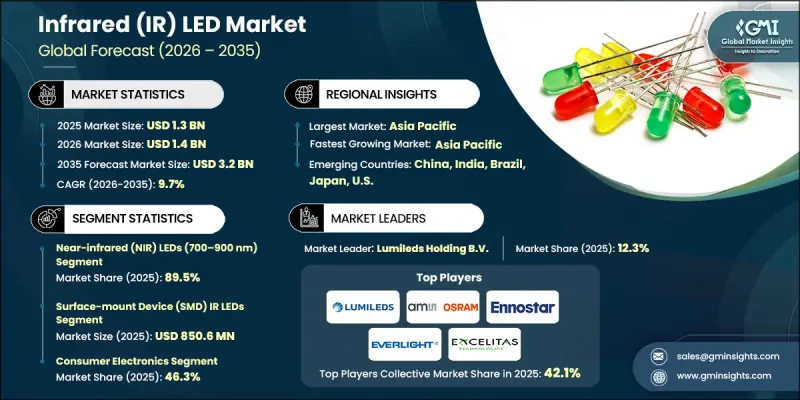
Market expansion is fueled by rising integration across consumer-focused technologies, stronger deployment within automotive sensing and safety platforms, accelerating adoption in factory automation and vision-based systems, increasing utilization in biometric identification and healthcare solutions, and sustained demand from security and monitoring infrastructures. Advancements in infrared LED design are focused on improving system-level efficiency rather than isolated component gains, allowing higher radiant output with reduced thermal stress. These performance improvements simplify packaging requirements, extend operational lifecycles, and enable more compact form factors. In the near term, gradual efficiency enhancements continue to accumulate, while mid-term development trends show original equipment manufacturers aligning product architectures directly with these improved infrared performance characteristics.
| Market Scope | |
|---|---|
| Start Year | 2025 |
| Forecast Year | 2026-2035 |
| Start Value | $1.3 Billion |
| Forecast Value | $3.2 Billion |
| CAGR | 9.7% |
Consumer-oriented electronics remain the largest contributor to overall demand, driven by continuous upgrades in sensing accuracy, power efficiency, and miniaturization. Manufacturers are transitioning away from traditional material structures toward more advanced heterostructure designs that limit efficiency degradation at elevated current levels and improve light extraction. This shift enables smaller die sizes with higher brightness output, supporting thinner modules and improved thermal control. The emphasis is increasingly placed on achieving higher performance at the system level, which allows longer operating cycles and greater design flexibility for integrators.
The short-wave infrared LED segment is forecast to register a CAGR of 11.8% during 2026-2035. Demand for SWIR technology is being driven by applications that require longer wavelength performance to achieve enhanced penetration, higher detection accuracy, and improved imaging reliability. Although this segment currently accounts for a smaller share of total shipments, revenue growth remains strong due to its use in high-value environments where performance outweighs cost sensitivity. Ongoing technical refinement and expanding acceptance across specialized industrial, medical, and defense-related systems are supporting premium pricing structures and sustained investment in SWIR development.
The automotive and transportation segment is expected to grow at a CAGR of 13.5% during 2026-2035, making it one of the fastest-growing end-use segments. Growth is linked to the rising deployment of advanced driver-assistance architectures, in-cabin monitoring platforms, and semi-autonomous and autonomous mobility systems. Increased production of electric vehicles and stricter global safety mandates are accelerating the integration of infrared LEDs for occupant detection, interior sensing, and low-light assistance functions. These applications demand high reliability and long operational life, creating opportunities for higher-margin products and deeper supplier relationships within the automotive supply chain.
North America Infrared (IR) LED Market accounted for 20.7% share in 2025. The region continues to serve as a key demand center, supported by strong activity across automotive manufacturing, industrial automation, and defense-related programs. Rapid adoption of smart sensing technologies, combined with a well-established manufacturing base, underpins consistent regional growth. The United States and Canada remain focal points for investment in advanced sensor integration, microelectromechanical systems, and performance-driven optoelectronic components, all of which contribute to stable long-term demand for infrared LEDs.
Key participants operating in the Global Infrared (IR) LED Market include ams-OSRAM AG, Vishay Intertechnology, Inc., Everlight Electronics Co., Ltd., Stanley Electric Co., Ltd., Broadcom, Lumileds Holding B.V., Wurth Elektronik eiSos GmbH & Co. KG, Hamamatsu Photonics K.K., Ennostar Inc., Luminus, Inc., Marktech Optoelectronics Inc., Dialight, Excelitas Technologies Corp., Kingbright, DOWA Electronics Materials Co., Ltd., and Boston Electronics. Companies operating in the Global Infrared (IR) LED Market are actively strengthening their market position through a combination of technology innovation, portfolio diversification, and strategic partnerships. A strong focus is placed on developing higher-efficiency emitters with improved thermal performance and longer operating lifespans to meet evolving system-level requirements. Many players are investing in advanced packaging techniques and wafer-level optimization to reduce form factors while enhancing output consistency. Expansion into high-growth application segments such as automotive sensing, industrial automation, and medical diagnostics is another key strategy, often supported by long-term supply agreements.
Table of Contents
Chapter 1 Methodology and Scope
- 1.1 Market scope and definition
- 1.2 Research design
- 1.2.1 Research approach
- 1.2.2 Data collection methods
- 1.3 Data mining sources
- 1.3.1 Global
- 1.3.2 Regional/Country
- 1.4 Base estimates and calculations
- 1.4.1 Base year calculation
- 1.4.2 Key trends for market estimation
- 1.5 Primary research and validation
- 1.5.1 Primary sources
- 1.6 Forecast model
- 1.7 Research assumptions and limitations
Chapter 2 Executive Summary
- 2.1 Industry 360° synopsis, 2022 - 2035
- 2.2 Key market trends
- 2.2.1 Wavelength range trends
- 2.2.2 Power output trends
- 2.2.3 Packaging type trends
- 2.2.4 Application trends
- 2.2.5 End-use industry trends
- 2.2.6 Regional trends
- 2.3 TAM Analysis, 2026-2035
- 2.4 CXO perspectives: Strategic imperatives
- 2.4.1 Executive decision points
- 2.4.2 Critical success factors
- 2.5 Future outlook and strategic recommendations
Chapter 3 Industry Insights
- 3.1 Industry ecosystem analysis
- 3.1.1 Supplier Landscape
- 3.1.2 Profit Margin
- 3.1.3 Cost structure
- 3.1.4 Value addition at each stage
- 3.1.5 Factor affecting the value chain
- 3.1.6 Disruptions
- 3.2 Industry impact forces
- 3.2.1 Growth drivers
- 3.2.1.1 Rising adoption in consumer electronics
- 3.2.1.2 Increasing use in automotive sensing & safety systems
- 3.2.1.3 Expansion of industrial automation & machine vision
- 3.2.1.4 Growing demand for biometric and healthcare applications
- 3.2.1.5 Growth in security & surveillance systems
- 3.2.2 Industry pitfalls and challenges
- 3.2.2.1 Technical limitations in high-power and long-wavelength IR LEDs
- 3.2.2.2 Dependence on component supply chain and semiconductor shortages
- 3.2.3 Market opportunities
- 3.2.3.1 Growth in wearable and portable healthcare devices
- 3.2.3.2 Increasing adoption in smart homes and IoT devices
- 3.2.1 Growth drivers
- 3.3 Growth potential analysis
- 3.4 Regulatory landscape
- 3.4.1 North America
- 3.4.2 Europe
- 3.4.3 Asia Pacific
- 3.4.4 Latin America
- 3.4.5 Middle East & Africa
- 3.5 Porter’s analysis
- 3.6 PESTEL analysis
- 3.7 Technology and Innovation landscape
- 3.7.1 Current technological trends
- 3.7.2 Emerging technologies
- 3.8 Price trends
- 3.8.1 By region
- 3.8.2 By product
- 3.9 Pricing Strategies
- 3.10 Emerging Business Models
- 3.11 Compliance Requirements
- 3.12 Patent and IP analysis
- 3.13 Geopolitical and trade dynamics
Chapter 4 Competitive Landscape, 2025
- 4.1 Introduction
- 4.2 Company market share analysis
- 4.2.1 By region
- 4.2.1.1 North America
- 4.2.1.2 Europe
- 4.2.1.3 Asia Pacific
- 4.2.1.4 Latin America
- 4.2.1.5 Middle East & Africa
- 4.2.2 Market concentration analysis
- 4.2.1 By region
- 4.3 Competitive benchmarking of key players
- 4.3.1 Financial performance comparison
- 4.3.1.1 Revenue
- 4.3.1.2 Profit margin
- 4.3.1.3 R&D
- 4.3.2 Product portfolio comparison
- 4.3.2.1 Product range breadth
- 4.3.2.2 Technology
- 4.3.2.3 Innovation
- 4.3.3 Geographic presence comparison
- 4.3.3.1 Global footprint analysis
- 4.3.3.2 Service network coverage
- 4.3.3.3 Market penetration by region
- 4.3.4 Competitive positioning matrix
- 4.3.4.1 Leaders
- 4.3.4.2 Challengers
- 4.3.4.3 Followers
- 4.3.4.4 Niche players
- 4.3.5 Strategic outlook matrix
- 4.3.1 Financial performance comparison
- 4.4 Key developments
- 4.4.1 Mergers and acquisitions
- 4.4.2 Partnerships and collaborations
- 4.4.3 Technological advancements
- 4.4.4 Expansion and investment strategies
- 4.4.5 Digital transformation initiatives
- 4.5 Emerging/ startup competitors landscape
Chapter 5 Market Estimates and Forecast, By Wavelength Range, 2022 - 2035 (USD Million & Units)
- 5.1 Key trends
- 5.2 Near-infrared (NIR) LEDs (700-900 nm)
- 5.3 Short-wave infrared (SWIR) LEDs (900-1,000+ nm)
Chapter 6 Market Estimates and Forecast, By Power Output, 2022 - 2035 (USD Million & Units)
- 6.1 Key trends
- 6.2 Low-power IR LEDs (≤100 mW)
- 6.3 Medium-power IR LEDs (100 mW-1 W)
- 6.4 High-power IR LEDs (>1 W)
Chapter 7 Market Estimates and Forecast, By Packaging Type, 2022 - 2035 (USD Million & Units)
- 7.1 Key trends
- 7.2 Through-hole IR LEDs
- 7.3 Surface-mount device (SMD) IR LEDs
- 7.4 Others
Chapter 8 Market Estimates and Forecast, By Application, 2022 - 2035 (USD Million & Units)
- 8.1 Key trends
- 8.2 Sensing & proximity detection
- 8.3 Biometric identification
- 8.4 IR illumination for imaging & night vision
- 8.5 Remote control & human-machine interface (HMI)
- 8.6 Optical communication & data transmission
- 8.7 Others
Chapter 9 Market Estimates and Forecast, By End-use Industry, 2022 - 2035 (USD Million & Units)
- 9.1 Key trends
- 9.2 Consumer electronics
- 9.3 Healthcare & medical devices
- 9.4 Automotive & transportation
- 9.5 Security, defense & law enforcement
- 9.6 Industrial manufacturing
- 9.7 Others
Chapter 10 Market Estimates and Forecast, By Region, 2022 - 2035 (USD Million & Units)
- 10.1 Key trends
- 10.2 North America
- 10.2.1 U.S.
- 10.2.2 Canada
- 10.3 Europe
- 10.3.1 Germany
- 10.3.2 UK
- 10.3.3 France
- 10.3.4 Spain
- 10.3.5 Italy
- 10.3.6 Netherlands
- 10.4 Asia Pacific
- 10.4.1 China
- 10.4.2 India
- 10.4.3 Japan
- 10.4.4 Australia
- 10.4.5 South Korea
- 10.5 Latin America
- 10.5.1 Brazil
- 10.5.2 Mexico
- 10.5.3 Argentina
- 10.6 Middle East and Africa
- 10.6.1 South Africa
- 10.6.2 Saudi Arabia
- 10.6.3 UAE
Chapter 11 Company Profiles
- 11.1 Global Key Players
- 11.1.1 Lumileds Holding B.V.
- 11.1.2 ams-OSRAM AG
- 11.1.3 Ennostar Inc.
- 11.1.4 Everlight Electronics Co., Ltd.
- 11.1.5 Excelitas Technologies Corp.
- 11.2 Regional key players
- 11.2.1 North America
- 11.2.1.1 Broadcom
- 11.2.1.2 Luminus, Inc.
- 11.2.1.3 Vishay Intertechnology, Inc.
- 11.2.2 Asia Pacific
- 11.2.2.1 Kingbright
- 11.2.2.2 DOWA Electronics Materials Co., Ltd.
- 11.2.2.3 Stanley Electric Co., Ltd.
- 11.2.2.4 Hamamatsu Photonics K.K.
- 11.2.3 Europe
- 11.2.3.1 Wurth Elektronik eiSos GmbH & Co. KG
- 11.2.3.2 Dialight
- 11.2.1 North America
- 11.3 Niche Players/Disruptors
- 11.3.1 Boston Electronics
- 11.3.2 Marktech Optoelectronics Inc.

