PUBLISHER: Global Market Insights Inc. | PRODUCT CODE: 1959580

PUBLISHER: Global Market Insights Inc. | PRODUCT CODE: 1959580
Glass Reinforced Plastic (GRP) Piping Market Opportunity, Growth Drivers, Industry Trend Analysis, and Forecast 2026 - 2035
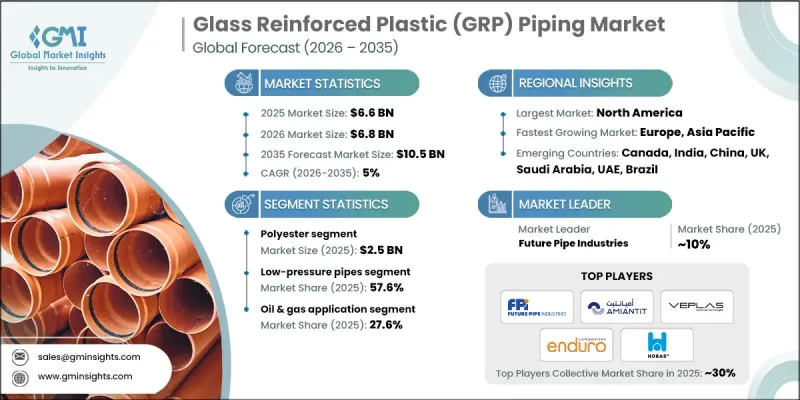
The Global Glass Reinforced Plastic Piping Market was valued at USD 6.6 billion in 2025 and is estimated to grow at a CAGR of 5% to reach USD 10.5 billion by 2035.
Market growth is driven by the rising adoption of GRP piping across industries that demand highly corrosion-resistant, durable, and low-maintenance materials. Sectors such as oil and gas, chemicals, and water management are increasingly using GRP due to its longer service life, chemical resistance, and lower operational costs compared to traditional steel or concrete systems. GRP piping also offers resilience under extreme environmental conditions while minimizing lifecycle costs, making it an attractive choice for industries seeking sustainable and durable infrastructure solutions. Rapid urbanization and expanding municipal infrastructure, particularly in developing regions, are fueling demand for GRP pipes in water distribution, sewage management, and irrigation networks. The material's performance stability over time, combined with its sustainability benefits, is encouraging governments and private enterprises to adopt GRP solutions for long-term reliability.
| Market Scope | |
|---|---|
| Start Year | 2025 |
| Forecast Year | 2026-2035 |
| Start Value | $6.6 Billion |
| Forecast Value | $10.5 Billion |
| CAGR | 5% |
The polyester-based GRP pipes segment accounted for USD 2.5 billion in 2025 and is expected to grow at a CAGR of 5.2% through 2035. These pipes are favored for their excellent corrosion resistance, making them ideal for water, sewage, irrigation, and industrial chemical applications. Polyester variants are cost-effective compared to epoxy and vinyl ester alternatives, driving their adoption in large-scale municipal and infrastructure projects, particularly in cost-sensitive markets seeking both reliability and efficiency.
The oil & gas segment held a 27.6% share in 2025 and is projected to grow at a CAGR of 4.8% during 2026-2035. GRP pipes provide long service life, corrosion resistance, and low maintenance requirements, making them suitable for flowlines, water injection systems, produced water handling, and refinery operations. As companies expand exploration, replace aging infrastructure, and seek operational efficiency, the demand for GRP solutions that reduce downtime and total lifecycle costs continues to rise.
North America Glass Reinforced Plastic (GRP) Piping Market was valued at USD 1.2 billion in 2025. Widespread aging pipelines in the U.S. require replacement with materials that provide longevity, corrosion resistance, and lower maintenance costs, positioning GRP pipes as a preferred solution. Increased investments across oil and gas, chemical processing, and renewable energy sectors are boosting demand for piping technologies that withstand harsh conditions while supporting sustainable operations. Regulatory focus on environmental compliance and efficiency further accelerates the adoption of eco-friendly GRP materials.
Key players in the Global Glass Reinforced Plastic Piping Market include Enduro Composites, Future Pipe Industries, Smithline Reinforced Composites, Veplas d.d., Industrial Plastic Systems, Plasticon Composites, Composite Pipes Industry, Dubai Pipes Factory, Graphite India Limited, Sarplast, HOBAS, Hanwei Energy Services Corp., Saudi Arabian Amiantit Company, and Fibrex. Companies in the Glass Reinforced Plastic Piping Market are pursuing multiple strategies to strengthen their foothold. They are investing in R&D to develop high-performance, corrosion-resistant, and lightweight pipes suitable for extreme conditions and specialized applications. Strategic partnerships with municipal authorities, industrial clients, and engineering firms allow for early adoption and integration of advanced piping systems. Expanding manufacturing capabilities and localizing production help reduce lead times and logistical costs while meeting regional demand. Firms are also emphasizing sustainable and eco-friendly materials to align with regulatory standards and environmental goals.
Table of Contents
Chapter 1 Methodology & Scope
- 1.1 Market scope and definition
- 1.2 Research design
- 1.2.1 Research approach
- 1.2.2 Data collection methods
- 1.3 Data mining sources
- 1.3.1 Global
- 1.3.2 Regional/Country
- 1.4 Base estimates and calculations
- 1.4.1 Base year calculation
- 1.4.2 Key trends for market estimation
- 1.5 Primary research and validation
- 1.5.1 Primary sources
- 1.6 Forecast model
- 1.7 Research assumptions and limitations
Chapter 2 Executive Summary
- 2.1 Industry 360° synopsis
- 2.2 Key market trends
- 2.2.1 Regional
- 2.2.2 Product type
- 2.2.3 Manufacturing process
- 2.2.4 Application
- 2.2.5 Distribution channel
- 2.3 CXO perspectives: Strategic imperatives
- 2.3.1 Key decision points for industry executives
- 2.3.2 Critical success factors for market players
- 2.4 Future outlook and strategic recommendations
Chapter 3 Industry Insights
- 3.1 Industry ecosystem analysis
- 3.1.1 Supplier landscape
- 3.1.2 Profit margin
- 3.1.3 Value addition at each stage
- 3.1.4 Factor affecting the value chain
- 3.2 Industry impact forces
- 3.2.1 Growth drivers
- 3.2.1.1 Increasing demand for corrosion-resistant & low-maintenance materials
- 3.2.1.2 Urbanization and growing water & wastewater needs
- 3.2.1.3 Infrastructure development & replacement of aging systems
- 3.2.2 Industry pitfalls & challenges
- 3.2.2.1 Impact of global trade uncertainties & tariff fluctuations
- 3.2.2.2 High initial capital costs & installation expenses
- 3.2.1 Growth drivers
- 3.3 Growth potential analysis
- 3.4 Future market trends
- 3.5 Technology and innovation landscape
- 3.5.1 Current technological trends
- 3.5.2 Emerging technologies
- 3.6 Price trends
- 3.6.1 By region
- 3.6.2 By product type
- 3.7 Regulatory landscape
- 3.7.1 Standards and compliance requirements
- 3.7.2 Regional regulatory frameworks
- 3.7.3 Certification standards
- 3.8 Trade statistics
- 3.8.1 Major importing countries
- 3.8.2 Major exporting countries
- 3.9 Porter's analysis
- 3.10 PESTEL analysis
Chapter 4 Competitive Landscape, 2025
- 4.1 Introduction
- 4.2 Company market share analysis
- 4.2.1 By Region
- 4.2.1.1 North America
- 4.2.1.2 Europe
- 4.2.1.3 Asia Pacific
- 4.2.1.4 Latin America
- 4.2.1.5 Middle East & Africa
- 4.2.1 By Region
- 4.3 Company matrix analysis
- 4.4 Competitive analysis of major market players
- 4.5 Competitive positioning matrix
- 4.6 Key developments
- 4.6.1 Mergers & acquisitions
- 4.6.2 Partnerships & collaborations
- 4.6.3 New product launches
- 4.6.4 Expansion plans
Chapter 5 Market Estimates & Forecast, By Product Type, 2022 - 2035, (USD Billion) (Thousand Units)
- 5.1 Key trends
- 5.2 Epoxy
- 5.3 Polyester
- 5.4 Vinyl ester
- 5.5 Others
Chapter 6 Market Estimates & Forecast, By Manufacturing Process, 2022 - 2035, (USD Billion) (Thousand Units)
- 6.1 Key trends
- 6.2 Filament winding
- 6.3 Resin transfer molding (RTM)
- 6.4 Centrifugal casting
Chapter 7 Market Estimates & Forecast, By Pressure Rating, 2022 - 2035, (USD Billion) (Thousand Units)
- 7.1 Key trends
- 7.2 Low-pressure pipes
- 7.3 High-pressure pipes
Chapter 8 Market Estimates & Forecast, By Application, 2022 - 2035, (USD Billion) (Thousand Units)
- 8.1 Key trends
- 8.2 Oil & gas
- 8.3 Chemicals
- 8.4 Wastewater treatment
- 8.5 Irrigation
- 8.6 Water supply
- 8.7 Others (pulp & paper, power generation, mining, etc.)
Chapter 9 Market Estimates & Forecast, By Distribution Channel, 2022 - 2035, (USD Billion) (Thousand Units)
- 9.1 Key trends
- 9.2 Direct
- 9.3 Indirect
Chapter 10 Market Estimates & Forecast, By Region, 2022 - 2035, (USD Billion) (Thousand Units)
- 10.1 Key trends
- 10.2 North America
- 10.2.1 U.S.
- 10.2.2 Canada
- 10.3 Europe
- 10.3.1 Germany
- 10.3.2 UK
- 10.3.3 France
- 10.3.4 Italy
- 10.3.5 Spain
- 10.4 Asia Pacific
- 10.4.1 China
- 10.4.2 India
- 10.4.3 Japan
- 10.4.4 South Korea
- 10.4.5 Australia
- 10.4.6 Indonesia
- 10.4.7 Malaysia
- 10.5 Latin America
- 10.5.1 Brazil
- 10.5.2 Mexico
- 10.5.3 Argentina
- 10.6 MEA
- 10.6.1 Saudi Arabia
- 10.6.2 UAE
- 10.6.3 South Africa
Chapter 11 Company Profiles
- 11.1 Composite Pipes Industry
- 11.2 Dubai Pipes Factory
- 11.3 Enduro Composites
- 11.4 Fibrex
- 11.5 Future Pipe Industries
- 11.6 Graphite India Limited
- 11.7 Hanwei Energy Services Corp.
- 11.8 Harwal Group
- 11.9 HOBAS
- 11.10 Industrial Plastic Systems
- 11.11 Plasticon Composites
- 11.12 Sarplast
- 11.13 Saudi Arabian Amiantit Company
- 11.14 Smithline Reinforced Composites
- 11.15 Veplas d.d.

