
PUBLISHER: Global Market Insights Inc. | PRODUCT CODE: 1959588

PUBLISHER: Global Market Insights Inc. | PRODUCT CODE: 1959588
Field Programmable Gate Array (FPGA) Market Opportunity, Growth Drivers, Industry Trend Analysis, and Forecast 2026 - 2035
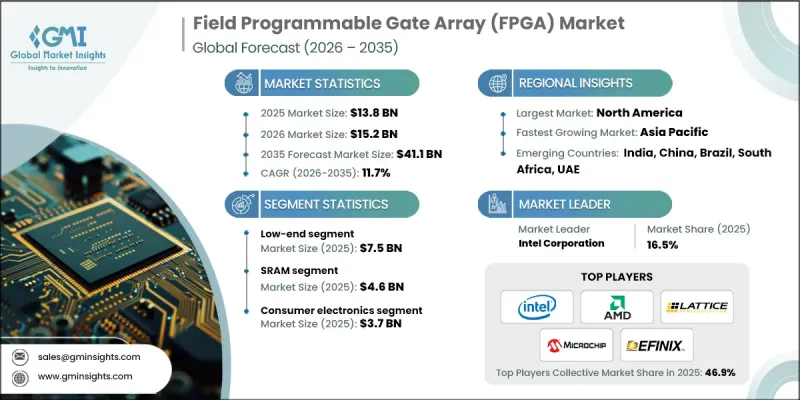
The Global Field Programmable Gate Array (FPGA) Market was valued at USD 13.8 billion in 2025 and is estimated to grow at a CAGR of 11.7% to reach USD 41.1 billion by 2035.
The market's growth is fueled by widespread adoption of artificial intelligence (AI) and machine learning, rapid deployment of 5G and next-generation telecommunication infrastructure, the rising use of advanced automotive electronics and ADAS systems, industrial automation, smart manufacturing, and the proliferation of edge computing and IoT devices. Governmental policies worldwide are increasingly focused on fostering innovation in AI, promoting strategic competitiveness, and supporting workforce training. Public investment in AI research strengthens the technological ecosystem, enabling both private and public organizations to leverage flexible, high-performance computing platforms capable of handling dynamic workloads. The ongoing expansion of next-generation mobile networks drives demand for programmable logic devices capable of sophisticated signal processing and adaptive performance, further enhancing market opportunities for FPGA technologies. The convergence of these trends is creating a strong foundation for long-term growth across multiple end-use sectors.
| Market Scope | |
|---|---|
| Start Year | 2025 |
| Forecast Year | 2026-2035 |
| Start Value | $13.8 Billion |
| Forecast Value | $41.1 Billion |
| CAGR | 11.7% |
The low-end FPGA segment generated USD 7.5 billion in 2025, leading the market due to rising demand for cost-effective programmable solutions in consumer electronics, basic industrial controls, and IoT endpoints. These devices provide design flexibility without the cost and complexity associated with custom ASICs, making them a preferred choice for applications requiring scalable, reconfigurable hardware. Government initiatives promoting digital infrastructure and electronics manufacturing are accelerating the adoption of entry-level FPGA devices, further boosting segment growth.
The SRAM-based FPGAs segment reached USD 4.6 billion in 2025. Their dominance is driven by high logic density, superior performance, and reprogrammability, making them essential for AI acceleration, data center operations, telecom infrastructure, and applications requiring frequent hardware updates. Increasing demand for rapid prototyping and post-deployment configuration across automotive, industrial, and communication systems continues to reinforce SRAM-based FPGA adoption. Manufacturers are enhancing SRAM FPGA offerings with integrated high-bandwidth memory, improved security, and advanced development toolchains to meet the needs of performance-critical and flexible computing applications.
North America Field Programmable Gate Array (FPGA) Market accounted for 36.3% share in 2025, maintaining a leadership position due to a robust semiconductor ecosystem, early adoption of AI and automotive electronics, and a strong presence of hyperscale data centers. The region benefits from significant public and private investment in 5G, AI, and defense-related FPGA applications, supported by collaborations between industry and academic research centers. Advanced manufacturing capabilities and a highly skilled workforce enable seamless FPGA integration across cloud infrastructure, embedded systems, and communication networks, establishing North America as a global innovation hub for programmable logic technologies.
Key players shaping the Global Field Programmable Gate Array (FPGA) Market include Lattice Semiconductor Corporation, Intel Corporation, Achronix Semiconductor Corporation, Efinix, Inc., Microchip Technology Inc., Quicklogic Corporation, Renesas Electronics Corporation, Advanced Micro Devices, Inc., Flex Logix Technologies, Inc., Gowin Semiconductor Corp., Menta S.A.S., Enclustra GmbH, Trenz Electronic GmbH, Cyient DLM, and Cologne Chip AG. Companies in the Field Programmable Gate Array (FPGA) Market are adopting strategies to strengthen their market presence through continuous innovation and portfolio expansion. Firms are investing heavily in research and development to introduce high-performance, reconfigurable hardware optimized for AI, telecom, automotive, and industrial applications. Strategic collaborations and licensing agreements expand geographic reach and enable access to emerging markets. Emphasis on advanced toolchains, security features, and high-bandwidth memory integration ensures differentiation in performance-critical applications. Many companies are enhancing production capabilities and establishing localized support networks to improve customer service and reduce time-to-market.
Table of Contents
Chapter 1 Methodology and Scope
- 1.1 Market scope and definition
- 1.2 Research design
- 1.2.1 Research approach
- 1.2.2 Data collection methods
- 1.3 Data mining sources
- 1.3.1 Global
- 1.3.2 Regional/Country
- 1.4 Base estimates and calculations
- 1.4.1 Base year calculation
- 1.4.2 Key trends for market estimation
- 1.5 Primary research and validation
- 1.5.1 Primary sources
- 1.6 Forecast model
- 1.7 Research assumptions and limitations
Chapter 2 Executive Summary
- 2.1 Industry 360° synopsis
- 2.2 Key market trends
- 2.2.1 Type trends
- 2.2.2 Technology trends
- 2.2.3 Application trends
- 2.2.4 Regional trends
- 2.3 TAM Analysis, 2026-2035 (USD Million)
- 2.4 CXO perspectives: Strategic imperatives
- 2.4.1 Executive decision points
- 2.4.2 Critical success factors
- 2.5 Future outlook and strategic recommendations
Chapter 3 Industry Insights
- 3.1 Industry ecosystem analysis
- 3.1.1 Supplier landscape
- 3.1.2 Profit margin
- 3.1.3 Cost structure
- 3.1.4 Value addition at each stage
- 3.1.5 Factor affecting the value chain
- 3.1.6 Disruptions
- 3.2 Industry impact forces
- 3.2.1 Growth drivers
- 3.2.1.1 AI and machine learning adoption
- 3.2.1.2 5G and next-generation telecom infrastructure
- 3.2.1.3 Automotive electronics and ADAS growth
- 3.2.1.4 Industrial automation and smart manufacturing
- 3.2.1.5 Edge computing and IoT expansion
- 3.2.2 Pitfalls and challenges
- 3.2.2.1 Programming complexity
- 3.2.2.2 High cost of advanced FPGAs
- 3.2.1 Growth drivers
- 3.3 Growth potential analysis
- 3.4 Regulatory landscape
- 3.4.1 North America
- 3.4.2 Europe
- 3.4.3 Asia Pacific
- 3.4.4 Latin America
- 3.4.5 Middle East & Africa
- 3.5 Porter's analysis
- 3.6 PESTEL analysis
- 3.7 Technology and Innovation landscape
- 3.7.1 Current technological trends
- 3.7.2 Emerging technologies
- 3.8 Emerging Business Models
- 3.9 Compliance Requirements
- 3.10 Sustainability Initiatives
- 3.11 Supply Chain Resilience
- 3.12 Geopolitical Analysis
- 3.13 Digital Transformation
Chapter 4 Competitive Landscape, 2025
- 4.1 Introduction
- 4.2 Company market share analysis
- 4.2.1 By region
- 4.2.1.1 North America
- 4.2.1.2 Europe
- 4.2.1.3 Asia Pacific
- 4.2.1.4 Latin America
- 4.2.1.5 Middle East & Africa
- 4.2.2 Market concentration analysis
- 4.2.1 By region
- 4.3 Competitive benchmarking of key players
- 4.3.1 Product portfolio comparison
- 4.3.1.1 Product range breadth
- 4.3.1.2 Technology
- 4.3.1.3 Innovation
- 4.3.2 Geographic presence comparison
- 4.3.2.1 Global footprint analysis
- 4.3.2.2 Service network coverage
- 4.3.2.3 Market penetration by region
- 4.3.3 Competitive positioning matrix
- 4.3.3.1 Leaders
- 4.3.3.2 Challengers
- 4.3.3.3 Followers
- 4.3.3.4 Niche players
- 4.3.4 Strategic outlook matrix
- 4.3.1 Product portfolio comparison
- 4.4 Key developments, 2022-2025
- 4.4.1 Mergers and acquisitions
- 4.4.2 Partnerships and collaborations
- 4.4.3 Technological advancements
- 4.4.4 Expansion and investment strategies
- 4.4.5 Sustainability initiatives
- 4.4.6 Digital transformation initiatives
- 4.5 Emerging/ startup competitors landscape
Chapter 5 Market Estimates and Forecast, By Type, 2022 - 2035 (USD Million)
- 5.1 Key trends
- 5.2 Low-end
- 5.3 Mid-range
- 5.4 High-end
Chapter 6 Market Estimates and Forecast, By Technology, 2022 - 2035 (USD Million)
- 6.1 Key trends
- 6.2 SRAM
- 6.3 EEPROM
- 6.4 Antifuse
- 6.5 Flash
- 6.6 Others
Chapter 7 Market Estimates and Forecast, By Application, 2022 - 2035 (USD Million)
- 7.1 Key Trends
- 7.2 Consumer Electronics
- 7.3 Automotive
- 7.4 Industrial
- 7.5 Data Processing
- 7.6 Military & Aerospace
- 7.7 Telecom
- 7.8 Others
Chapter 8 Market Estimates and Forecast, By Region, 2022 - 2035 (USD Million)
- 8.1 Key trends
- 8.2 North America
- 8.2.1 U.S.
- 8.2.2 Canada
- 8.3 Europe
- 8.3.1 Germany
- 8.3.2 UK
- 8.3.3 France
- 8.3.4 Spain
- 8.3.5 Italy
- 8.3.6 Netherlands
- 8.4 Asia Pacific
- 8.4.1 China
- 8.4.2 India
- 8.4.3 Japan
- 8.4.4 Australia
- 8.4.5 South Korea
- 8.5 Latin America
- 8.5.1 Brazil
- 8.5.2 Mexico
- 8.5.3 Argentina
- 8.6 Middle East and Africa
- 8.6.1 Saudi Arabia
- 8.6.2 South Africa
- 8.6.3 UAE
Chapter 9 Company Profiles
- 9.1 Global Key Players
- 9.1.1 Advanced Micro Devices, Inc.
- 9.1.2 Intel Corporation
- 9.1.3 Lattice Semiconductor Corporation
- 9.1.4 Microchip Technology Inc.
- 9.2 Regional Key Players
- 9.2.1 North America
- 9.2.1.1 Achronix Semiconductor Corporation
- 9.2.1.2 Efinix, Inc.
- 9.2.1.3 Flex Logix Technologies, Inc.
- 9.2.1.4 Quicklogic Corporation
- 9.2.2 Europe
- 9.2.2.1 Cologne Chip AG
- 9.2.2.2 Enclustra GmbH
- 9.2.2.3 Menta S.A.S.
- 9.2.2.4 NanoXplore
- 9.2.3 Asia Pacific
- 9.2.3.1 Gowin Semiconductor Corp.
- 9.2.3.2 Renesas Electronics Corporation
- 9.2.3.3 Cyient DLM
- 9.2.1 North America
- 9.3 Niche / Disruptors
- 9.3.1 Trenz Electronic GmbH

