
PUBLISHER: Global Market Insights Inc. | PRODUCT CODE: 1959600

PUBLISHER: Global Market Insights Inc. | PRODUCT CODE: 1959600
Fingerprint Access Control System Market Opportunity, Growth Drivers, Industry Trend Analysis, and Forecast 2026 - 2035
The Global Fingerprint Access Control System Market was valued at USD 3.04 billion in 2025 and is estimated to grow at a CAGR of 10.6% to reach USD 7.35 billion by 2035.
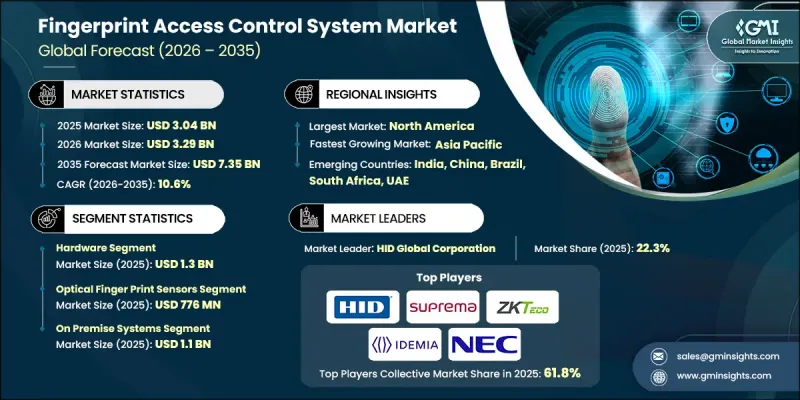
Market expansion is driven by the rising emphasis on security across residential, commercial, and industrial facilities, coupled with the shift from conventional access methods to advanced biometric solutions. Government mandates for secure access in sensitive zones, growing integration of IoT and smart building technologies, and the surge in commercial infrastructure development in emerging economies are further propelling growth. Organizations and authorities are increasingly recognizing that traditional keys, ID badges, or PIN-based systems are prone to duplication and misuse, whereas biometric authentication provides reliable, individualized verification. This transition is fueled by the need to prevent unauthorized entry, enhance accountability, and safeguard critical infrastructure, workplace assets, and sensitive operational areas across both public and private sectors.
| Market Scope | |
|---|---|
| Start Year | 2025 |
| Forecast Year | 2026-2035 |
| Start Value | $3.04 Billion |
| Forecast Value | $7.35 Billion |
| CAGR | 10.6% |
The hardware segment reached USD 1.3 billion in 2025. Deployment of fingerprint scanners, controllers, and readers is expanding across industrial, commercial, and government facilities due to growing security requirements. Government initiatives to modernize security infrastructure are accelerating the adoption of robust hardware for public facilities and critical assets. Manufacturers are focusing on high-accuracy, ruggedized fingerprint devices that meet stringent government and industry security standards, enabling long-term adoption in regulated industrial environments, transportation hubs, and public infrastructure projects.
The optical fingerprint sensors segment accounted for USD 776 million in 2025 and led the market in terms of adoption. These sensors are widely preferred for their cost-effectiveness, reliability, and ease of integration across commercial offices, residential complexes, and government projects. Optical sensors are particularly popular in high-volume deployments due to their durability and proven performance. Companies are optimizing these devices for affordability and robustness to meet standardized security requirements in public and private facilities.
U.S. Fingerprint Access Control System Market was valued at USD 826.5 million in 2025. Adoption in the U.S. is expanding in line with broader federal priorities to modernize security infrastructure and enhance identity verification across border control, critical infrastructure, and government facilities. Fingerprint access systems are increasingly central to federal security strategies, including immigration enforcement and facility access management. Manufacturers are prioritizing compliance with U.S. Department of Homeland Security standards and establishing strategic partnerships to support deployments across federal and critical infrastructure projects.
Prominent players in the Global Fingerprint Access Control System Market include 3M Cogent, Inc., Anviz Global Inc., Aratek Biometrics, Aware, Inc., BioEnable Technologies Pvt. Ltd., Fingerprint Cards AB (Fingerprints), HID Global Corporation, IDEMIA (Morpho), Integrated Biometrics, M2SYS Technology, Mantra Softech (India) Pvt. Ltd., NEC Corporation, Nitgen Co., Ltd., Precise Biometrics AB, Secugen Corporation, Suprema Inc., Thales Group, and ZKTeco Co., Ltd. Companies operating in the Global Fingerprint Access Control System Market are employing several key strategies to strengthen their market position. These include investing in research and development to improve sensor accuracy, speed, and durability; expanding product portfolios with integrated IoT and cloud-based solutions; and forming strategic alliances with government agencies and commercial integrators to secure large-scale contracts. Companies are also focusing on geographic expansion into emerging markets, enhancing after-sales support and maintenance services, and developing customized solutions for specific industries. Strategic mergers and acquisitions are being leveraged to enhance technological capabilities, broaden global reach, and secure long-term supply agreements, reinforcing competitive advantage in a rapidly evolving market.
Table of Contents
Chapter 1 Methodology and Scope
- 1.1 Market scope and definition
- 1.2 Research design
- 1.2.1 Research approach
- 1.2.2 Data collection methods
- 1.3 Data mining sources
- 1.3.1 Global
- 1.3.2 Regional/Country
- 1.4 Base estimates and calculations
- 1.4.1 Base year calculation
- 1.4.2 Key trends for market estimation
- 1.5 Primary research and validation
- 1.5.1 Primary sources
- 1.6 Forecast model
- 1.7 Research assumptions and limitations
Chapter 2 Executive Summary
- 2.1 Industry 360° synopsis
- 2.2 Key market trends
- 2.2.1 Component trends
- 2.2.2 Sensor type trends
- 2.2.3 Deployment type trends
- 2.2.4 Application trends
- 2.2.5 End users trends
- 2.2.6 Regional trends
- 2.3 TAM Analysis, 2026-2035 (USD Million)
- 2.4 CXO perspectives: Strategic imperatives
- 2.4.1 Executive decision points
- 2.4.2 Critical success factors
- 2.5 Future outlook and strategic recommendations
Chapter 3 Industry Insights
- 3.1 Industry ecosystem analysis
- 3.1.1 Supplier landscape
- 3.1.2 Profit margin
- 3.1.3 Cost structure
- 3.1.4 Value addition at each stage
- 3.1.5 Factor affecting the value chain
- 3.1.6 Disruptions
- 3.2 Industry impact forces
- 3.2.1 Growth drivers
- 3.2.1.1 Rising security concerns in residential, commercial, and industrial sectors
- 3.2.1.2 Increasing adoption of biometric solutions over traditional access systems
- 3.2.1.3 Government regulations and mandates for secure access in sensitive areas
- 3.2.1.4 Integration with IoT and smart building technologies
- 3.2.1.5 Expansion of commercial infrastructure in emerging markets
- 3.2.2 Pitfalls and challenges
- 3.2.2.1 High initial investment and installation costs
- 3.2.2.2 Privacy concerns and data protection regulations
- 3.2.1 Growth drivers
- 3.3 Growth potential analysis
- 3.4 Regulatory landscape
- 3.4.1 North America
- 3.4.2 Europe
- 3.4.3 Asia Pacific
- 3.4.4 Latin America
- 3.4.5 Middle East & Africa
- 3.5 Porter’s analysis
- 3.6 PESTEL analysis
- 3.7 Technology and Innovation landscape
- 3.7.1 Current technological trends
- 3.7.2 Emerging technologies
- 3.8 Emerging Business Models
- 3.9 Compliance Requirements
- 3.10 Sustainability Initiatives
- 3.11 Supply Chain Resilience
- 3.12 Geopolitical Analysis
- 3.13 Digital Transformation
Chapter 4 Competitive Landscape, 2025
- 4.1 Introduction
- 4.2 Company market share analysis
- 4.2.1 By region
- 4.2.1.1 North America
- 4.2.1.2 Europe
- 4.2.1.3 Asia Pacific
- 4.2.1.4 Latin America
- 4.2.1.5 Middle East & Africa
- 4.2.2 Market concentration analysis
- 4.2.1 By region
- 4.3 Competitive benchmarking of key players
- 4.3.1 Product portfolio comparison
- 4.3.1.1 Product range breadth
- 4.3.1.2 Technology
- 4.3.1.3 Innovation
- 4.3.2 Geographic presence comparison
- 4.3.2.1 Global footprint analysis
- 4.3.2.2 Service network coverage
- 4.3.2.3 Market penetration by region
- 4.3.3 Competitive positioning matrix
- 4.3.3.1 Leaders
- 4.3.3.2 Challengers
- 4.3.3.3 Followers
- 4.3.3.4 Niche players
- 4.3.4 Strategic outlook matrix
- 4.3.1 Product portfolio comparison
- 4.4 Key developments, 2022-2025
- 4.4.1 Mergers and acquisitions
- 4.4.2 Partnerships and collaborations
- 4.4.3 Technological advancements
- 4.4.4 Expansion and investment strategies
- 4.4.5 Sustainability initiatives
- 4.4.6 Digital transformation initiatives
- 4.5 Emerging/ startup competitors landscape
Chapter 5 Market Estimates and Forecast, By Component, 2022 - 2035 (USD Million)
- 5.1 Key trends
- 5.2 Hardware
- 5.2.1 Readers/scanners
- 5.2.2 Fingerprint terminals
- 5.2.3 Door locks & controllers
- 5.3 Software
- 5.3.1 Algorithm engine
- 5.3.2 Access control management software
- 5.3.3 Time & attendance
- 5.4 Services
- 5.4.1 Installation
- 5.4.2 Integration
- 5.4.3 Maintenance/support
Chapter 6 Market Estimates and Forecast, By Sensor Type, 2022 - 2035 (USD Million)
- 6.1 Key trends
- 6.2 Optical
- 6.3 Capacitive
- 6.4 Ultrasonic
- 6.5 Thermal
- 6.6 Multispectral
- 6.7 Other
Chapter 7 Market Estimates and Forecast, By Deployment Type, 2022 - 2035 (USD Million)
- 7.1 Key trends
- 7.2 On-premise systems
- 7.3 Cloud-managed systems
- 7.4 Hybrid systems
Chapter 8 Market Estimates and Forecast, By Application, 2022 - 2035 (USD Million)
- 8.1 Key Trends
- 8.2 Door access control
- 8.3 Restricted facility access
- 8.4 Workforce attendance tracking
- 8.5 Visitor management
Chapter 9 Market Estimates and Forecast, By End-use Industry, 2022 - 2035 (USD Million)
- 9.1 Key trends
- 9.2 Commercial
- 9.3 Residential
- 9.4 Industrial/manufacturing
- 9.5 Government & defense
- 9.6 Healthcare
- 9.7 Education
- 9.8 Hospitality & retail
- 9.9 Others
Chapter 10 Market Estimates and Forecast, By Region, 2022 - 2035 (USD Million)
- 10.1 Key trends
- 10.2 North America
- 10.2.1 U.S.
- 10.2.2 Canada
- 10.3 Europe
- 10.3.1 Germany
- 10.3.2 UK
- 10.3.3 France
- 10.3.4 Spain
- 10.3.5 Italy
- 10.3.6 Netherlands
- 10.4 Asia Pacific
- 10.4.1 China
- 10.4.2 India
- 10.4.3 Japan
- 10.4.4 Australia
- 10.4.5 South Korea
- 10.5 Latin America
- 10.5.1 Brazil
- 10.5.2 Mexico
- 10.5.3 Argentina
- 10.6 Middle East and Africa
- 10.6.1 Saudi Arabia
- 10.6.2 South Africa
- 10.6.3 UAE
Chapter 11 Company Profiles
- 11.1 Global Key Players
- 11.1.1 HID Global Corporation
- 11.1.2 IDEMIA (Morpho)
- 11.1.3 Thales Group
- 11.1.4 NEC Corporation
- 11.1.5 Suprema Inc.
- 11.2 Regional Key Players
- 11.2.1 North America
- 11.2.1.1 3M Cogent, Inc.
- 11.2.1.2 Aware, Inc.
- 11.2.1.3 Integrated Biometrics
- 11.2.1.4 Secugen Corporation
- 11.2.1.5 M2SYS Technology
- 11.2.2 Europe
- 11.2.2.1 Fingerprint Cards AB
- 11.2.2.2 Precise Biometrics AB
- 11.2.3 Asia Pacific
- 11.2.3.1 Anviz Global Inc.
- 11.2.3.2 Aratek Biometrics
- 11.2.3.3 BioEnable Technologies Pvt. Ltd.
- 11.2.3.4 Mantra Softech (India) Pvt. Ltd.
- 11.2.1 North America
- 11.3 Niche / Disruptors
- 11.3.1 Nitgen Co., Ltd.
- 11.3.2 ZKTeco Co., Ltd.

