PUBLISHER: Global Market Insights Inc. | PRODUCT CODE: 1959604

PUBLISHER: Global Market Insights Inc. | PRODUCT CODE: 1959604
Mass Flow Controller Market Opportunity, Growth Drivers, Industry Trend Analysis, and Forecast 2026 - 2035
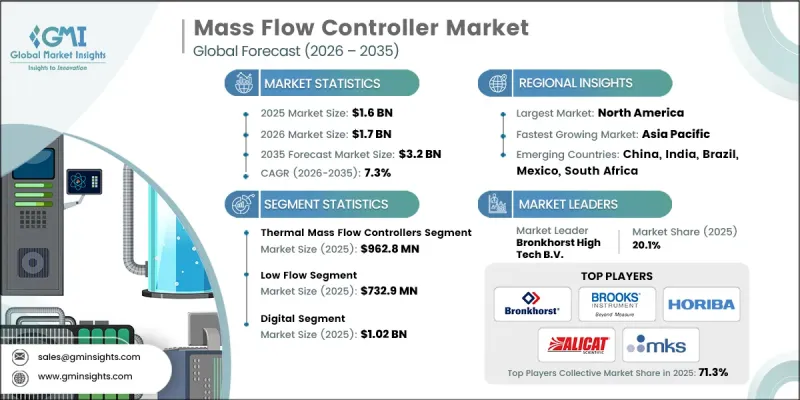
The Global Mass Flow Controller Market was valued at USD 1.6 billion in 2025 and is estimated to grow at a CAGR of 7.3% to reach USD 3.2 billion by 2035.
The growth is fueled by increasing adoption of automation and precision control technologies across industries such as semiconductors, aerospace, chemicals, energy, and manufacturing. As industrial processes become more complex and output demands rise, the need for precise, reliable flow measurement systems has intensified. Mass flow controllers are essential for accurately regulating gas and liquid flows, ensuring process stability, quality consistency, and adherence to safety standards. The expansion of semiconductor fabrication and advanced manufacturing operations is further accelerating the market. Critical processes such as deposition, etching, and chemical vapor applications require high repeatability and compact integration. In addition, the push toward Industry 4.0 and smart manufacturing drives demand for digitally enabled and IIoT-compatible mass flow controllers, offering real-time monitoring, reduced downtime, and increased operational efficiency, ultimately reinforcing the value of MFC adoption across high-precision industries.
| Market Scope | |
|---|---|
| Start Year | 2025 |
| Forecast Year | 2026-2035 |
| Start Value | $1.6 Billion |
| Forecast Value | $3.2 Billion |
| CAGR | 7.3% |
The thermal mass flow controllers segment generated USD 962.8 million in 2025. These controllers dominate because of their ability to maintain precise flow measurements in semiconductor fabrication, chemical production, and clean technology operations. Thermal MFCs provide rapid response times, consistent repeatability, and long-term durability even in demanding process environments. Their capability to control gas flows accurately under varying conditions makes them indispensable for maintaining process stability and operational efficiency in critical applications.
The low flow segment accounted for USD 732.9 million in 2025, maintaining the largest market share due to its critical applications in semiconductor manufacturing, pharmaceuticals, and analytical processes. Low flow MFCs are preferred for high-precision tasks, offering fast response, accuracy, and repeatability when regulating small volumes of liquids or gases. These features make them essential for processes where even minor deviations can affect quality and yield.
North America Mass Flow Controller Market held a 31.4% share in 2025, driven by high adoption of automation, smart manufacturing, and digital process control. Industrial sectors, including semiconductors, chemicals, energy, and pharmaceuticals, leverage IIoT-enabled MFCs, predictive maintenance, and advanced analytics to optimize operations, reduce downtime, and maintain process stability. Growing emphasis on energy efficiency, sustainability, and regulatory compliance is further boosting demand for reliable, high-precision mass flow controllers across the region.
Key players in the Global Mass Flow Controller Market include Brooks Instrument, Alicat Scientific, Inc., MKS Instruments, Inc., Azbil Corporation, Bronkhorst High Tech B.V., Christian Burkert GmbH & Co. KG, Fujikin Incorporated, HORIBA Ltd., KOFLOC Corporation, Parker Hannifin Corporation, Sensirion AG, Sierra Instruments, Inc., Teledyne Hastings Instruments, Tokyo Keiso Co., Ltd., and Vogtlin Instruments GmbH. Companies are strengthening their Global Mass Flow Controller Market presence through continuous R&D and technology development, focusing on high-precision, reliable, and digitally compatible controllers. Strategic partnerships with semiconductor, chemical, and energy firms enable tailored solutions for complex industrial applications. Firms are investing in IIoT-enabled controllers, real-time monitoring, predictive maintenance, and analytics to enhance operational efficiency and minimize downtime. Expansion into emerging markets, flexible pricing models, and customer support services improve accessibility. Companies are also emphasizing sustainability, energy efficiency, and compact designs for space-limited applications.
Table of Contents
Chapter 1 Methodology and Scope
- 1.1 Market scope and definition
- 1.2 Research design
- 1.2.1 Research approach
- 1.2.2 Data collection methods
- 1.3 Data mining sources
- 1.3.1 Global
- 1.3.2 Regional/Country
- 1.4 Base estimates and calculations
- 1.4.1 Base year calculation
- 1.4.2 Key trends for market estimation
- 1.5 Primary research and validation
- 1.5.1 Primary sources
- 1.6 Forecast model
- 1.7 Research assumptions and limitations
Chapter 2 Executive Summary
- 2.1 Industry 360° synopsis, 2022 - 2035
- 2.2 Key market trends
- 2.2.1 Sensor type trends
- 2.2.2 Technology trends
- 2.2.3 Connectivity trends
- 2.2.4 End Use industry trends
- 2.2.5 Regional trends
- 2.3 TAM analysis, 2025-2035
- 2.4 CXO perspectives: Strategic imperatives
Chapter 3 Industry Insights
- 3.1 Industry ecosystem analysis
- 3.1.1 Supplier landscape
- 3.1.2 Profit margin analysis
- 3.1.3 Cost structure
- 3.1.4 Value addition at each stage
- 3.1.5 Factor affecting the value chain
- 3.1.6 Disruptions
- 3.2 Industry impact forces
- 3.2.1 Growth drivers
- 3.2.1.1 Expansion of Semiconductor and Electronics Manufacturing
- 3.2.1.2 Integration of Digitalization and Industry 4.0 Technologies
- 3.2.1.3 Growth in Renewable Energy and Clean Technology Applications
- 3.2.1.4 Expansion in Pharmaceuticals, Chemical Processing and Biotechnology Sectors
- 3.2.1.5 Regional Industrialization & Manufacturing Investment
- 3.2.2 Industry pitfalls and challenges
- 3.2.2.1 High Cost of Advanced MFCs
- 3.2.2.2 Complex Integration with Existing Systems
- 3.2.3 Market opportunities
- 3.2.3.1 IoT-Enabled and Smart MFC Solutions
- 3.2.3.2 Expansion in Emerging Markets
- 3.2.1 Growth drivers
- 3.3 Growth potential analysis
- 3.4 Regulatory landscape
- 3.4.1 North America
- 3.4.2 Europe
- 3.4.3 Asia Pacific
- 3.4.4 Latin America
- 3.4.5 Middle East & Africa
- 3.5 Porter’s analysis
- 3.6 PESTEL analysis
- 3.7 Technology and innovation landscape
- 3.7.1 Current technological trends
- 3.7.2 Emerging technologies
- 3.8 Price trends
- 3.8.1 By region
- 3.8.2 By product
- 3.9 Pricing Strategies
- 3.10 Emerging Business Models
- 3.11 Compliance Requirements
- 3.12 Geopolitical and trade dynamics
Chapter 4 Competitive Landscape, 2025
- 4.1 Introduction
- 4.2 Company market share analysis
- 4.2.1 By region
- 4.2.1.1 North America
- 4.2.1.2 Europe
- 4.2.1.3 Asia Pacific
- 4.2.1.4 Latin America
- 4.2.1.5 Middle East & Africa
- 4.2.1 By region
- 4.3 Competitive benchmarking of key players
- 4.3.1 Financial performance comparison
- 4.3.1.1 Revenue
- 4.3.1.2 Profit margin
- 4.3.1.3 R&D
- 4.3.2 Product portfolio comparison
- 4.3.2.1 Product range breadth
- 4.3.2.2 Technology
- 4.3.2.3 Innovation
- 4.3.3 Geographic presence comparison
- 4.3.3.1 Global footprint analysis
- 4.3.3.2 Service network coverage
- 4.3.3.3 Market penetration by region
- 4.3.4 Competitive positioning matrix
- 4.3.4.1 Leaders
- 4.3.4.2 Challengers
- 4.3.4.3 Followers
- 4.3.4.4 Niche players
- 4.3.1 Financial performance comparison
- 4.4 Key developments, 2022-2025
- 4.4.1 Mergers and acquisitions
- 4.4.2 Partnerships and collaborations
- 4.4.3 Technological advancements
- 4.4.4 Expansion and investment strategies
- 4.4.5 Digital transformation initiatives
- 4.5 Emerging/ startup competitors landscape
Chapter 5 Market Estimates and Forecast, By Technology, 2022 - 2035 (USD Million)
- 5.1 Key trends
- 5.2 Thermal mass flow controllers
- 5.3 Coriolis mass flow controllers
- 5.4 Differential pressure mass flow controllers
- 5.5 Ultrasonic / emerging mass flow controllers
Chapter 6 Market Estimates and Forecast, By Connectivity, 2022 - 2035 (USD Million)
- 6.1 Key trends
- 6.2 Analog
- 6.3 Digital
Chapter 7 Market Estimates and Forecast, By Media Type, 2022 - 2035 (USD Million)
- 7.1 Key trends
- 7.2 Gas
- 7.3 Liquid
Chapter 8 Market Estimates and Forecast, By Flow Rate Capacity, 2022 - 2035 (USD Million)
- 8.1 Key trends
- 8.2 Low flow
- 8.3 Medium flow
- 8.4 High flow
Chapter 9 Market Estimates and Forecast, By End-use Application, 2022 - 2035 (USD Million)
- 9.1 Key trends
- 9.2 Semiconductor & Electronics
- 9.2.1 Chemical Vapor Deposition (CVD)
- 9.2.2 Physical Vapor Deposition (PVD)
- 9.2.3 Thermal processing & diffusion
- 9.2.4 Others
- 9.3 Chemicals & specialty chemicals
- 9.3.1 Chemical reaction control
- 9.3.2 Spray & coating processes
- 9.3.3 Gas blending & mixing
- 9.3.4 Others
- 9.4 Environmental & utilities
- 9.4.1 Water & wastewater treatment
- 9.4.2 Air quality monitoring & emissions
- 9.4.3 Others
- 9.5 Pharmaceuticals & biotechnology
- 9.6 Energy & advanced materials
- 9.7 Metals & mining
- 9.8 Food & beverage
- 9.9 Aerospace & defense
- 9.10 Medical & healthcare
- 9.11 Others
Chapter 10 Market Estimates and Forecast, By Region, 2022 - 2035 (USD Million)
- 10.1 Key trends
- 10.2 North America
- 10.2.1 U.S.
- 10.2.2 Canada
- 10.3 Europe
- 10.3.1 Germany
- 10.3.2 UK
- 10.3.3 France
- 10.3.4 Spain
- 10.3.5 Italy
- 10.3.6 Netherlands
- 10.4 Asia Pacific
- 10.4.1 China
- 10.4.2 India
- 10.4.3 Japan
- 10.4.4 Australia
- 10.4.5 South Korea
- 10.5 Latin America
- 10.5.1 Brazil
- 10.5.2 Mexico
- 10.5.3 Argentina
- 10.6 Middle East and Africa
- 10.6.1 South Africa
- 10.6.2 Saudi Arabia
- 10.6.3 UAE
Chapter 11 Company Profiles
- 11.1 Alicat Scientific, Inc.
- 11.2 Azbil Corporation
- 11.3 Bronkhorst High-Tech B.V.
- 11.4 Brooks Instrument
- 11.5 Christian Burkert GmbH & Co. KG
- 11.6 Fujikin Incorporated
- 11.7 HORIBA Ltd.
- 11.8 KOFLOC Corporation
- 11.9 MKS Instruments, Inc.
- 11.10 Parker Hannifin Corporation
- 11.11 Sensirion AG
- 11.12 Sierra Instruments, Inc.
- 11.13 Teledyne Hastings Instruments
- 11.14 Tokyo Keiso Co., Ltd.
- 11.15 Vogtlin Instruments GmbH

