
PUBLISHER: Global Market Insights Inc. | PRODUCT CODE: 1959619

PUBLISHER: Global Market Insights Inc. | PRODUCT CODE: 1959619
Blood Collection Market Opportunity, Growth Drivers, Industry Trend Analysis, and Forecast 2026 - 2035
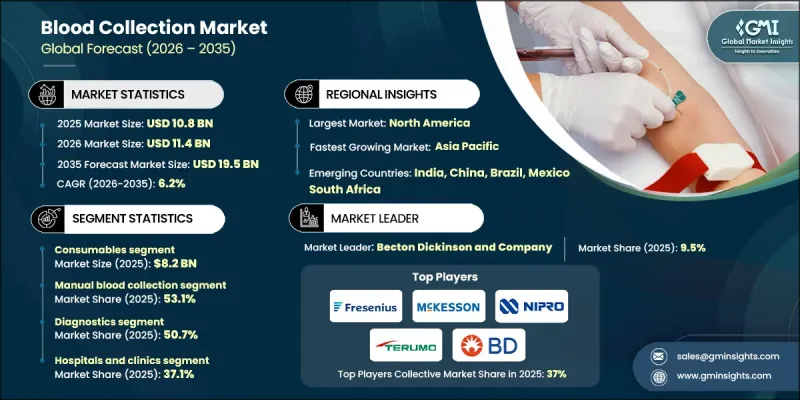
The Global Blood Collection Market was valued at USD 10.8 billion in 2025 and is estimated to grow at a CAGR of 6.2% to reach USD 19.5 billion by 2035.
Growth is supported by the rising global disease burden, continuous progress in blood collection technologies, and the increasing volume of medical procedures performed worldwide. As healthcare systems place greater emphasis on early detection, routine monitoring, and precision-based treatment, the demand for accurate and efficient blood sampling continues to rise. Blood collection remains a foundational step in diagnostic workflows, supporting disease detection, therapy evaluation, and long-term patient monitoring across multiple care settings. The growing number of clinical interventions further reinforces demand, as blood-based assessments are required throughout patient evaluation and recovery processes. Advancements in collection methods, safety-focused designs, and workflow efficiency are also contributing to broader adoption. Together, these factors are strengthening market growth while reinforcing the importance of reliable blood collection solutions across hospitals, laboratories, and point-of-care environments.
| Market Scope | |
|---|---|
| Start Year | 2025 |
| Forecast Year | 2026-2035 |
| Start Value | $10.8 Billion |
| Forecast Value | $19.5 Billion |
| CAGR | 6.2% |
The consumables category generated USD 8.2 billion in 2025. This segment includes single-use products essential for collecting, handling, and transporting blood samples. Due to their disposable nature, these items are required for every blood draw, making them indispensable across healthcare facilities. Consumables play a critical role in maintaining sample integrity, preventing contamination, and ensuring accurate diagnostic outcomes. Their widespread and repetitive use continues to drive consistent demand across clinical and laboratory settings.
The diagnostics segment held 50.7% share in 2025. This segment encompasses devices and consumables used to collect and analyze blood samples for disease identification, monitoring, and management. Rising demand for routine testing and long-term condition management has increased reliance on efficient and advanced blood collection systems, supporting sustained growth in this segment.
North America Blood Collection Market accounted for 35.4% share in 2025. Regional growth is driven by high diagnostic testing volumes, well-established healthcare infrastructure, and a rapidly aging population. Increasing healthcare utilization among older individuals has led to higher demand for blood-based diagnostic tools, reinforcing market expansion across the region.
Key companies operating in the Global Blood Collection Market include Thermo Fisher Scientific, Becton, Dickinson, and Company, Abbott Laboratories, Siemens Healthineers, Cardinal Health, McKesson Corporation, Terumo Corporation, Greiner, Sarstedt AG & Co, Nipro Corporation, QIAGEN, Streck, Haemonetics Corporation, F. Hoffmann-La Roche, Fresenius SE & Co, and FL MEDICAL. Companies in the blood collection market are strengthening their market position through product innovation, safety enhancements, and expanded distribution networks. Manufacturers are investing in user-friendly, safety-engineered designs to reduce contamination risks and improve clinical efficiency. Emphasis on automation and compatibility with advanced diagnostic platforms helps streamline laboratory workflows. Strategic partnerships with healthcare providers and distributors support broader market reach. Firms are also expanding manufacturing capacity to meet rising global demand while ensuring regulatory compliance. Continuous focus on quality assurance, cost optimization, and sustainability initiatives further enhances competitiveness, allowing companies to maintain strong relationships with healthcare systems and reinforce long-term market presence.
Table of Contents
Chapter 1 Methodology and Scope
- 1.1 Market scope and definitions
- 1.2 Research design
- 1.2.1 Research approach
- 1.2.2 Data collection methods
- 1.3 Data mining sources
- 1.3.1 Global
- 1.3.2 Regional/Country
- 1.4 Base estimates and calculations
- 1.4.1 Base year calculation
- 1.4.2 Key trends for market estimation
- 1.5 Primary research and validation
- 1.5.1 Primary sources
- 1.6 Forecast model
- 1.7 Research assumptions and limitations
Chapter 2 Executive Summary
- 2.1 Industry 3600 synopsis
- 2.2 Key market trends
- 2.2.1 Product trends
- 2.2.2 Method trends
- 2.2.3 Application trends
- 2.2.4 End use trends
- 2.2.5 Regional trends
- 2.3 CXO perspectives: Strategic imperatives
- 2.3.1 Key decision points for industry executives
- 2.3.2 Critical success factors for market players
- 2.4 Future outlook and strategic recommendations
Chapter 3 Industry Insights
- 3.1 Industry ecosystem analysis
- 3.2 Industry impact forces
- 3.2.1 Growth drivers
- 3.2.1.1 Rising incidence of chronic and infectious diseases
- 3.2.1.2 Advancements in blood collection technologies
- 3.2.1.3 Increasing number of surgical procedures
- 3.2.1.4 Rising geriatric population
- 3.2.2 Industry pitfalls and challenges
- 3.2.2.1 Risks associated with blood transfusions
- 3.2.2.2 Lack of skilled healthcare professionals
- 3.2.3 Market opportunities
- 3.2.3.1 Rising government-led campaigns for promoting blood donation and disease screening
- 3.2.1 Growth drivers
- 3.3 Growth potential analysis
- 3.4 Regulatory landscape
- 3.4.1 North America
- 3.4.2 Europe
- 3.5 Technology landscape
- 3.5.1 Current technological trends
- 3.5.2 Emerging technologies
- 3.6 Future market trends
- 3.7 Gap analysis
- 3.8 Porter’s analysis
- 3.9 PESTEL analysis
Chapter 4 Competitive Landscape, 2025
- 4.1 Introduction
- 4.2 Company market share analysis
- 4.3 Company matrix analysis
- 4.4 Competitive analysis of major market players
- 4.5 Competitive positioning matrix
- 4.6 Strategy dashboard
- 4.7 Key developments
- 4.7.1 Mergers and acquisitions
- 4.7.2 Partnerships and collaborations
- 4.7.3 New product launches
- 4.7.4 Expansion plans
Chapter 5 Market Estimates and Forecast, By Product Type, 2021 - 2034 ($ Mn)
- 5.1 Key trends
- 5.2 System
- 5.2.1 Automated systems
- 5.2.2 Manual systems
- 5.3 Consumables
- 5.3.1 Venous
- 5.3.1.1 Needles and syringes
- 5.3.1.1.1 Double-ended needles
- 5.3.1.1.2 Winged blood collection sets
- 5.3.1.1.3 Standard hypodermic needles
- 5.3.1.1.4 Other blood collection needles
- 5.3.1.2 Blood collection tubes
- 5.3.1.2.1 Serum-separating
- 5.3.1.2.2 EDTA
- 5.3.1.2.3 Heparin
- 5.3.1.2.4 Plasma-separating
- 5.3.1.3 Blood bags
- 5.3.1.4 Other venous products
- 5.3.1.1 Needles and syringes
- 5.3.2 Capillary
- 5.3.2.1 Lancets
- 5.3.2.2 Micro-container tubes
- 5.3.2.3 Micro-hematocrit tubes
- 5.3.2.4 Warming devices
- 5.3.2.5 Other capillary products
- 5.3.1 Venous
Chapter 6 Market Estimates and Forecast, By Method, 2021 - 2034 ($ Mn)
- 6.1 Key trends
- 6.2 Manual blood collection
- 6.3 Automated blood collection
Chapter 7 Market Estimates and Forecast, By Application, 2021 - 2034 ($ Mn)
- 7.1 Key trends
- 7.2 Diagnostics
- 7.3 Treatment
- 7.4 Research
Chapter 8 Market Estimates and Forecast, By End Use, 2021 - 2034 ($ Mn)
- 8.1 Key trends
- 8.2 Hospitals and clinics
- 8.3 Diagnostic centers
- 8.4 Blood banks
- 8.5 Academic and research institutes
Chapter 9 Market Estimates and Forecast, By Region, 2021 - 2034 ($ Mn)
- 9.1 Key trends
- 9.2 North America
- 9.2.1 U.S.
- 9.2.2 Canada
- 9.3 Europe
- 9.3.1 Germany
- 9.3.2 UK
- 9.3.3 France
- 9.3.4 Spain
- 9.3.5 Italy
- 9.3.6 Netherlands
- 9.4 Asia Pacific
- 9.4.1 China
- 9.4.2 Japan
- 9.4.3 India
- 9.4.4 Australia
- 9.4.5 South Korea
- 9.5 Latin America
- 9.5.1 Brazil
- 9.5.2 Mexico
- 9.5.3 Argentina
- 9.6 Middle East and Africa
- 9.6.1 South Africa
- 9.6.2 Saudi Arabia
- 9.6.3 UAE
Chapter 10 Company Profiles
- 10.1 Abbott Laboratories
- 10.2 Becton, Dickinson, and Company
- 10.3 Cardinal Health
- 10.4 F. Hoffmann-La Roche
- 10.5 FL MEDICAL
- 10.6 Fresenius SE & Co
- 10.7 Greiner
- 10.8 Haemonetics Corporation
- 10.9 McKesson Corporation
- 10.10 Nipro Corporation
- 10.11 QIAGEN
- 10.12 Sarstedt AG & Co
- 10.13 Siemens Healthineers
- 10.14 Streck
- 10.15 Terumo Corporation
- 10.16 Thermo Fisher Scientific

