
PUBLISHER: Global Market Insights Inc. | PRODUCT CODE: 1959621

PUBLISHER: Global Market Insights Inc. | PRODUCT CODE: 1959621
Aquaculture Vaccines Market Opportunity, Growth Drivers, Industry Trend Analysis, and Forecast 2026 - 2035
The Global Aquaculture Vaccines Market was valued at USD 434.6 million in 2025 and is estimated to grow at a CAGR of 8.2% to reach USD 942.9 million by 2035.
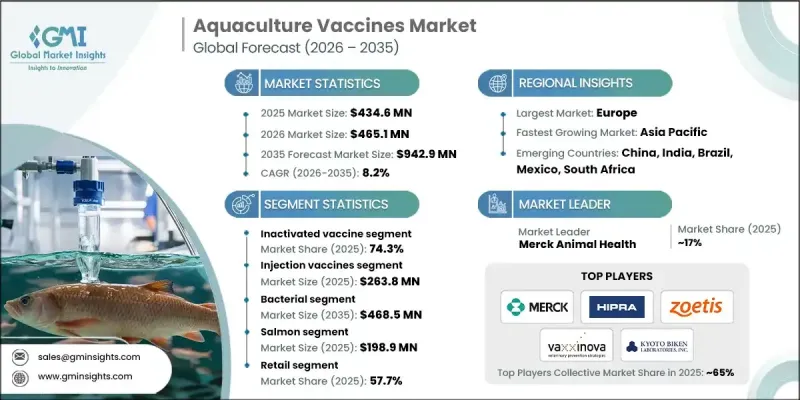
Market growth is driven by the expansion of global aquaculture production and the rising demand for fish. Frequent bacterial and viral outbreaks, including infections caused by Vibrio, Aeromonas, and other pathogens, have increased the need for vaccines that reduce mortality and improve productivity. Aquaculture vaccines are biological preparations that stimulate the immune system of aquatic animals, such as fish and crustaceans, providing resistance to specific pathogens. Administered via injection, immersion, or oral routes, these vaccines help minimize disease outbreaks, reduce antibiotic use, and promote sustainable fish farming. Emerging markets, particularly in Asia-Pacific and Latin America, are contributing to growth, alongside rising investments in R&D for oral and immersion vaccine delivery. Collaborations between manufacturers and aquaculture companies are enabling faster commercialization and broader access to innovative solutions.
| Market Scope | |
|---|---|
| Start Year | 2025 |
| Forecast Year | 2026-2035 |
| Start Value | $434.6 Million |
| Forecast Value | $942.9 Million |
| CAGR | 8.2% |
The inactivated vaccines segment held a 74.3% share and is expected to grow at a CAGR of 8.1% through 2035. Their safety profile, broad-spectrum protection, and stability make them highly preferred among producers. These vaccines are widely used across various aquaculture species and provide consistent immune responses without the risk of reverting to virulence. They are available in multiple delivery formats, including injectable and immersion, offering operational flexibility. Regulatory standards favoring non-live formulations, increasing consumer demand for antibiotic-free seafood, and a focus on biosecurity in intensive farming systems further support their adoption.
The injection vaccines segment accounted for USD 263.8 million in 2025 and is projected to grow at a CAGR of 8.1% through 2035. Injectable vaccines offer superior efficacy and long-lasting immunity by delivering precise doses directly to fish, ensuring optimal protection against bacterial and viral pathogens. Innovations in automated vaccination systems and ergonomic devices have simplified administration, reduced stress on animals, and increased operational efficiency across hatcheries and grow-out farms.
Europe Aquaculture Vaccines Market held a 43% share in 2025, driven by its advanced aquaculture industry, strong regulatory emphasis on disease prevention, and early adoption of vaccination programs. Regulatory restrictions on prophylactic antibiotic use have accelerated the shift toward vaccines, while a well-established cold-chain distribution network, skilled veterinary support, and the presence of leading vaccine manufacturers contribute to sustained growth.
Key players in the Global Aquaculture Vaccines Market include Cavac, CIBA, HIPRA, Kemin Industries, Kyoritsu Seiyaku, Kyoto Biken Laboratories, Merck Animal Health, Nisseiken, Phibro Animal Health, Tecnovax, Vaxxinova International, Veterquimica, Virbac, Zoetis. Companies in the Global Aquaculture Vaccines Market are strengthening their positions by investing in research and development of oral and immersion-based delivery systems, expanding manufacturing capacity, and forming strategic alliances with aquaculture operators for faster commercialization. They are also focusing on emerging markets, enhancing cold-chain logistics, offering value-added services such as technical support and training, and ensuring regulatory compliance to build trust and maintain market leadership.
Table of Contents
Chapter 1 Methodology and Scope
- 1.1 Market scope and definition
- 1.2 Research approach
- 1.3 Quality commitments
- 1.3.1 GMI AI policy and data integrity commitment
- 1.3.1.1 Source consistency protocol
- 1.3.1 GMI AI policy and data integrity commitment
- 1.4 Research trail and confidence scoring
- 1.4.1 Research trail components
- 1.4.2 Scoring components
- 1.5 Data collection
- 1.5.1 Partial list of primary sources
- 1.6 Data mining sources
- 1.6.1 Paid sources
- 1.6.1.1 Sources, by region
- 1.6.1 Paid sources
- 1.7 Base estimates and calculations
- 1.7.1 Revenue share analysis
- 1.7.2 Base year calculation
- 1.8 Forecast model
- 1.9 Research transparency addendum
- 1.9.1 Source attribution framework
- 1.9.2 Quality assurance metrics
- 1.9.3 Our commitment to trust
Chapter 2 Executive Summary
- 2.1 Industry 360° synopsis
- 2.2 Key market trends
- 2.2.1 Regional trends
- 2.2.2 Vaccine type trends
- 2.2.3 Route of administration trends
- 2.2.4 Application trends
- 2.2.5 Species trends
- 2.2.6 Distribution channel trends
- 2.3 CXO perspectives: Strategic imperatives
- 2.3.1 Key decision points for industry executives
- 2.3.2 Critical success factors for market players
- 2.4 Future outlook and strategic recommendations
Chapter 3 Industry Insights
- 3.1 Industry ecosystem analysis
- 3.2 Industry impact forces
- 3.2.1 Growth drivers
- 3.2.1.1 Surging prevalence of bacterial and viral infections
- 3.2.1.2 Increasing aquaculture production across the globe
- 3.2.1.3 Development and launch of new aquaculture vaccines
- 3.2.1.4 Rising adoption of aquaculture vaccines over antibiotics
- 3.2.2 Industry pitfalls and challenges
- 3.2.2.1 Limited awareness among small-scale farmers
- 3.2.2.2 Complex vaccine development procedures
- 3.2.3 Market opportunities
- 3.2.3.1 Emergence of oral and immersion-based vaccines
- 3.2.3.2 Expansion into emerging markets with rising aquaculture investments
- 3.2.1 Growth drivers
- 3.3 Growth potential analysis
- 3.4 Technology landscape
- 3.4.1 Current technological trends
- 3.4.2 Emerging technologies
- 3.5 Regulatory landscape
- 3.5.1 North America
- 3.5.2 Europe
- 3.5.3 Asia Pacific
- 3.6 Pipeline analysis
- 3.7 Future market trends
- 3.8 Porter’s analysis
- 3.9 PESTEL analysis
Chapter 4 Competitive Landscape, 2025
- 4.1 Introduction
- 4.2 Company market share analysis
- 4.3 Company matrix analysis
- 4.4 Competitive analysis of major market players
- 4.5 Competitive positioning matrix
- 4.6 Key developments
- 4.6.1 Merger and acquisition
- 4.6.2 Partnership and collaboration
- 4.6.3 New product launches
- 4.6.4 Expansion plans
Chapter 5 Market Estimates and Forecast, By Vaccine Type, 2022 - 2035 ($ Mn)
- 5.1 Key trends
- 5.2 Inactivated vaccine
- 5.3 Live attenuated vaccine
- 5.4 Subunit vaccine
- 5.5 Other vaccine types
Chapter 6 Market Estimates and Forecast, By Route of Administration, 2022 - 2035 ($ Mn)
- 6.1 Key trends
- 6.2 Injection vaccines
- 6.3 Oral vaccines
- 6.4 Immersion and spray
Chapter 7 Market Estimates and Forecast, By Application, 2022 - 2035 ($ Mn)
- 7.1 Key trends
- 7.2 Bacterial
- 7.3 Viral
- 7.4 Parasitic
- 7.5 Combined
Chapter 8 Market Estimates and Forecast, By Species, 2022 - 2035 ($ Mn)
- 8.1 Key trends
- 8.2 Salmon
- 8.3 Trout
- 8.4 Tilapia
- 8.5 Seabass
- 8.6 Seabream
- 8.7 Turbot
- 8.8 Carp
- 8.9 Other species
Chapter 9 Market Estimates and Forecast, By Distribution Channel, 2022 - 2035 ($ Mn)
- 9.1 Key trends
- 9.2 Retail
- 9.3 E-commerce
- 9.4 Veterinary hospital/clinic pharmacy
Chapter 10 Market Estimates and Forecast, By Region, 2022 - 2035 ($ Mn)
- 10.1 Key trends
- 10.2 North America
- 10.2.1 U.S.
- 10.2.2 Canada
- 10.3 Europe
- 10.3.1 Germany
- 10.3.2 UK
- 10.3.3 France
- 10.3.4 Spain
- 10.3.5 Italy
- 10.3.6 Norway
- 10.3.7 Ireland
- 10.3.8 Turkey
- 10.3.9 Denmark
- 10.4 Asia Pacific
- 10.4.1 China
- 10.4.2 India
- 10.4.3 Indonesia
- 10.4.4 Philippines
- 10.4.5 Vietnam
- 10.4.6 Australia
- 10.4.7 New Zealand
- 10.5 Latin America
- 10.5.1 Brazil
- 10.5.2 Mexico
- 10.5.3 Chile
- 10.6 Middle East and Africa
- 10.6.1 South Africa
- 10.6.2 Saudi Arabia
- 10.6.3 UAE
Chapter 11 Company Profiles
- 11.1 Cavac
- 11.2 CIBA
- 11.3 HIPRA
- 11.4 Kemin Industries
- 11.5 Kyoritsu Seiyaku
- 11.6 Kyoto Biken Laboratories
- 11.7 Merck Animal Health
- 11.8 Nisseiken
- 11.9 Phibro Animal Health
- 11.10 Tecnovax
- 11.11 Vaxxinova International
- 11.12 Veterquimica
- 11.13 Virbac
- 11.14 Zoetis

