PUBLISHER: Global Market Insights Inc. | PRODUCT CODE: 1959633

PUBLISHER: Global Market Insights Inc. | PRODUCT CODE: 1959633
Cooler Bags Market Opportunity, Growth Drivers, Industry Trend Analysis, and Forecast 2026 - 2035
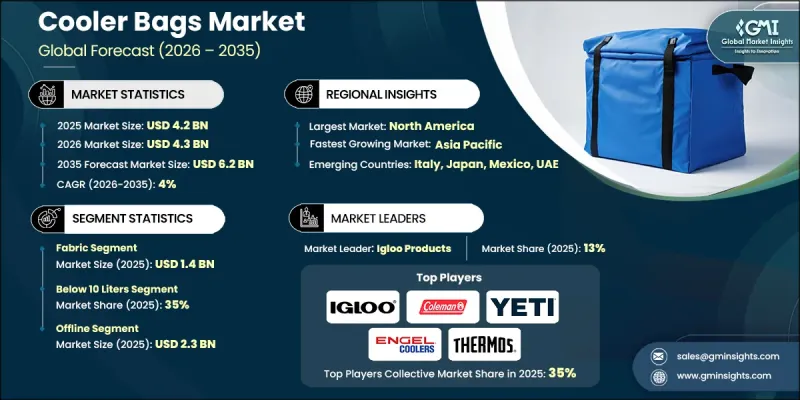
The Global Cooler Bags Market was valued at USD 4.2 billion in 2025 and is estimated to grow at a CAGR of 4% to reach USD 6.2 billion by 2035.
Market growth is tied to the rising participation in outdoor and recreational lifestyles, which have become deeply embedded in consumer behavior. Individuals increasingly prioritize flexible, short-duration experiences that require portable food and beverage storage solutions. As a result, demand for lightweight and convenient cooling products continues to rise. Cooler bags provide a practical alternative to fixed refrigeration, enabling users to transport fresh meals and chilled drinks efficiently. Urban consumers, particularly younger demographics, are fueling this trend as they seek spontaneous, socially driven activities that emphasize experience over ownership. Beyond functionality, cooler bags are evolving into lifestyle-oriented products associated with wellness, mobility, and active living. Design innovation, color variation, and modern styling have repositioned cooler bags from simple utility items to fashionable accessories that align with health-conscious and outdoor-focused lifestyles, further strengthening the global cooler bags market outlook.
| Market Scope | |
|---|---|
| Start Year | 2025 |
| Forecast Year | 2026-2035 |
| Start Value | $4.2 Billion |
| Forecast Value | $6.2 Billion |
| CAGR | 4% |
In 2025, the fabric segment generated USD 1.4 billion. Fabric-based cooler bags remain widely preferred due to their affordability, versatility, and adaptability across multiple use cases. Materials such as polyester, nylon, canvas, and recycled textiles enable manufacturers to develop lightweight and flexible designs suited for daily use, recreation, and commercial applications. Soft-sided construction enhances portability and storage convenience, making fabric cooler bags highly popular across various consumer segments.
The segment with a capacity of below 10 liters accounted for 35% share in 2025. Compact cooler bags are favored for their balance of portability and convenience, addressing everyday mobility needs. Their manageable size and lightweight structure appeal strongly to urban consumers who prioritize ease of transport and space efficiency. This size category continues to gain traction as consumers seek practical cooling solutions that align with active and on-the-go lifestyles.
U.S. Cooler Bags Market held 64.5% share, generating USD 900 million in 2025. The United States represents a mature and well-established market supported by a strong culture of outdoor recreation and high participation in leisure activities. Widespread acceptance of portable food consumption further supports consistent demand. Cooler bags are deeply integrated into everyday routines as well as recreational activities, contributing to sustained market growth across the country.
Major companies operating in the Global Cooler Bags Market include AO Coolers, Arctic Zone, Carhartt, Coleman Company, Dometic Group, Engel Coolers, Grizzly Coolers, Hydro Flask, Igloo Products, Klein Tools, Stanley, Pelican Products, RTIC Outdoors, Thermos, and YETI Holdings. Companies in the cooler bags market are reinforcing their competitive position through product innovation, material advancements, and brand-driven marketing strategies. Leading players are investing in improved insulation technologies and durable, eco-friendly materials to meet evolving consumer expectations. Many brands emphasize design differentiation to align with lifestyle trends and premium positioning. Strategic retail partnerships and expanded e-commerce channels are enhancing market reach and customer accessibility. Companies are also leveraging collaborations and limited-edition releases to strengthen brand loyalty. Sustainability initiatives, including the use of recycled fabrics and responsible sourcing practices, are becoming central to corporate strategies.
Table of Contents
Chapter 1 Methodology and Scope
- 1.1 Market scope and definition
- 1.2 Research design
- 1.2.1 Research approach
- 1.2.2 Data collection methods
- 1.3 Data mining sources
- 1.3.1 Global
- 1.3.2 Regional/Country
- 1.4 Base estimates and calculations
- 1.4.1 Base year calculation
- 1.4.2 Key trends for market estimation
- 1.5 Primary research and validation
- 1.5.1 Primary sources
- 1.6 Forecast model
- 1.7 Research assumptions and limitations
Chapter 2 Executive Summary
- 2.1 Industry 360° synopsis
- 2.2 Key market trends
- 2.2.1 Regional
- 2.2.2 Material type
- 2.2.3 Capacity
- 2.2.4 Price
- 2.2.5 Application
- 2.2.6 Distribution channel
- 2.3 CXO perspectives: Strategic imperatives
- 2.3.1 Key decision points for industry executives
- 2.3.2 Critical success factors for market players
- 2.4 Future outlook and strategic recommendations
Chapter 3 Industry Insights
- 3.1 Industry ecosystem analysis
- 3.1.1 Supplier landscape
- 3.1.2 Profit margin
- 3.1.3 Value addition at each stage
- 3.1.4 Factor affecting the value chain
- 3.2 Industry impact forces
- 3.2.1 Growth drivers
- 3.2.1.1 Rising outdoor & leisure activities
- 3.2.1.2 Sustainability awareness & reusable product preference
- 3.2.1.3 Product design & functional innovation
- 3.2.2 Industry pitfalls & challenges
- 3.2.2.1 Cost management under sustainability pressure
- 3.2.2.2 Limited technological defensibility
- 3.2.3 Opportunities
- 3.2.3.1 Premium & performance-focused segments
- 3.2.3.2 Customization & corporate branding
- 3.2.1 Growth drivers
- 3.3 Growth potential analysis
- 3.4 Future market trends
- 3.5 Technology and innovation landscape
- 3.5.1 Current technological trends
- 3.5.2 Emerging technologies
- 3.6 Price trends
- 3.6.1 By region
- 3.6.2 By material type
- 3.7 Regulatory landscape
- 3.7.1 Standards and compliance requirements
- 3.7.2 Regional regulatory frameworks
- 3.7.3 Certification standards
- 3.8 Porter’s analysis
- 3.9 PESTEL analysis
Chapter 4 Competitive Landscape, 2025
- 4.1 Introduction
- 4.2 Company market share analysis
- 4.2.1 By region
- 4.2.1.1 North America
- 4.2.1.2 Europe
- 4.2.1.3 Asia Pacific
- 4.2.1.4 Latin America
- 4.2.1.5 Middle East and Africa
- 4.2.1 By region
- 4.3 Company matrix analysis
- 4.4 Competitive analysis of major market players
- 4.5 Competitive positioning matrix
- 4.6 Key developments
- 4.6.1 Mergers & acquisitions
- 4.6.2 Partnerships & collaborations
- 4.6.3 New product launches
- 4.6.4 Expansion plans
Chapter 5 Market Estimates and Forecast, By Material Type, 2022 - 2035 (USD Billion) (Million Units)
- 5.1 Key trends
- 5.2 Plastic
- 5.3 Metal
- 5.4 Fabric
- 5.5 Foam
- 5.6 Others (gel, etc.)
Chapter 6 Market Estimates and Forecast, By Capacity, 2022 - 2035 (USD Billion) (Million Units)
- 6.1 Key trends
- 6.2 Below 10 liters
- 6.3 Between 10-20 liters
- 6.4 Above 20 liters
Chapter 7 Market Estimates and Forecast, By Price Range, 2022 - 2035 (USD Billion) (Million Units)
- 7.1 Key trends
- 7.2 Low
- 7.3 Medium
- 7.4 High
Chapter 8 Market Estimates and Forecast, By Application, 2022 - 2035 (USD Billion) (Million Units)
- 8.1 Key trends
- 8.2 Individual
- 8.3 Retail
- 8.4 Travel
- 8.5 Others
Chapter 9 Market Estimates and Forecast, By Distribution Channel, 2022 - 2035 (USD Billion) (Million Units)
- 9.1 Key trends
- 9.1.1 Online
- 9.1.1.1 E-commerce
- 9.1.1.2 Company websites
- 9.1.2 Offline
- 9.1.2.1 Supermarkets
- 9.1.2.2 Specialty stores
- 9.1.2.3 Others (Departmental stores. Etc.)
- 9.1.1 Online
Chapter 10 Market Estimates and Forecast, By Region, 2022 - 2035 (USD Billion) (Million Units)
- 10.1 Key trends
- 10.2 North America
- 10.2.1 U.S.
- 10.2.2 Canada
- 10.3 Europe
- 10.3.1 Germany
- 10.3.2 UK
- 10.3.3 France
- 10.3.4 Italy
- 10.3.5 Spain
- 10.4 Asia Pacific
- 10.4.1 China
- 10.4.2 Japan
- 10.4.3 India
- 10.4.4 Australia
- 10.4.5 South Korea
- 10.5 Latin America
- 10.5.1 Brazil
- 10.5.2 Mexico
- 10.5.3 Argentina
- 10.6 Middle East and Africa
- 10.6.1 South Africa
- 10.6.2 Saudi Arabia
- 10.6.3 UAE
Chapter 11 Company Profiles
- 11.1 AO Coolers
- 11.2 Arctic Zone
- 11.3 Carhartt
- 11.4 Coleman Company
- 11.5 Dometic Group
- 11.6 Engel Coolers
- 11.7 Grizzly Coolers
- 11.8 Hydro Flask
- 11.9 Igloo Products
- 11.10 Klein Tools
- 11.11 Stanley
- 11.12 Pelican Products
- 11.13 RTIC Outdoors
- 11.14 Thermos
- 11.15 YETI Holdings

