PUBLISHER: Global Market Insights Inc. | PRODUCT CODE: 1959641

PUBLISHER: Global Market Insights Inc. | PRODUCT CODE: 1959641
Industrial Communication Market Opportunity, Growth Drivers, Industry Trend Analysis, and Forecast 2026 - 2035
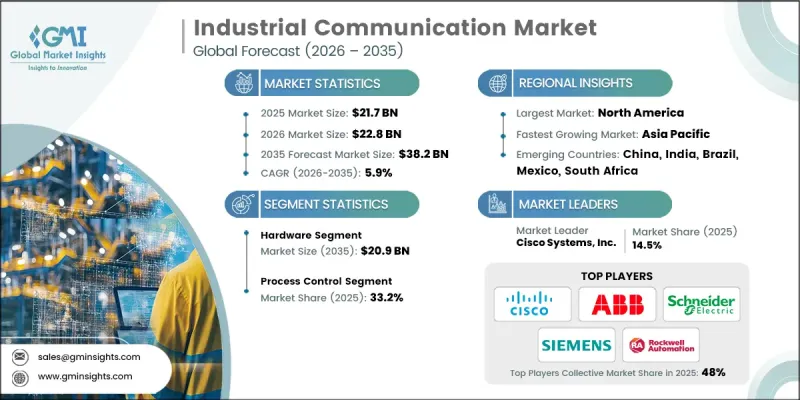
The Global Industrial Communication Market was valued at USD 21.7 billion in 2025 and is estimated to grow at a CAGR of 5.9% to reach USD 38.2 billion by 2035.
The market is driven by the widespread adoption of advanced technologies, including robotics, artificial intelligence, and digital twins, which require fast, reliable, and interoperable communication networks to operate efficiently. As industrial infrastructures become more connected, the importance of cybersecurity, network availability, and deterministic performance has grown significantly. The proliferation of connected devices, cloud systems, and edge computing increases exposure to cyber threats, data breaches, and operational downtime. This has led manufacturers to invest in secure communication networks equipped with encryption, authentication, redundancy, and network segmentation to ensure uninterrupted and protected operations. Industrial Ethernet has largely replaced traditional fieldbus systems due to its higher bandwidth, enabling real-time control for data-intensive applications. Simultaneously, wireless communication technologies, such as industrial Wi-Fi and private 5G networks, are gaining traction for their flexibility, reduced cabling costs, and faster deployment in complex production environments, making them essential for modern, adaptive manufacturing systems.
| Market Scope | |
|---|---|
| Start Year | 2025 |
| Forecast Year | 2026-2035 |
| Start Value | $21.7 Billion |
| Forecast Value | $38.2 Billion |
| CAGR | 5.9% |
The hardware segment is expected to reach USD 20.9 billion by 2035, driven by the demand for ruggedized components capable of operating reliably under extreme industrial conditions, including high temperatures, vibration, and electromagnetic interference. Integration of edge devices and embedded connectivity modules is accelerating, enabling low-latency, real-time data processing and efficient network management.
The process control segment held 33.2% share in 2025. Industrial communication networks are increasingly integrated with distributed control systems and programmable logic controllers, enhancing precision, scalability, and synchronization in automated operations. High-speed, deterministic networks allow real-time process monitoring and control, optimizing overall operational efficiency.
North America Industrial Communication Market accounted for a 31.2% share in 2025. The region's growth is fueled by large-scale digital transformation initiatives in manufacturing and energy sectors, coupled with the rapid adoption of industrial Ethernet and IIoT technologies. North American manufacturers are prioritizing automation, private wireless networks, and secure network architectures, supporting resilient and efficient industrial operations.
Key players in the Global Industrial Communication Market include Rockwell Automation, Siemens, Cisco Systems, ABB, Omron, Schneider Electric, and Huawei. Companies are strengthening their Industrial Communication Market position by investing heavily in R&D to develop high-speed, secure, and interoperable communication solutions. They are forming strategic partnerships with technology providers, industrial manufacturers, and automation integrators to expand adoption and deployment. Firms are focusing on edge connectivity, private 5G, and IIoT-enabled devices to support digital transformation initiatives across industries. Additionally, players are offering scalable, modular hardware and software systems to cater to small and large-scale industrial operations while providing services for cybersecurity, predictive maintenance, and real-time analytics. Market expansion into emerging regions, flexible pricing models, and comprehensive customer support strategies further reinforce their presence and enhance competitiveness.
Table of Contents
Chapter 1 Methodology and Scope
- 1.1 Market scope and definition
- 1.2 Research design
- 1.2.1 Research approach
- 1.2.2 Data collection methods
- 1.3 Data mining sources
- 1.3.1 Global
- 1.3.2 Regional/Country
- 1.4 Base estimates and calculations
- 1.4.1 Base year calculation
- 1.4.2 Key trends for market estimation
- 1.5 Primary research and validation
- 1.5.1 Primary sources
- 1.6 Forecast model
- 1.7 Research assumptions and limitations
Chapter 2 Executive Summary
- 2.1 Industry 360° synopsis, 2022 - 2035
- 2.2 Key market trends
- 2.2.1 Offering trends
- 2.2.2 Communication protocol trends
- 2.2.3 Application trends
- 2.2.4 End use industry trends
- 2.2.5 Regional trends
- 2.3 TAM analysis, 2026-2035
- 2.4 CXO perspectives: Strategic imperatives
- 2.4.1 Executive decision points
- 2.4.2 Critical success factors
- 2.5 Future outlook and strategic recommendations
Chapter 3 Industry Insights
- 3.1 Industry ecosystem analysis
- 3.1.1 Supplier landscape
- 3.1.2 Profit margin analysis
- 3.1.3 Cost structure
- 3.1.4 Value addition at each stage
- 3.1.5 Factor affecting the value chain
- 3.1.6 Disruptions
- 3.2 Industry impact forces
- 3.2.1 Growth drivers
- 3.2.1.1 Expansion of industrial internet of things (IIoT) ecosystems
- 3.2.1.2 Growth in connected and autonomous industrial equipment
- 3.2.1.3 Integration of advanced technologies (robotics, AI, digital twins)
- 3.2.1.4 Demand for seamless IT-OT convergence across industrial facilities
- 3.2.1.5 Growing emphasis on industrial cybersecurity and network resilience
- 3.2.2 Industry pitfalls and challenges
- 3.2.2.1 High initial deployment and integration costs
- 3.2.2.2 Interoperability challenges across multiple communication protocols
- 3.2.3 Market opportunities
- 3.2.3.1 Emergence of private industrial 5G and time-sensitive networking (TSN)
- 3.2.3.2 Expansion of industrial communication in small and mid-sized manufacturing facilities
- 3.2.1 Growth drivers
- 3.3 Regulatory landscape
- 3.3.1 North America
- 3.3.2 Europe
- 3.3.3 Asia Pacific
- 3.3.4 Latin America
- 3.3.5 Middle East & Africa
- 3.4 Porter’s analysis
- 3.5 PESTEL analysis
- 3.6 Technology and innovation landscape
- 3.6.1 Current technological trends
- 3.6.2 Emerging technologies
- 3.7 Emerging business models
- 3.8 Compliance requirements
- 3.9 Patent and IP analysis
- 3.10 Geopolitical and trade dynamics
Chapter 4 Competitive Landscape, 2025
- 4.1 Introduction
- 4.2 Company market share analysis
- 4.2.1 By region
- 4.2.1.1 North America
- 4.2.1.2 Europe
- 4.2.1.3 Asia Pacific
- 4.2.1.4 Latin America
- 4.2.1.5 Middle East & Africa
- 4.2.1 By region
- 4.3 Competitive benchmarking of key players
- 4.3.1 Financial performance comparison
- 4.3.1.1 Revenue
- 4.3.1.2 Profit margin
- 4.3.1.3 R&D
- 4.3.2 Product portfolio comparison
- 4.3.2.1 Product range breadth
- 4.3.2.2 Technology
- 4.3.2.3 Innovation
- 4.3.3 Geographic presence comparison
- 4.3.3.1 Global footprint analysis
- 4.3.3.2 Service network coverage
- 4.3.3.3 Market penetration by region
- 4.3.4 Competitive positioning matrix
- 4.3.4.1 Leaders
- 4.3.4.2 Challengers
- 4.3.4.3 Followers
- 4.3.4.4 Niche players
- 4.3.5 Strategic outlook matrix
- 4.3.1 Financial performance comparison
- 4.4 Key developments, 2022-2025
- 4.4.1 Mergers and acquisitions
- 4.4.2 Partnerships and collaborations
- 4.4.3 Technological advancements
- 4.4.4 Expansion and investment strategies
- 4.4.5 Digital transformation initiatives
- 4.5 Emerging/ startup competitors landscape
Chapter 5 Market Estimates and Forecast, By Offering, 2022 - 2035 ($ Mn)
- 5.1 Key trends
- 5.2 Hardware
- 5.2.1 Industrial switches
- 5.2.2 Gateways & protocol converters
- 5.2.3 Routers & wireless access points
- 5.2.4 Controllers & connectors
- 5.2.5 Communication interfaces & converters
- 5.2.6 Power supply devices
- 5.2.7 Other components
- 5.3 Software
- 5.3.1 Protocol stacks & firmware
- 5.3.2 Network management & monitoring tools
- 5.3.3 Industrial iot integration software
- 5.3.4 Configuration & diagnostic software
- 5.4 Services
- 5.4.1 System integration & consulting
- 5.4.2 Network deployment & commissioning
- 5.4.3 Maintenance & support services
Chapter 6 Market Estimates and Forecast, By Communication Protocol, 2022 - 2035 ($ Mn)
- 6.1 Key trends
- 6.2 Fieldbus protocols
- 6.2.1 PROFIBUS
- 6.2.2 MODBUS RTU
- 6.2.3 CAN
- 6.2.4 DeviceNet
- 6.2.5 CANopen
- 6.2.6 Other Fieldbus
- 6.3 Industrial ethernet protocols
- 6.3.1 PROFINET
- 6.3.2 EtherNet/IP
- 6.3.3 EtherCAT
- 6.3.4 MODBUS-TCP
- 6.3.5 POWERLINK
- 6.3.6 SERCOS III
- 6.3.7 CC-Link IE
- 6.3.8 Time-sensitive networking (TSN)
- 6.3.9 Other industrial ethernet
- 6.4 Wireless Industrial Protocols
- 6.4.1 Industrial WLAN (Wi-Fi 6/6E)
- 6.4.2 5G / Private LTE
- 6.4.3 Bluetooth Industrial
- 6.4.4 ISA100.11a
- 6.4.5 WirelessHART
- 6.4.6 Zigbee
- 6.4.7 Other Wireless
Chapter 7 Market Estimates and Forecast, By Application, 2022 - 2035 ($ Mn)
- 7.1 Key trends
- 7.2 Process control
- 7.3 Machine-to-machine (M2M) communication
- 7.4 Remote monitoring & diagnostics
- 7.5 Predictive maintenance & condition monitoring
- 7.6 Safety & security systems
- 7.7 Others
Chapter 8 Market Estimates and Forecast, By End-use Industry, 2022 - 2035 ($ Mn)
- 8.1 Key trends
- 8.2 Manufacturing sectors
- 8.2.1 Automotive
- 8.2.2 Aerospace & defense
- 8.2.3 Food & beverage
- 8.2.4 Pharmaceutical & medical devices
- 8.2.5 Electronics & semiconductor
- 8.2.6 Metals & mining
- 8.2.7 Machinery & equipment
- 8.2.8 Textile & apparel
- 8.2.9 Pulp, paper & packaging
- 8.2.10 Others
- 8.3 Process & utilities sectors
- 8.3.1 Oil & gas
- 8.3.2 Energy & power generation
- 8.3.3 Water & wastewater management
- 8.3.4 Renewable energy
- 8.3.5 Others
- 8.4 Others
Chapter 9 Market Estimates and Forecast, By Region, 2022 - 2035 ($ Mn)
- 9.1 Key trends
- 9.2 North America
- 9.2.1 U.S.
- 9.2.2 Canada
- 9.3 Europe
- 9.3.1 Germany
- 9.3.2 UK
- 9.3.3 France
- 9.3.4 Spain
- 9.3.5 Italy
- 9.3.6 Netherlands
- 9.4 Asia Pacific
- 9.4.1 China
- 9.4.2 India
- 9.4.3 Japan
- 9.4.4 Australia
- 9.4.5 South Korea
- 9.5 Latin America
- 9.5.1 Brazil
- 9.5.2 Mexico
- 9.5.3 Argentina
- 9.6 Middle East and Africa
- 9.6.1 South Africa
- 9.6.2 Saudi Arabia
- 9.6.3 UAE
Chapter 10 Company Profiles
- 10.1 Global Key Players
- 10.1.1 Cisco Systems
- 10.1.2 Siemens
- 10.1.3 ABB
- 10.1.4 Huawei
- 10.2 Regional Key Players
- 10.2.1 North America
- 10.2.1.1 Rockwell Automation
- 10.2.1.2 Emerson Electric
- 10.2.1.3 Belden
- 10.2.2 Europe
- 10.2.2.1 Schneider Electric
- 10.2.2.2 Phoenix Contact
- 10.2.2.3 HMS Networks
- 10.2.3 APAC
- 10.2.3.1 Omron
- 10.2.3.2 Mitsubishi Electric
- 10.2.3.3 Yokogawa Electric
- 10.2.1 North America
- 10.3 Niche Players / Disruptors
- 10.3.1 Advantech
- 10.3.2 Moxa

