PUBLISHER: Global Market Insights Inc. | PRODUCT CODE: 1959643

PUBLISHER: Global Market Insights Inc. | PRODUCT CODE: 1959643
Wireless Charging IC Market Opportunity, Growth Drivers, Industry Trend Analysis, and Forecast 2026 - 2035
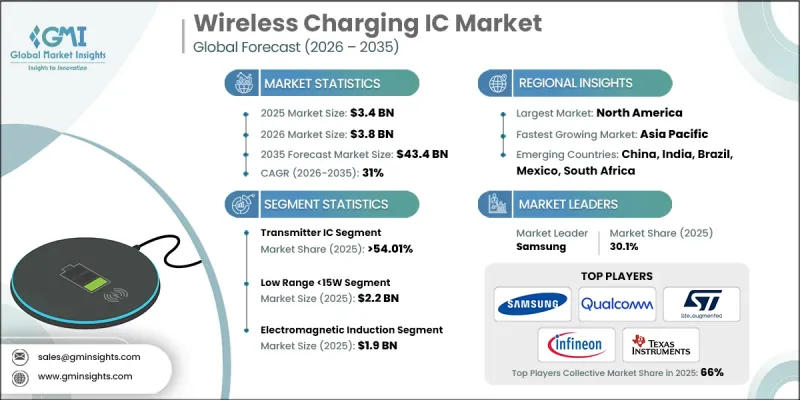
The Global Wireless Charging IC Market was valued at USD 3.4 billion in 2025 and is estimated to grow at a CAGR of 31% to reach USD 43.4 billion by 2035.
A wireless charging integrated circuit is a dedicated semiconductor component engineered to manage inductive power transfer within wireless charging systems. It converts alternating current supplied by the transmitting coil into direct current suitable for battery charging. These ICs also supervise communication protocols, regulate voltage and current flow, enable foreign object detection, and enhance overall energy efficiency across multiple electronic platforms. Rapid innovation in power management architecture and rising adoption of cable-free charging solutions is accelerating demand. As industries and consumers increasingly prioritize convenience, durability, and streamlined device design, manufacturers are investing heavily in advanced wireless power control technologies. Expanding integration of wireless charging capabilities into compact and high-performance electronics continues to elevate the importance of high-efficiency IC solutions worldwide.
| Market Scope | |
|---|---|
| Start Year | 2025 |
| Forecast Year | 2026-2035 |
| Start Value | $3.4 Billion |
| Forecast Value | $43.4 Billion |
| CAGR | 31% |
Growing investments in automation technologies are expected to stimulate demand for wireless charging ICs further. Industrial operators are seeking efficient, low-maintenance power delivery systems that reduce physical wear and improve operational continuity. Contactless power transfer supported by wireless charging ICs minimizes reliance on mechanical connectors and enhances system reliability. Adoption is broadening across automotive, industrial, telecommunications, and consumer electronics sectors, strengthening long-term growth prospects. As standardization and safety requirements evolve, manufacturers are developing IC platforms capable of supporting secure and interoperable wireless power transfer across diverse applications.
The transmitter IC segment accounted for 54.01% share in 2025 and is anticipated to witness strong growth momentum. Expansion is supported by increasing deployment of shared charging infrastructure and higher power requirements aligned with advanced charging standards. Enhanced transmitter designs are necessary to enable accurate power regulation, thermal management, and foreign object detection while supporting output levels exceeding 50W. Manufacturers are prioritizing high-power transmitter IC development, integrating advanced thermal protection, efficient gallium nitride components, compact multi-coil configurations, and compliance with automotive-grade AEC-Q100 certification to capture expanding infrastructure opportunities.
The low-range 15W segment generated USD 2.2 billion in 2025. This segment maintains the largest share due to widespread demand for compact and energy-efficient ICs optimized for everyday charging needs. Devices operating within the 5-10W range emphasize slim form factors, reduced heat generation, and universal compatibility standards. Cost efficiency and battery optimization further reinforce the dominance of this power category within the mass-market consumer segment.
North America Wireless Charging IC Market held a 19.4% share in 2025. Regional growth is supported by early adoption of advanced electronic technologies and strong integration of wireless charging capabilities across connected devices. Automotive integration represents a significant growth avenue, driven by innovation in electrified mobility and in-cabin digital systems. Established regulatory frameworks and active industry collaboration contribute to structured market development. The region is characterized by ongoing technological advancements, strategic partnerships between OEMs and component suppliers, and rapid implementation of next-generation wireless charging solutions.
Key participants operating in the Global Wireless Charging IC Market include Texas Instruments Incorporated, Qualcomm Incorporated, STMicroelectronics, Infineon Technologies AG, NXP Semiconductors, Renesas Electronics Corporation, Analog Devices, MediaTek Inc., Nordic Semiconductor, Richtek Technology Corporation, Silergy Corp., Samsung, Toshiba Electronic Devices & Storage Corporation, Energous Corporation, ConvenientPower HK Limited, Kinetic Technologies, Maxic Technology Incorporated, ABLIC, Southchip Semiconductor Technology (Shanghai) Co., Ltd., Weltrend Semiconductor, Inc., LAPIS Technology Co., Ltd., BOEONE, FU DA TONG TECHNOLOGY CO., LTD., and Xiamen Newyea Science and Technology Co., Ltd.. Companies competing in the Global Wireless Charging IC Market are reinforcing their competitive standing through sustained innovation and technology differentiation. Many firms are increasing investment in research and development to design high-efficiency, compact, and thermally optimized IC architectures that align with evolving global standards. Strategic collaborations with device manufacturers and automotive OEMs are strengthening supply chain integration and long-term contracts. Businesses are also focusing on certification compliance, automotive-grade reliability, and advanced power management features to address emerging infrastructure requirements. Geographic expansion into high-growth regions, combined with portfolio diversification across transmitter and receiver solutions, supports broader market penetration.
Table of Contents
Chapter 1 Methodology and Scope
- 1.1 Market scope and definition
- 1.2 Research design
- 1.2.1 Research approach
- 1.2.2 Data collection methods
- 1.3 Data mining sources
- 1.3.1 Global
- 1.3.2 Regional/Country
- 1.4 Base estimates and calculations
- 1.4.1 Base year calculation
- 1.4.2 Key trends for market estimation
- 1.5 Primary research and validation
- 1.5.1 Primary sources
- 1.6 Forecast model
- 1.7 Research assumptions and limitations
Chapter 2 Executive Summary
- 2.1 Industry 360° synopsis
- 2.2 Key market trends
- 2.2.1 Type trends
- 2.2.2 Power Range trends
- 2.2.3 Charging Method trends
- 2.2.4 Application trends
- 2.2.5 Regional trends
- 2.3 TAM Analysis, 2025-2034 (USD Billion)
- 2.4 CXO perspectives: Strategic imperatives
- 2.4.1 Executive decision points
- 2.4.2 critical success factors
- 2.5 Future outlook and strategic recommendations
Chapter 3 Industry Insights
- 3.1 Industry ecosystem analysis
- 3.1.1 Supplier landscape
- 3.1.2 Profit margin
- 3.1.3 Cost structure
- 3.1.4 Value addition at each stage
- 3.1.5 Factor affecting the value chain
- 3.1.6 Disruptions
- 3.2 Industry impact forces
- 3.2.1 Growth drivers
- 3.2.1.1 Rising adoption of electric vehicles and fast charging
- 3.2.1.2 Growth of Qi2-enabled smartphones and wearables
- 3.2.1.3 Expansion of wireless EV charging infrastructure
- 3.2.1.4 Increasing penetration in consumer electronics
- 3.2.1.5 Growing demand for high-power wireless standards
- 3.2.2 Industry pitfalls and challenges
- 3.2.2.1 High development and certification costs
- 3.2.2.2 Efficiency and thermal management limitations
- 3.2.3 Market opportunities
- 3.2.3.1 Advancements in MagSafe and proprietary fast charging
- 3.2.3.2 Expansion of wireless charging in medical and robotics
- 3.2.1 Growth drivers
- 3.3 Growth potential analysis
- 3.4 Regulatory landscape
- 3.4.1 North America
- 3.4.2 Europe
- 3.4.3 Asia Pacific
- 3.4.4 Latin America
- 3.4.5 Middle East & Africa
- 3.5 Porter’s analysis
- 3.6 PESTEL analysis
- 3.7 Technology and Innovation landscape
- 3.7.1 Current technological trends
- 3.7.2 Emerging technologies
- 3.8 Emerging Business Models
- 3.9 Compliance Requirements
- 3.10 Sustainability Initiatives
- 3.11 Supply Chain Resilience
- 3.12 Geopolitical Analysis
- 3.13 Digital Transformation
Chapter 4 Competitive Landscape, 2025
- 4.1 Introduction
- 4.2 Company market share analysis
- 4.2.1 By region
- 4.2.1.1 North America
- 4.2.1.2 Europe
- 4.2.1.3 Asia Pacific
- 4.2.1.4 Latin America
- 4.2.1.5 Middle East & Africa
- 4.2.2 Market concentration analysis
- 4.2.1 By region
- 4.3 Competitive benchmarking of key players
- 4.3.1 Product portfolio comparison
- 4.3.1.1 Product range breadth
- 4.3.1.2 Technology
- 4.3.1.3 Innovation
- 4.3.2 Geographic presence comparison
- 4.3.2.1 Global footprint analysis
- 4.3.2.2 Service network coverage
- 4.3.2.3 Market penetration by region
- 4.3.3 Competitive positioning matrix
- 4.3.3.1 Leaders
- 4.3.3.2 Challengers
- 4.3.3.3 Followers
- 4.3.3.4 Niche players
- 4.3.4 Strategic outlook matrix
- 4.3.1 Product portfolio comparison
- 4.4 Key developments, 2022-2025
- 4.4.1 Mergers and acquisitions
- 4.4.2 Partnerships and collaborations
- 4.4.3 Technological advancements
- 4.4.4 Expansion and investment strategies
- 4.4.5 Sustainability initiatives
- 4.4.6 Digital transformation initiatives
- 4.5 Emerging/ startup competitors landscape
Chapter 5 Wireless Charging IC Market Estimates & Forecast, By Type, 2022 - 2035 (USD Million)
- 5.1 Key trends,
- 5.2 Receiver IC
- 5.3 Transmitter IC
Chapter 6 Wireless Charging IC Market Estimates and Forecast, By Power Range, 2022 - 2035 (USD Million)
- 6.1 Key trends
- 6.2 Low range - <15W
- 6.3 Mid range- 16-50W
- 6.4 High range - >51 W
Chapter 7 Wireless Charging IC Market Estimates and Forecast, By Charging Method, 2022 - 2035 (USD Million)
- 7.1 Key trends
- 7.2 Electromagnetic Induction
- 7.3 Electrolytic Coupling
- 7.4 Microwave
- 7.4.1 <1GHz
- 7.4.2 <5GHz
- 7.4.3 <10GHz
- 7.4.4 <50GHz
- 7.4.5 <100GHz
- 7.4.6 <300GHz
- 7.5 Others
Chapter 8 Wireless Charging IC Market Estimates and Forecast, By Application, 2022 - 2035 (USD Million)
- 8.1 Key trends
- 8.2 Consumer Electronics
- 8.3 Automotive
- 8.4 Industrial
- 8.5 Medical
- 8.6 Telecom
- 8.7 Aerospace
- 8.8 Others
Chapter 9 Wireless Charging IC Market Estimates & Forecast, By Region, 2022 - 2035 (USD Million)
- 9.1 Key trends, by region
- 9.2 North America
- 9.2.1 U.S.
- 9.2.2 Canada
- 9.3 Europe
- 9.3.1 UK
- 9.3.2 Germany
- 9.3.3 France
- 9.3.4 Italy
- 9.3.5 Spain
- 9.3.6 Netherlands
- 9.4 Asia-Pacific
- 9.4.1 China
- 9.4.2 India
- 9.4.3 Japan
- 9.4.4 South Korea
- 9.4.5 Australia
- 9.5 Latin America
- 9.5.1 Brazil
- 9.5.2 Mexico
- 9.5.3 Argentina
- 9.6 MEA
- 9.6.1 Saudi Arabia
- 9.6.2 South Africa
- 9.6.3 UAE
Chapter 10 Company Profiles
- 10.1 Qualcomm Incorporated
- 10.2 STMicroelectronics
- 10.3 Infineon Technologies AG
- 10.4 Texas Instruments Incorporated
- 10.5 MediaTek Inc.
- 10.6 TOSHIBA ELECTRONIC DEVICES & STORAGE CORPORATION
- 10.7 ConvenientPower HK Limited
- 10.8 Renesas Electronics Corporation.
- 10.9 BOEONE
- 10.10 NXP Semiconductors
- 10.11 Analog Devices
- 10.12 Silergy Corp.
- 10.13 Weltrend Semiconductor, Inc.
- 10.14 LAPIS Technology Co., Ltd. (ROHM)
- 10.15 Xiamen Newyea Science and Technology Co.,Ltd.
- 10.16 Kinetic Technologies
- 10.17 ABLIC
- 10.18 Maxic Technology Incorporated
- 10.19 FU DA TONG TECHNOLOGY CO., LTD.
- 10.20 Energous Corporation

