
PUBLISHER: Global Market Insights Inc. | PRODUCT CODE: 1959648

PUBLISHER: Global Market Insights Inc. | PRODUCT CODE: 1959648
LED Lamp Market Opportunity, Growth Drivers, Industry Trend Analysis, and Forecast 2026 - 2035
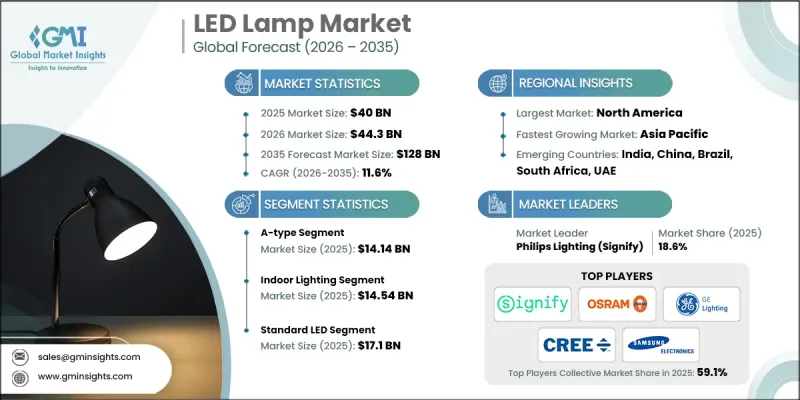
The Global LED Lamp Market was valued at USD 40 billion in 2025 and is estimated to grow at a CAGR of 11.6% to reach USD 128 billion by 2035.
The market is expanding rapidly, driven by the push for energy-efficient lighting, cost savings, favorable government regulations, rapid urbanization, and rising adoption of smart and connected lighting systems. LED lamps consume significantly less energy than traditional lighting technologies, offering long-term savings for households, businesses, and public institutions while reducing environmental impact. Governments worldwide are introducing efficiency standards that accelerate LED adoption, cut greenhouse gas emissions, and lower electricity expenses. Smart and networked LED lighting solutions, integrated with sensors and controls, are increasingly deployed in commercial, institutional, and smart city projects, optimizing energy consumption and enhancing user comfort. Industrial, commercial, and residential sectors are driving widespread adoption, making LED lamps a critical component in modern infrastructure and sustainable development initiatives.
| Market Scope | |
|---|---|
| Start Year | 2025 |
| Forecast Year | 2026-2035 |
| Start Value | $40 Billion |
| Forecast Value | $128 Billion |
| CAGR | 11.6% |
The A-type segment generated USD 14.14 billion in 2025. A-type LED lamps are widely adopted due to government mandates phasing out incandescent and inefficient lighting. These lamps offer longer lifespans, lower maintenance, and reduced energy consumption across residential and commercial spaces. Energy efficiency programs, building codes, and retrofit initiatives are driving mainstream adoption, with manufacturers focusing on high-efficacy, retrofit-ready A-type lamps to align with regulatory compliance and sustainability targets.
The indoor lighting segment accounted for USD 14.54 billion in 2025. Rising demand in homes, offices, and institutional buildings is fueling the market. Indoor LED lighting provides high efficiency, extended durability, and lower operational costs compared to conventional lighting. Compliance with energy-efficiency regulations and building codes across regions further encourages adoption. Manufacturers are prioritizing versatile, high-quality indoor LED solutions with retrofit kits and smart control capabilities to capture large-scale deployments.
North America LED Lamp Market held a 38.5% share in 2025. The region's growth is supported by stringent energy efficiency standards, sustainability initiatives, and government incentives promoting solid-state lighting in public infrastructure, residential retrofits, and commercial projects. Utility rebate programs, connected lighting systems, and smart controls enhance operational performance while lowering energy costs, driving adoption across new constructions and retrofit projects.
Key players in the LED Lamp Market include Philips Lighting (Signify), Osram, GE Lighting, Cree, Inc., Samsung Electronics, LG Innotek, Acuity Brands, Eaton Corporation, Hubbell Incorporated, Zumtobel Group, Nichia Corporation, Seoul Semiconductor, Everlight Electronics, Lumileds Holding B.V., Dialight plc, MLS Co., Ltd. (Forest Lighting), Toshiba Lighting & Technology Corporation, Panasonic Corporation, Bridgelux, Inc., Lumens Co., Ltd., Epistar Corporation, Toyoda Gosei Co., Ltd., Citizen Electronics Co., Ltd., and Sharp Corporation. Companies in the Global LED Lamp Market are adopting strategies such as expanding R&D for high-efficacy and smart lighting solutions, developing retrofit-compatible products, and ensuring compliance with energy certification standards. Firms are forming strategic alliances, leveraging government incentives, and targeting commercial, industrial, and smart city projects to boost adoption. Geographic expansion, digital marketing, and distributor partnerships enhance market reach. Innovation in connected and energy-efficient lighting, combined with after-sales support, ensures customer loyalty, strengthens brand positioning, and addresses evolving sustainability and operational efficiency demands.
Table of Contents
Chapter 1 Methodology and Scope
- 1.1 Market scope and definition
- 1.2 Research design
- 1.2.1 Research approach
- 1.2.2 Data collection methods
- 1.3 Data mining sources
- 1.3.1 Global
- 1.3.2 Regional/Country
- 1.4 Base estimates and calculations
- 1.4.1 Base year calculation
- 1.4.2 Key trends for market estimation
- 1.5 Primary research and validation
- 1.5.1 Primary sources
- 1.6 Forecast model
- 1.7 Research assumptions and limitations
Chapter 2 Executive Summary
- 2.1 Industry 360° synopsis
- 2.2 Key market trends
- 2.2.1 Product type trends
- 2.2.2 Technology trends
- 2.2.3 Distribution Channel trends
- 2.2.4 Application trends
- 2.2.5 End-user trends
- 2.2.6 Regional trends
- 2.3 TAM Analysis, 2026 - 2035 (USD Million)
- 2.4 CXO perspectives: Strategic imperatives
- 2.4.1 Executive decision points
- 2.4.2 Critical success factors
- 2.5 Future outlook and strategic recommendations
Chapter 3 Industry Insights
- 3.1 Industry ecosystem analysis
- 3.1.1 Supplier landscape
- 3.1.2 Profit margin
- 3.1.3 Cost structure
- 3.1.4 Value addition at each stage
- 3.1.5 Factor affecting the value chain
- 3.1.6 Disruptions
- 3.2 Industry impact forces
- 3.2.1 Growth drivers
- 3.2.1.1 Energy efficiency and cost savings
- 3.2.1.2 Government regulations and energy policies
- 3.2.1.3 Rapid urbanization and infrastructure development
- 3.2.1.4 Growing demand for smart and connected lighting
- 3.2.1.5 Rising adoption in commercial and industrial applications
- 3.2.2 Pitfalls and challenges
- 3.2.2.1 High initial installation costs in price-sensitive markets
- 3.2.2.2 Quality inconsistency and presence of counterfeit products
- 3.2.1 Growth drivers
- 3.3 Growth potential analysis
- 3.4 Regulatory landscape
- 3.4.1 North America
- 3.4.2 Europe
- 3.4.3 Asia Pacific
- 3.4.4 Latin America
- 3.4.5 Middle East & Africa
- 3.5 Porter’s analysis
- 3.6 PESTEL analysis
- 3.7 Technology and Innovation landscape
- 3.7.1 Current technological trends
- 3.7.2 Emerging technologies
- 3.8 Emerging Business Models
- 3.9 Compliance Requirements
- 3.10 Supply Chain Resilience
- 3.11 Geopolitical Analysis
Chapter 4 Competitive Landscape, 2025
- 4.1 Introduction
- 4.2 Company market share analysis
- 4.2.1 By region
- 4.2.1.1 North America
- 4.2.1.2 Europe
- 4.2.1.3 Asia Pacific
- 4.2.1.4 Latin America
- 4.2.1.5 Middle East & Africa
- 4.2.2 Market concentration analysis
- 4.2.1 By region
- 4.3 Competitive benchmarking of key players
- 4.3.1 Product portfolio comparison
- 4.3.1.1 Product range breadth
- 4.3.1.2 Technology
- 4.3.1.3 Innovation
- 4.3.2 Geographic presence comparison
- 4.3.2.1 Global footprint analysis
- 4.3.2.2 Service network coverage
- 4.3.2.3 Market penetration by region
- 4.3.3 Competitive positioning matrix
- 4.3.3.1 Leaders
- 4.3.3.2 Challengers
- 4.3.3.3 Followers
- 4.3.3.4 Niche players
- 4.3.4 Strategic outlook matrix
- 4.3.1 Product portfolio comparison
- 4.4 Key developments, 2022-2025
- 4.4.1 Mergers and acquisitions
- 4.4.2 Partnerships and collaborations
- 4.4.3 Technological advancements
- 4.4.4 Expansion and investment strategies
- 4.4.5 Sustainability initiatives
- 4.4.6 Digital transformation initiatives
- 4.5 Emerging/ startup competitors landscape
Chapter 5 Market Estimates and Forecast, By Product Type, 2022 - 2035 (USD Million & Units)
- 5.1 Key trends
- 5.2 A-type
- 5.3 T-type
- 5.4 Decorative lamps
- 5.5 Reflectors
- 5.6 Others
Chapter 6 Market Estimates and Forecast, By Technology, 2022 - 2035 (USD Million & Units)
- 6.1 Key Trends
- 6.2 Standard LED
- 6.3 Smart LED
- 6.4 OLED
Chapter 7 Market Estimates and Forecast, By Distribution Channel, 2022 - 2035 (USD Million & Units)
- 7.1 Key Trends
- 7.2 Online retailers
- 7.3 Specialty stores
- 7.4 Supermarkets/Hypermarkets
- 7.5 Direct sales
Chapter 8 Market Estimates and Forecast, By Application, 2022 - 2035 (USD Million & Units)
- 8.1 Key Trends
- 8.2 Indoor lighting
- 8.3 Outdoor lighting
- 8.4 Automotive lighting
- 8.5 Others (e.g., horticulture, signage)
Chapter 9 Market Estimates and Forecast, By End-User, 2022 - 2035 (USD Million & Units)
- 9.1 Key trends
- 9.2 Residential
- 9.3 Commercial
- 9.4 Industrial
- 9.5 Government/Public
Chapter 10 Market Estimates and Forecast, By Region, 2022 - 2035 (USD Million & Units)
- 10.1 Key trends
- 10.2 North America
- 10.2.1 U.S.
- 10.2.2 Canada
- 10.3 Europe
- 10.3.1 Germany
- 10.3.2 UK
- 10.3.3 France
- 10.3.4 Spain
- 10.3.5 Italy
- 10.3.6 Netherlands
- 10.4 Asia Pacific
- 10.4.1 China
- 10.4.2 India
- 10.4.3 Japan
- 10.4.4 Australia
- 10.4.5 South Korea
- 10.5 Latin America
- 10.5.1 Brazil
- 10.5.2 Mexico
- 10.5.3 Argentina
- 10.6 Middle East and Africa
- 10.6.1 Saudi Arabia
- 10.6.2 South Africa
- 10.6.3 UAE
Chapter 11 Company Profiles
- 11.1 Global Key Players
- 11.1.1 Philips Lighting (Signify)
- 11.1.2 Osram
- 11.1.3 GE Lighting
- 11.1.4 Samsung Electronics
- 11.1.5 Cree, Inc.
- 11.1.6 Nichia Corporation
- 11.1.7 Panasonic Corporation
- 11.1.8 Lumileds Holding B.V.
- 11.2 Regional Key Players
- 11.2.1 North America
- 11.2.1.1 Acuity Brands
- 11.2.1.2 Eaton Corporation
- 11.2.1.3 Hubbell Incorporated
- 11.2.1.4 Bridgelux, Inc.
- 11.2.2 Europe
- 11.2.2.1 Zumtobel Group
- 11.2.2.2 Dialight plc
- 11.2.2.3 Toyoda Gosei Co., Ltd.
- 11.2.2.4 Citizen Electronics Co., Ltd.
- 11.2.3 Asia Pacific
- 11.2.3.1 LG Innotek
- 11.2.3.2 Seoul Semiconductor
- 11.2.3.3 Everlight Electronics
- 11.2.3.4 MLS Co., Ltd. (Forest Lighting)
- 11.2.3.5 Toshiba Lighting & Technology Corporation
- 11.2.3.6 Lumens Co., Ltd.
- 11.2.1 North America
- 11.3 Niche / Disruptors
- 11.3.1 Epistar Corporation
- 11.3.2 Sharp Corporation

