PUBLISHER: Global Market Insights Inc. | PRODUCT CODE: 1959651

PUBLISHER: Global Market Insights Inc. | PRODUCT CODE: 1959651
Distributed Antenna System (DAS) Market Opportunity, Growth Drivers, Industry Trend Analysis, and Forecast 2026 - 2035
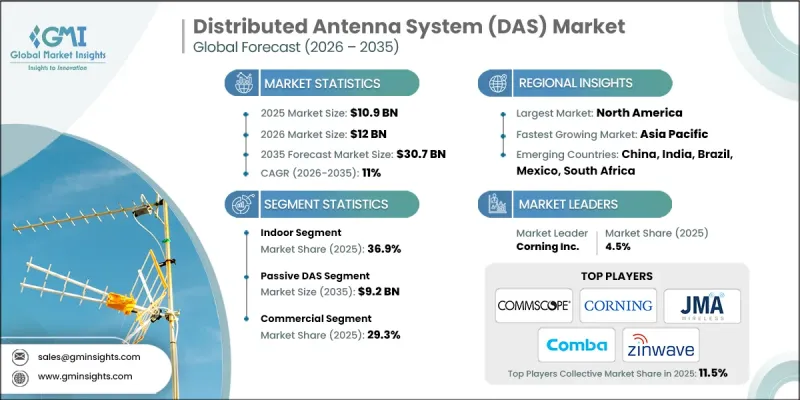
The Global Distributed Antenna System (DAS) Market was valued at USD 10.9 billion in 2025 and is estimated to grow at a CAGR of 11% to reach USD 30.7 billion by 2035.
A distributed antenna system (DAS) is a wireless network architecture that deploys multiple antenna nodes across various locations, all connected to a centralized source to deliver seamless coverage across large or structurally complex areas. This approach enhances signal strength, expands network capacity, and improves service reliability in environments where traditional macro towers are insufficient. The Distributed Antenna System (DAS) Market is increasingly centered on strengthening indoor connectivity within dense and high-traffic facilities. Modern systems are engineered to eliminate coverage gaps, stabilize signal performance, and support uninterrupted connectivity for both mobile users and IoT-enabled devices. Rising data consumption and the rapid expansion of connected technologies are further accelerating DAS adoption. As digital infrastructure becomes central to enterprise operations and smart environments, distributed antenna systems are emerging as a foundational component of high-performance wireless ecosystems.
| Market Scope | |
|---|---|
| Start Year | 2025 |
| Forecast Year | 2026-2035 |
| Start Value | $10.9 Billion |
| Forecast Value | $30.7 Billion |
| CAGR | 11% |
Adoption of DAS networks is rising across transportation hubs, large commercial facilities, and event-driven venues where consistent indoor coverage is essential. Enterprises are integrating DAS with advanced Wi-Fi standards to manage escalating network traffic and support bandwidth-intensive applications. Vendors are prioritizing energy-efficient designs and modular architectures that simplify upgrades and enable phased deployments. Scalable DAS frameworks allow operators to expand coverage incrementally while managing capital investment effectively. The growing integration of IoT across industrial, healthcare, and enterprise environments is further strengthening the role of DAS in enabling real-time communication and operational visibility. As building intelligence solutions evolve, distributed antenna systems are becoming critical to supporting interconnected digital infrastructure.
The indoor segment accounted for 36.9% share in 2025. Deployment of indoor DAS solutions across commercial complexes, healthcare facilities, and transportation infrastructure continues to accelerate in response to rising connectivity demands. Indoor systems address signal dead zones, accommodate high user density, and integrate seamlessly with 5G and advanced Wi-Fi technologies. Manufacturers are focusing on improving modular configurations, enhancing high-capacity performance, and simplifying installation and lifecycle management to support enterprise and public-sector deployments.
The passive DAS segment is projected to reach USD 9.2 billion by 2035. Passive systems are widely selected for cost-effective building and venue installations, utilizing components such as splitters and couplers to distribute signals without active amplification. These systems offer low maintenance requirements, support multiple carriers, and provide reliable signal extension at reduced operational complexity. Industry participants are emphasizing affordable design, simplified deployment, and enhanced multi-operator compatibility to attract clients seeking stable coverage without significant infrastructure investment.
North America Distributed Antenna System (DAS) Market held 33.2% share in 2025. Regional leadership is supported by rapid 5G rollouts, expanding public safety communication requirements, and increasing demand for reliable indoor wireless coverage across commercial, healthcare, and transportation sectors. Enterprise and neutral-host DAS solutions are gaining traction in high-density facilities, supported by integrated small-cell deployments and fiber-rich backhaul infrastructure that boosts network capacity. Ongoing public safety mandates and smart building modernization initiatives continue to drive innovation in DAS network architecture throughout the region.
Key companies operating in the Global Distributed Antenna System (DAS) Market include CommScope, Inc., Corning Incorporated, JMA Wireless, HUBER+SUHNER, Comba Telecom Systems Holdings Ltd., Boingo Wireless, Inc., Zinwave, Advanced RF Technologies, Inc., BTI Wireless, Betacom, ATC IP LLC, CenRF Communications Limited, Symphony Technology Solutions, Inc., Decypher, Fixtel Services, and Corning Inc. Companies in the distributed antenna system market are strengthening their competitive position through strategic partnerships with telecom operators, expansion of neutral-host solutions, and continuous investment in 5G-compatible infrastructure. Many vendors are focusing on modular, energy-efficient system designs that allow scalable deployment and simplified upgrades. Collaboration with real estate developers and enterprise clients supports early integration of DAS into new construction projects. Firms are also enhancing multi-operator support and fiber integration capabilities to improve network performance.
Table of Contents
Chapter 1 Methodology and Scope
- 1.1 Market scope and definition
- 1.2 Research design
- 1.2.1 Research approach
- 1.2.2 Data collection methods
- 1.3 Data mining sources
- 1.3.1 Global
- 1.3.2 Regional/Country
- 1.4 Base estimates and calculations
- 1.4.1 Base year calculation
- 1.4.2 Key trends for market estimation
- 1.5 Primary research and validation
- 1.5.1 Primary sources
- 1.6 Forecast model
- 1.7 Research assumptions and limitations
Chapter 2 Executive Summary
- 2.1 Industry 360° synopsis, 2022 - 2035
- 2.2 Key market trends
- 2.2.1 Network coverage trends
- 2.2.2 Ownership trends
- 2.2.3 Distribution type trends
- 2.2.4 Signal source trends
- 2.2.5 Application trends
- 2.2.6 Regional trends
- 2.3 TAM analysis, 2026-2035
- 2.4 CXO perspectives: Strategic imperatives
- 2.4.1 Executive decision points
- 2.4.2 Critical success factors
- 2.5 Future outlook and strategic recommendations
Chapter 3 Industry Insights
- 3.1 Industry ecosystem analysis
- 3.1.1 Supplier landscape
- 3.1.2 Profit margin analysis
- 3.1.3 Cost structure
- 3.1.4 Value addition at each stage
- 3.1.5 Factor affecting the value chain
- 3.1.6 Disruptions
- 3.2 Industry impact forces
- 3.2.1 Growth drivers
- 3.2.1.1 Rapid proliferation of smart devices and IoT endpoints
- 3.2.1.2 Growing adoption of 5G networks
- 3.2.1.3 Surge in data traffic and network congestion
- 3.2.1.4 Infrastructure investments by telecom operators
- 3.2.2 Industry pitfalls and challenges
- 3.2.2.1 Routing backhauling concerns associated with DAS
- 3.2.2.2 High costs associated with Das network deployment
- 3.2.1 Growth drivers
- 3.3 Growth potential analysis
- 3.4 Regulatory landscape
- 3.4.1 North America
- 3.4.2 Europe
- 3.4.3 Asia Pacific
- 3.4.4 Latin America
- 3.4.5 Middle East & Africa
- 3.5 Porter's analysis
- 3.6 PESTEL analysis
- 3.7 Technology and Innovation landscape
- 3.7.1 Current technological trends
- 3.7.2 Emerging technologies
- 3.8 Emerging business models
- 3.9 Compliance requirements
- 3.10 Geopolitical analysis
- 3.11 Mergers, acquisitions, and strategic partnerships landscape
Chapter 4 Competitive Landscape, 2025
- 4.1 Introduction
- 4.2 Company market share analysis
- 4.2.1 By region
- 4.2.1.1 North America
- 4.2.1.2 Europe
- 4.2.1.3 Asia Pacific
- 4.2.1.4 Latin America
- 4.2.1.5 Middle East & Africa
- 4.2.1 By region
- 4.3 Competitive benchmarking of key players
- 4.3.1 Financial performance comparison
- 4.3.1.1 Revenue
- 4.3.1.2 Profit margin
- 4.3.1.3 R&D
- 4.3.2 Product portfolio comparison
- 4.3.2.1 Product range breadth
- 4.3.2.2 Technology
- 4.3.2.3 Innovation
- 4.3.3 Geographic presence comparison
- 4.3.3.1 Global footprint analysis
- 4.3.3.2 Service network coverage
- 4.3.3.3 Market penetration by region
- 4.3.4 Competitive positioning matrix
- 4.3.4.1 Leaders
- 4.3.4.2 Challengers
- 4.3.4.3 Followers
- 4.3.4.4 Niche players
- 4.3.5 Strategic outlook matrix
- 4.3.1 Financial performance comparison
- 4.4 Key developments, 2021-2024
- 4.4.1 Mergers and acquisitions
- 4.4.2 Partnerships and collaborations
- 4.4.3 Technological advancements
- 4.4.4 Expansion and investment strategies
- 4.4.5 Digital transformation initiatives
- 4.5 Emerging/ startup competitors landscape
Chapter 5 Market Estimates and Forecast, By Network Coverage, 2022 - 2035 ($ Mn)
- 5.1 Key trends
- 5.2 Indoor
- 5.3 Outdoor
Chapter 6 Market Estimates and Forecast, By Ownership, 2022 - 2035 ($ Mn)
- 6.1 Key trends
- 6.2 Carrier ownership
- 6.3 Neutral-host ownership
- 6.4 Enterprise ownership
Chapter 7 Market Estimates and Forecast, By Distribution Type, 2022 - 2035 ($ Mn)
- 7.1 Key trends
- 7.2 Active DAS
- 7.2.1 Analog
- 7.2.2 Digital
- 7.3 Passive DAS
- 7.4 Hybrid DAS
Chapter 8 Market Estimates and Forecast, By Signal Source, 2022 - 2035 ($ Mn)
- 8.1 Key trends
- 8.2 Off air antennas
- 8.3 On-site base transceiver station (BTS)
- 8.4 Small cells
Chapter 9 Market Estimates and Forecast, By Application, 2022 - 2035 ($ Mn)
- 9.1 Key trends
- 9.2 Commercial
- 9.2.1 Hospitality
- 9.2.2 Healthcare
- 9.2.3 Educational
- 9.2.4 Retail
- 9.3 Residential
- 9.4 Airport & transportation
- 9.5 Industrial
- 9.6 Government & public safety
- 9.7 Others
Chapter 10 Market Estimates and Forecast, By Region, 2022 - 2035 ($ Mn)
- 10.1 Key trends
- 10.2 North America
- 10.2.1 U.S.
- 10.2.2 Canada
- 10.3 Europe
- 10.3.1 Germany
- 10.3.2 UK
- 10.3.3 France
- 10.3.4 Spain
- 10.3.5 Italy
- 10.3.6 Netherlands
- 10.4 Asia Pacific
- 10.4.1 China
- 10.4.2 India
- 10.4.3 Japan
- 10.4.4 Australia
- 10.4.5 South Korea
- 10.5 Latin America
- 10.5.1 Brazil
- 10.5.2 Mexico
- 10.5.3 Argentina
- 10.6 Middle East and Africa
- 10.6.1 South Africa
- 10.6.2 Saudi Arabia
- 10.6.3 UAE
Chapter 11 Company Profiles
- 11.1 Global Key Players
- 11.1.1 CommScope, Inc.
- 11.1.2 Corning Incorporated
- 11.1.3 Nokia
- 11.2 Regional Key Players
- 11.2.1 North America
- 11.2.1.1 Advanced RF Technologies, Inc.
- 11.2.1.2 ATC TRS V LLC.
- 11.2.1.3 Boingo Wireless, Inc.
- 11.2.1.4 JMA Wireless
- 11.2.1.5 Symphony Technology Solutions, Inc.
- 11.2.2 Europe
- 11.2.2.1 BTI wireless
- 11.2.2.2 Cobham Wireless
- 11.2.2.3 HUBER+SUHNER
- 11.2.2.4 Zinwave
- 11.2.3 APAC
- 11.2.3.1 Betacom
- 11.2.3.2 CenRF Communications Limited
- 11.2.3.3 Comba Telecom Systems Holdings Ltd.
- 11.2.3.4 Decypher
- 11.2.1 North America
- 11.3 Niche Players / Disruptors
- 11.3.1 Fixtel Services
- 11.3.2 Galtronics

