PUBLISHER: Global Market Insights Inc. | PRODUCT CODE: 1959652

PUBLISHER: Global Market Insights Inc. | PRODUCT CODE: 1959652
Electric Mobile Light Tower Market Opportunity, Growth Drivers, Industry Trend Analysis, and Forecast 2026 - 2035
The Global Electric Mobile Light Tower Market was valued at USD 447.6 million in 2025 and is estimated to grow at a CAGR of 6.1% to reach USD 811.4 million by 2035.
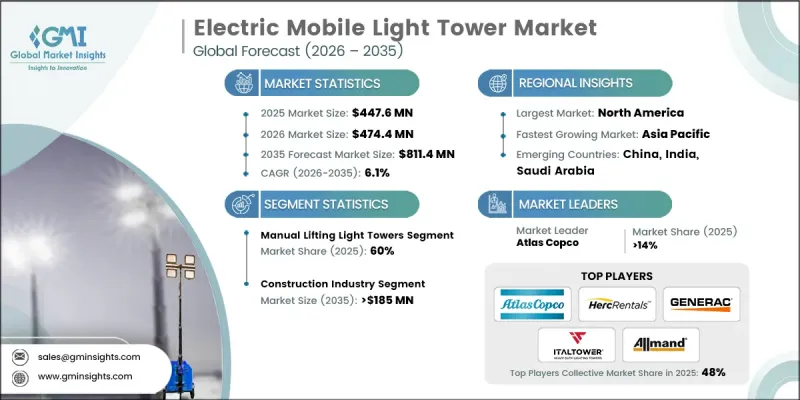
The shift from diesel-powered to electric light towers is being driven by decarbonization targets, regulatory support, and financial incentives that improve the total cost of ownership, operational compliance, and access to project financing. Rising energy security concerns and fuel supply volatility are encouraging contractors, municipalities, and industrial operators to adopt battery, plug-in, and solar-powered lighting solutions that reduce diesel dependency and minimize refueling logistics. Falling costs for clean technologies, along with expanded production capacities, are making electric light towers more accessible to rental fleets and end users worldwide. Large-scale infrastructure programs requiring nighttime operations are increasing demand for mobile lighting while favoring quieter, zero-emission equipment in urban areas. Emerging markets with rapid infrastructure development are expanding the addressable base for electric mobile light towers, particularly where projects prioritize noise and air quality management. Public funding and industrial policies targeting higher-performance batteries, advanced power electronics, and hydrogen systems are enhancing operational range, charging flexibility, and overall tower reliability.
| Market Scope | |
|---|---|
| Start Year | 2025 |
| Forecast Year | 2026-2035 |
| Start Value | $447.6 Million |
| Forecast Value | $811.4 Million |
| CAGR | 6.1% |
The manual lifting light towers segment accounted for 60% share in 2025 and is expected to grow at a CAGR of 5.3% through 2035. These towers remain popular because they offer simple mechanical elevation, fast field serviceability, and minimal training requirements for smaller crews. Buyers increasingly pair manual lifting systems with low-noise electric powertrains to reduce community disruption and worker exposure, making these models ideal for urban, utility, and event applications. Manual lifting designs are particularly favored in rental fleets due to portability, compact footprints, fewer hydraulic components, and straightforward inspection routines, which reduce downtime and allow quicker deployment between projects. Their simplicity, combined with quieter electric operation, provides a cost-effective and reliable solution for diverse work environments.
The construction industry represented 22% share in 2025 and is projected to reach USD 185 million by 2035. Contractors increasingly rely on electric mobile light towers to maintain compliant illumination during extended work hours while minimizing emissions and noise pollution at job sites. Battery-powered solutions, often integrated with LED lighting, allow construction operators to reduce operational costs and meet sustainability goals, particularly in urban and residential areas where environmental regulations are strict.
U.S. Electric Mobile Light Tower Market was valued at USD 108.8 million in 2025, driven by energy-efficient LED and hybrid lighting systems that enhance performance, reduce power consumption, and extend operational uptime. Expanding jobsite electrification and corridor-based charging networks are supporting rental fleets in deploying battery-powered lighting solutions without relying on diesel refueling, further encouraging uptake across construction, industrial, and municipal applications.
Key players in the Global Electric Mobile Light Tower Market include Alrouf, Allmand, Atlas Copco, Axiom Equipment Group, Boss LTR, Chicago Pneumatic, Generac, Grandwatt Electric, Herc Rentals, Italtower, Larson Electronics, Metrolite, Olikara Lighting Towers, Pramac, Tower Light, TRIME, United Rentals, and Wanco. Companies in the Electric Mobile Light Tower Market are focusing on strengthening their position by investing in R&D to improve battery capacity, charging speed, and energy efficiency. Partnerships with energy providers, rental operators, and municipalities enable integrated lighting solutions that reduce operational costs and increase adoption. Expansion into emerging regions, standardization of modular tower designs, and development of hybrid and solar-assisted solutions help broaden market reach. Manufacturers are also improving service networks, offering predictive maintenance and extended warranties, and enhancing fleet management software to optimize uptime and efficiency. By combining technology innovation, strategic alliances, and strong after-sales support, companies are solidifying their market presence and accelerating the transition from diesel to electric mobile lighting systems.
Table of Contents
Chapter 1 Methodology & Scope
- 1.1 Research design
- 1.1.1 Research approach
- 1.1.2 Data collection methods
- 1.2 Base estimates and calculations
- 1.2.1 Base year calculation
- 1.2.2 Market estimates & forecast parameters
- 1.3 Forecast
- 1.3.1 Key trends for market estimates
- 1.3.2 Quantified market impact analysis
- 1.3.2.1 Mathematical impact of growth parameters on forecast
- 1.3.3 Scenario analysis framework
- 1.4 Primary research and validation
- 1.4.1 Some of the primary sources (but not limited to)
- 1.5 Data mining sources
- 1.5.1 Paid Sources
- 1.5.2 Sources, by region
- 1.6 Research trail & scoring components
- 1.6.1 Research trail components
- 1.6.2 Scoring components
- 1.7 Research transparency addendum
- 1.7.1 Source attribution framework
- 1.7.2 Quality assurance metrics
- 1.7.3 Our commitment to trust
- 1.8 Market definitions
Chapter 2 Executive Summary
- 2.1 Industry synopsis, 2022 - 2035
- 2.1.1 Business trends
- 2.1.2 Technology trends
- 2.1.3 Application trends
- 2.1.4 Regional trends
Chapter 3 Industry Insights
- 3.1 Industry ecosystem analysis
- 3.1.1 Raw material availability & sourcing analysis
- 3.1.2 Manufacturing capacity assessment
- 3.1.3 Supply chain resilience & risk factors
- 3.1.4 Distribution network analysis
- 3.2 Regulatory landscape
- 3.3 Industry impact forces
- 3.3.1 Growth drivers
- 3.3.2 Industry pitfalls & challenges
- 3.4 Growth potential analysis
- 3.5 Porter's analysis
- 3.5.1 Bargaining power of suppliers
- 3.5.2 Bargaining power of buyers
- 3.5.3 Threat of new entrants
- 3.5.4 Threat of substitutes
- 3.6 PESTEL analysis
- 3.6.1 Political factors
- 3.6.2 Economic factors
- 3.6.3 Social factors
- 3.6.4 Technological factors
- 3.6.5 Legal factors
- 3.6.6 Environmental factors
- 3.7 Technology & Innovation Landscape
- 3.7.1 Battery energy storage systems (BESS) integration
- 3.7.2 Lithium-Ion vs lead-acid technology comparison
- 3.7.3 Solar-hybrid integration technologies
- 3.8 Price trend analysis, 2022-2035
- 3.9 Emerging opportunities & trends
- 3.10 Investment analysis & future prospects
Chapter 4 Competitive Landscape, 2025
- 4.1 Introduction
- 4.2 Company market share analysis, by region, 2025
- 4.2.1 North America
- 4.2.2 Europe
- 4.2.3 Asia Pacific
- 4.2.4 Middle East & Africa
- 4.2.5 Latin America
- 4.3 Key developments
- 4.3.1 Mergers & acquisitions
- 4.3.2 Partnerships & collaborations
- 4.3.3 New product launches
- 4.3.4 Expansion plans and funding
- 4.4 Competitive benchmarking
- 4.5 Innovation & sustainability landscape
Chapter 5 Market Size and Forecast, By Technology, 2022 - 2035 (USD Million & '000 Units)
- 5.1 Key trends
- 5.2 Manual lifting system
- 5.3 Hydraulic lifting system
Chapter 6 Market Size and Forecast, By Application, 2022 - 2035 (USD Million & '000 Units)
- 6.1 Key trends
- 6.2 Construction
- 6.3 Infrastructure development
- 6.4 Oil & gas
- 6.5 Mining
- 6.6 Military & defense
- 6.7 Emergency & disaster relief
- 6.8 Others
Chapter 7 Market Size and Forecast, By Region, 2022 - 2035 (USD Million & '000 Units)
- 7.1 Key trends
- 7.2 North America
- 7.2.1 U.S.
- 7.2.2 Canada
- 7.2.3 Mexico
- 7.3 Europe
- 7.3.1 Germany
- 7.3.2 UK
- 7.3.3 France
- 7.3.4 Italy
- 7.3.5 Spain
- 7.3.6 Russia
- 7.4 Asia Pacific
- 7.4.1 China
- 7.4.2 Japan
- 7.4.3 India
- 7.4.4 Australia
- 7.4.5 South Korea
- 7.5 Middle East & Africa
- 7.5.1 Saudi Arabia
- 7.5.2 UAE
- 7.5.3 Qatar
- 7.5.4 Iran
- 7.5.5 South Africa
- 7.6 Latin America
- 7.6.1 Brazil
- 7.6.2 Argentina
Chapter 8 Company Profiles
- 8.1 Alrouf
- 8.2 Allmand
- 8.3 Atlas Copco
- 8.4 Axiom Equipment Group
- 8.5 Boss LTR
- 8.6 Chicago Pneumatic
- 8.7 Generac
- 8.8 Grandwatt Electric
- 8.9 Herc Rentals
- 8.10 Italtower
- 8.11 Larson Electronic
- 8.12 Metrolite
- 8.13 Olikara Lighting Towers
- 8.14 Pramac
- 8.15 Tower Light
- 8.16 TRIME
- 8.17 United Rentals
- 8.18 Wanco

