
PUBLISHER: Global Market Insights Inc. | PRODUCT CODE: 1959654

PUBLISHER: Global Market Insights Inc. | PRODUCT CODE: 1959654
Down Jacket Market Opportunity, Growth Drivers, Industry Trend Analysis, and Forecast 2026 - 2035
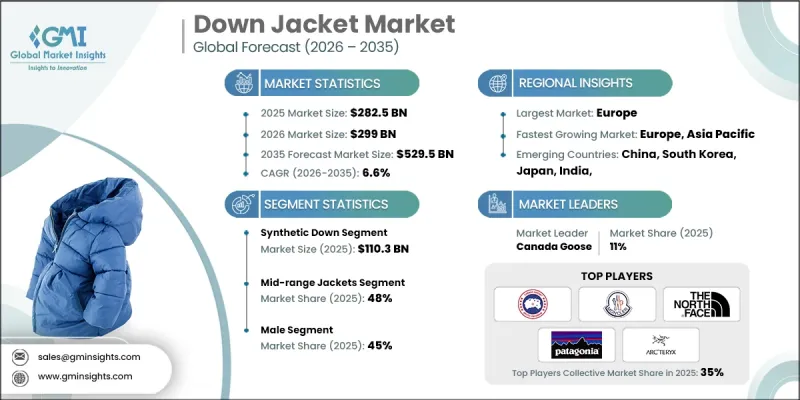
The Global Down Jacket Market was valued at USD 282.5 billion in 2025 and is estimated to grow at a CAGR of 6.6% to reach USD 529.5 billion by 2035.
The market has emerged as a dynamic and steadily expanding segment within the global apparel industry, fueled by growing demand for thermal comfort, fashion-forward designs, and performance-driven outerwear. Consumers are increasingly seeking jackets that combine superior insulation, lightweight construction, and warmth in extreme cold conditions. Rising interest in functional, durable, and stylish winter apparel is driving steady adoption, particularly in regions with long and harsh winters. In addition, the growing participation in winter sports, adventure tourism, and outdoor recreational activities has heightened the need for high-performance down jackets. Affordability and long-term value play a critical role in purchasing decisions, as buyers now consider these jackets as lasting investments rather than luxury items. Sustainability has also emerged as a key trend, with consumers increasingly preferring environmentally responsible and ethically sourced materials. Overall, the market is witnessing balanced growth through a mix of fashion appeal, performance innovation, and practical considerations.
| Market Scope | |
|---|---|
| Start Year | 2025 |
| Forecast Year | 2026-2035 |
| Start Value | $282.5 Billion |
| Forecast Value | $529.5 Billion |
| CAGR | 6.6% |
The synthetic down segment held a 39.3% share, generating USD 110.3 billion in 2025. Synthetic insulation maintains loft and warmth even in wet conditions, unlike natural down, which loses efficiency when damp. Its water-resistant and quick-drying properties make it highly suitable for wet climates, outdoor adventures, and high-activity pursuits. Additionally, synthetic down jackets are more durable, easier to care for, and retain their shape over repeated use and washing, appealing to consumers seeking low-maintenance, long-lasting outerwear options.
The mid-range down jackets segment accounted for 48% share in 2025 and is projected to grow at a CAGR of 48.8% through 2035. This segment provides a balanced combination of quality, performance, and affordability. Consumers in this category seek superior insulation, durability, and functional features without the premium price tag associated with high-end jackets. Mid-range products democratize access to high-quality outerwear, appealing to a broader audience beyond dedicated outdoor enthusiasts. Brands offering competitively priced jackets in this segment capture market share by emphasizing value, performance, and everyday usability, while budget options continue to rely heavily on affordability as the primary driver.
North America Down Jacket Market reached USD 81.4 billion in 2025 and is projected to grow at a CAGR of 6.4% through 2035. The region benefits from extreme winter climates, a strong outdoor culture, and consumers' willingness to invest in high-performance winter apparel. Growth is supported by rising participation in winter sports, outdoor recreation, and adventure travel. At the same time, urban consumers increasingly adopt down jackets for daily wear, which reinforces year-round relevance and allows brands to maintain premium pricing.
Key players in the Global Down Jacket Market include Patagonia, Inc., Black Diamond Equipment, Ltd., Fjallraven International AB, The North Face, Arc'teryx Equipment, Inc., Columbia Sportswear Company, Jack Wolfskin GmbH & Co. KGaA, Moncler, Helly Hansen, Mammut Sports Group AG, Outdoor Research, Eddie Bauer LLC, Canada Goose Holdings Inc., Marmot Mountain, LLC, and Rab Equipment Ltd. Companies in the down jacket market strengthen their presence by launching innovative products that balance warmth, style, and environmental sustainability. Many invest in R&D to improve insulation technology, lightweight materials, and water-resistance features. Strategic collaborations with retail and e-commerce partners expand distribution reach, while marketing campaigns highlight performance, fashion, and eco-conscious aspects. Brands are also focusing on limited-edition and seasonal collections to create exclusivity and maintain brand desirability.
Table of Contents
Chapter 1 Methodology and Scope
- 1.1 Market scope and definition
- 1.2 Research design
- 1.2.1 Research approach
- 1.2.2 Data collection methods
- 1.3 Data mining sources
- 1.3.1 Region
- 1.3.2 Regional/Country
- 1.4 Base estimates and calculations
- 1.4.1 Base year calculation
- 1.4.2 Key trends for market estimation
- 1.5 Primary research and validation
- 1.5.1 Primary sources
- 1.6 Forecast model
- 1.7 Research assumptions and limitations
Chapter 2 Executive Summary
- 2.1 Industry 360° synopsis
- 2.2 Key market trends
- 2.2.1 Country
- 2.2.2 Material
- 2.2.3 Consumer Group
- 2.2.4 Price range
- 2.2.5 End User
- 2.2.6 Distribution Channel
- 2.3 CXO perspectives: Strategic imperatives
- 2.3.1 Key decision points for industry executives
- 2.3.2 Critical success factors for market players
- 2.4 Future outlook and strategic recommendations
Chapter 3 Industry Insights
- 3.1 Industry ecosystem analysis
- 3.1.1 Supplier landscape
- 3.1.2 Profit margin
- 3.1.3 Value addition at each stage
- 3.1.4 Factor affecting the value chain
- 3.2 Industry impact forces
- 3.2.1 Growth drivers
- 3.2.1.1 Rising demand for cold-weather performance apparel
- 3.2.1.2 Growing focus on sustainability & ethical sourcing
- 3.2.1.3 Expansion of outdoor & lifestyle fashion
- 3.2.2 Industry pitfalls & challenges
- 3.2.2.1 Volatility in raw material prices
- 3.2.2.2 Ethical sourcing & regulatory compliance
- 3.2.3 Opportunities
- 3.2.3.1 Sustainable and recycled down innovations
- 3.2.3.2 Technological fabric advancements
- 3.2.1 Growth drivers
- 3.3 Growth potential analysis
- 3.4 Future market trends
- 3.5 Technology and innovation landscape
- 3.5.1 Current technological trends
- 3.5.2 Emerging technologies
- 3.6 Price trends
- 3.6.1 By Region
- 3.6.2 By Material
- 3.7 Regulatory landscape
- 3.7.1 Standards and compliance requirements
- 3.7.2 Regional regulatory frameworks
- 3.7.3 Certification standards
- 3.8 Porter's analysis
- 3.9 PESTEL analysis
Chapter 4 Competitive Landscape, 2025
- 4.1 Introduction
- 4.2 Company market share analysis
- 4.2.1 North America
- 4.2.1.1 U.S.
- 4.2.1.2 Canada
- 4.2.2 Europe
- 4.2.2.1 UK
- 4.2.2.2 Germany
- 4.2.2.3 France
- 4.2.2.4 Italy
- 4.2.2.5 Spain
- 4.2.2.6 Rest of Europe
- 4.2.3 Asia Pacific
- 4.2.3.1 China
- 4.2.3.2 Japan
- 4.2.3.3 India
- 4.2.3.4 South Korea
- 4.2.3.5 Australia
- 4.2.3.6 Rest of Asia Pacific
- 4.2.4 Latin America
- 4.2.4.1 Brazil
- 4.2.4.2 Mexico
- 4.2.4.3 Rest of Latin America
- 4.2.5 MEA
- 4.2.5.1 Saudi Arabia
- 4.2.5.2 UAE
- 4.2.5.3 South Africa
- 4.2.5.4 Rest of MEA
- 4.2.1 North America
- 4.3 Company matrix analysis
- 4.4 Competitive analysis of major market players
- 4.5 Competitive positioning matrix
- 4.6 Key developments
- 4.6.1 Mergers & acquisitions
- 4.6.2 Partnerships & collaborations
- 4.6.3 New product launches
- 4.6.4 Expansion plans
Chapter 5 Estimates & Forecast, By Material, 2022 - 2035 (USD Billion) (Thousand Units)
- 5.1 Key trends
- 5.2 Duck down
- 5.3 Goose down
- 5.4 Synthetic down
Chapter 6 Estimates & Forecast, By Consumer Group 2022 - 2035 (USD Billion) (Thousand Units)
- 6.1 Key trends
- 6.2 Male
- 6.3 Female
- 6.4 Kids
Chapter 7 Market Estimates and Forecast, By Price Range, 2022 - 2035 (USD Billion) (Thousand Units)
- 7.1 Key trends
- 7.2 Budget
- 7.3 Mid-range
- 7.4 Premium
Chapter 8 Estimates & Forecast, By Application 2022 - 2035 (USD Billion) (Thousand Units)
- 8.1 Key trends
- 8.2 Online
- 8.2.1 E-commerce websites
- 8.2.2 Company websites
- 8.3 Offline
- 8.3.1 Hypermarket/supermarket
- 8.3.2 Departmental stores
- 8.3.3 Others
Chapter 9 Market Estimates and Forecast, By Region, 2022 - 2035 (USD Billion) (Thousand Units)
- 9.1 Key trends
- 9.2 North America
- 9.2.1 U.S.
- 9.2.2 Canada
- 9.3 Europe
- 9.3.1 UK
- 9.3.2 Germany
- 9.3.3 France
- 9.3.4 Italy
- 9.3.5 Spain
- 9.3.6 Rest of Europe
- 9.4 Asia Pacific
- 9.4.1 China
- 9.4.2 India
- 9.4.3 Japan
- 9.4.4 South Korea
- 9.4.5 Australia
- 9.4.6 Rest of Asia Pacific
- 9.5 Latin America
- 9.5.1 Brazil
- 9.5.2 Mexico
- 9.5.3 Rest of Latin America
- 9.6 MEA
- 9.6.1 Saudi Arabia
- 9.6.2 UAE
- 9.6.3 South Africa
- 9.6.4 Rest of MEA
Chapter 10 Company Profiles
- 10.1 Arc'teryx Equipment, Inc.
- 10.2 Black Diamond Equipment, Ltd.
- 10.3 Canada Goose Holdings Inc.
- 10.4 Columbia Sportswear Company
- 10.5 Eddie Bauer LLC
- 10.6 Fjallraven International AB
- 10.7 Helly Hansen
- 10.8 Jack Wolfskin GmbH & Co. KGaA
- 10.9 Mammut Sports Group AG
- 10.10 Marmot Mountain, LLC
- 10.11 Moncler
- 10.12 Outdoor Research
- 10.13 Patagonia, Inc.
- 10.14 Rab Equipment Ltd.
- 10.15 The North Face

