PUBLISHER: Global Market Insights Inc. | PRODUCT CODE: 1959656

PUBLISHER: Global Market Insights Inc. | PRODUCT CODE: 1959656
Complex Inorganic Color Pigments Market Opportunity, Growth Drivers, Industry Trend Analysis, and Forecast 2026 - 2035
The Global Complex Inorganic Color Pigments Market was valued at USD 405.6 million in 2025 and is estimated to grow at a CAGR of 2.8% to reach USD 539.3 million by 2035.
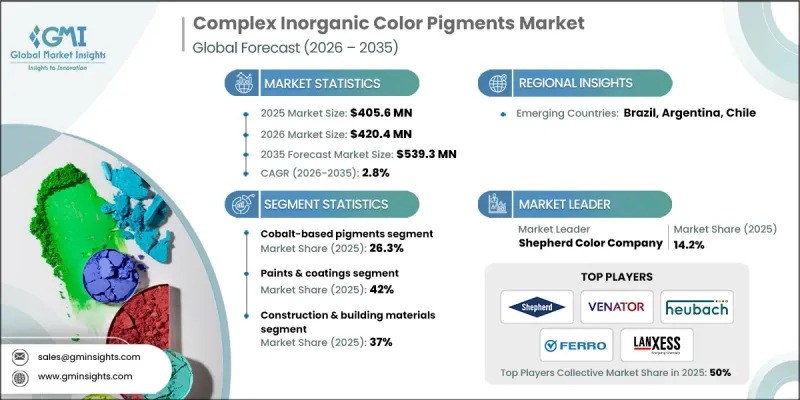
The market continues to advance steadily as industries seek high-performance pigments that deliver superior durability, thermal stability, and long-term color retention. Demand is rising across automotive coatings, plastics, construction materials, and ceramics, where performance reliability under harsh environmental conditions is critical. Complex inorganic color pigments are engineered to provide exceptional resistance to weathering, chemical exposure, and color migration, making them suitable for applications that require regulatory compliance and extended service life. Expanding infrastructure and urban development activities, particularly in developing economies, are supporting higher consumption in structural materials and architectural finishes. These pigments are increasingly preferred in exterior building applications due to their ultraviolet resistance and heat endurance. In addition, the tightening of environmental and product safety regulations across major markets is reinforcing the adoption of stable, non-toxic, and sustainable pigment technologies.
| Market Scope | |
|---|---|
| Start Year | 2025 |
| Forecast Year | 2026-2035 |
| Start Value | $405.6 Million |
| Forecast Value | $539.3 Million |
| CAGR | 2.8% |
The cobalt-based pigments segment accounted for 26.3% share in 2025 and is projected to grow at a CAGR of 1.9% through 2035. This segment maintains leadership due to its strong thermal endurance, high tinting strength, and compliance with environmental standards. Cobalt-based formulations are widely utilized in advanced industrial and architectural coatings where consistent performance under extreme temperature variation and chemical exposure is required. Their ability to maintain vibrant coloration and structural integrity over extended periods contributes to sustained demand across performance-driven applications.
The construction and building materials segment held 37% share in 2025 and is expected to grow at a CAGR of 1.9% between 2026 and 2035. Complex inorganic color pigments are extensively integrated into exterior construction components, including surface coatings and structural materials, due to their resistance to fading, pollution, and temperature stress. Their long-lasting aesthetic stability and protective characteristics make them essential in projects that demand durability and environmental resilience. As global infrastructure investments expand, pigment consumption in this segment is anticipated to remain consistent.
North America Complex Inorganic Color Pigments Market accounted for 20.9% share in 2025. The region is characterized by advanced infrastructure development, established regulatory oversight, and a strong emphasis on environmentally responsible materials. Demand is supported by refurbishment projects, architectural coatings, and industrial applications requiring high-performance pigment solutions. Regulatory frameworks that encourage sustainable construction practices are further accelerating the integration of advanced inorganic pigment technologies across key metropolitan regions.
Key companies operating in the Global Complex Inorganic Color Pigments Market include BASF SE, Clariant AG, LANXESS AG, Venator Materials PLC, Heubach GmbH, Cathay Industries, DCL Corporation, Shepherd Color Company, Ferro Corporation, Tata Pigments Limited, Mason Color Works, Inc., Asahi Kasei Kogyo Co., Ltd., HANIL HOLDINGS Co., Ltd., LANSCO Colors, and TOMATEC Corporation. Companies in the Complex Inorganic Color Pigments Market are strengthening their competitive position through product innovation, regulatory compliance, and strategic capacity expansion. Leading manufacturers are investing in research and development to enhance pigment durability, environmental safety, and application versatility. Strategic collaborations with coatings, plastics, and construction material producers enable customized formulation development and long-term supply agreements. Firms are also expanding production facilities in high-growth regions to improve distribution efficiency and reduce supply chain risks. Sustainability initiatives, including low-emission manufacturing processes and eco-compliant product portfolios, are central to corporate strategies.
Table of Contents
Chapter 1 Methodology & Scope
- 1.1 Market scope and definition
- 1.2 Research design
- 1.2.1 Research approach
- 1.2.2 Data collection methods
- 1.3 Data mining sources
- 1.3.1 Global
- 1.3.2 Regional/Country
- 1.4 Base estimates and calculations
- 1.4.1 Base year calculation
- 1.4.2 Key trends for market estimation
- 1.5 Primary research and validation
- 1.5.1 Primary sources
- 1.6 Forecast model
- 1.7 Research assumptions and limitations
Chapter 2 Executive Summary
- 2.1 Industry 360° synopsis
- 2.2 Key market trends
- 2.2.1 Regional
- 2.2.2 Product type
- 2.2.3 Application
- 2.2.4 End use industry
- 2.3 TAM Analysis, 2026-2035
- 2.4 CXO perspectives: Strategic imperatives
- 2.4.1 Executive decision points
- 2.4.2 Critical success factors
- 2.5 Future outlook and strategic recommendations
Chapter 3 Industry Insights
- 3.1 Industry ecosystem analysis
- 3.1.1 Supplier landscape
- 3.1.2 Profit margin
- 3.1.3 Value addition at each stage
- 3.1.4 Factor affecting the value chain
- 3.1.5 Disruptions
- 3.2 Industry impact forces
- 3.2.1 Growth drivers
- 3.2.2 Industry pitfalls and challenges
- 3.2.3 Market opportunities
- 3.3 Growth potential analysis
- 3.4 Regulatory landscape
- 3.4.1 North America
- 3.4.2 Europe
- 3.4.3 Asia Pacific
- 3.4.4 Latin America
- 3.4.5 Middle East & Africa
- 3.5 Porter’s analysis
- 3.6 PESTEL analysis
- 3.7 Price trends
- 3.7.1 By region
- 3.7.2 By product type
- 3.8 Future market trends
- 3.9 Technology and Innovation landscape
- 3.9.1 Current technological trends
- 3.9.2 Emerging technologies
- 3.10 Patent Landscape
- 3.11 Trade statistics (HS code)
- 3.11.1 Major importing countries
- 3.11.2 Major exporting countries
- 3.12 Sustainability and environmental aspects
- 3.12.1 Sustainable practices
- 3.12.2 Waste reduction strategies
- 3.12.3 Energy efficiency in production
- 3.12.4 Eco-friendly initiatives
- 3.13 Carbon footprint consideration
Chapter 4 Competitive Landscape, 2025
- 4.1 Introduction
- 4.2 Company market share analysis
- 4.2.1 By region
- 4.2.1.1 North America
- 4.2.1.2 Europe
- 4.2.1.3 Asia Pacific
- 4.2.1.4 LATAM
- 4.2.1.5 MEA
- 4.2.1 By region
- 4.3 Company matrix analysis
- 4.4 Competitive analysis of major market players
- 4.5 Competitive positioning matrix
- 4.6 Key developments
- 4.6.1 Mergers & acquisitions
- 4.6.2 Partnerships & collaborations
- 4.6.3 New Product Launches
- 4.6.4 Expansion Plans
Chapter 5 Market Estimates and Forecast, By Product Type, 2022-2035 (USD Billion) (Kilo Tons)
- 5.1 Key trends
- 5.2 Cobalt-based Pigments
- 5.3 Titanium-based (Titanate) Pigments
- 5.4 Iron-based Pigments
- 5.5 Chromium-based Pigments
- 5.6 Nickel Manganese-based Pigments
- 5.7 Zinc-based Pigments
- 5.8 Antimony-based Pigments
- 5.9 Copper-based Pigments
- 5.10 Others
Chapter 6 Market Estimates and Forecast, By Application, 2022-2035 (USD Billion) (Kilo Tons)
- 6.1 Key trends
- 6.2 Paints & Coatings
- 6.2.1 Architectural Coatings
- 6.2.2 Automotive Coatings
- 6.2.3 Industrial Coatings
- 6.2.4 Powder Coatings
- 6.2.5 Coil Coatings
- 6.3 Plastics
- 6.4 Concrete
- 6.5 Glass & Ceramics
- 6.6 Inks & Printing
- 6.7 Others
Chapter 7 Market Estimates and Forecast, By End Use Industry, 2022-2035 (USD Billion) (Kilo Tons)
- 7.1 Key trends
- 7.2 Construction & Building Materials
- 7.3 Automotive
- 7.4 Consumer Goods
- 7.5 Packaging
- 7.6 Electronics
- 7.7 Industrial Manufacturing
- 7.8 Others
Chapter 8 Market Estimates and Forecast, By Region, 2022-2035 (USD Billion) (Kilo Tons)
- 8.1 Key trends
- 8.2 North America
- 8.2.1 U.S.
- 8.2.2 Canada
- 8.3 Europe
- 8.3.1 Germany
- 8.3.2 UK
- 8.3.3 France
- 8.3.4 Spain
- 8.3.5 Italy
- 8.3.6 Rest of Europe
- 8.4 Asia Pacific
- 8.4.1 China
- 8.4.2 India
- 8.4.3 Japan
- 8.4.4 Australia
- 8.4.5 South Korea
- 8.4.6 Rest of Asia Pacific
- 8.5 Latin America
- 8.5.1 Brazil
- 8.5.2 Mexico
- 8.5.3 Argentina
- 8.5.4 Rest of Latin America
- 8.6 Middle East and Africa
- 8.6.1 Saudi Arabia
- 8.6.2 South Africa
- 8.6.3 UAE
- 8.6.4 Rest of Middle East and Africa
Chapter 9 Company Profiles
- 9.1 Asahi Kasei Kogyo Co., Ltd.
- 9.2 BASF SE
- 9.3 Cathay Industries
- 9.4 Clariant AG
- 9.5 DCL Corporation
- 9.6 Ferro Corporation
- 9.7 HANIL HOLDINGS Co., Ltd.
- 9.8 Heubach GmbH
- 9.9 LANSCO Colors
- 9.10 LANXESS AG
- 9.11 Mason Color Works, Inc.
- 9.12 Shepherd Color Company
- 9.13 Tata Pigments Limited
- 9.14 TOMATEC Corporation
- 9.15 Venator Materials PLC
- 9.16 Others

