
PUBLISHER: Global Market Insights Inc. | PRODUCT CODE: 1959658

PUBLISHER: Global Market Insights Inc. | PRODUCT CODE: 1959658
Body Mist Market Opportunity, Growth Drivers, Industry Trend Analysis, and Forecast 2026 - 2035
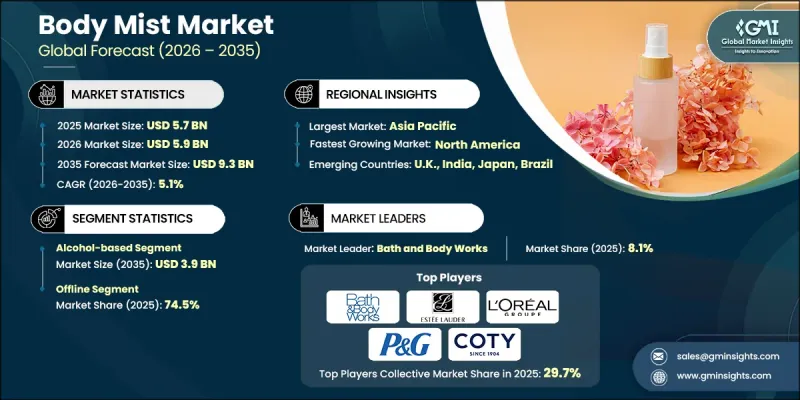
The Global Body Mist Market was valued at USD 5.7 billion in 2025 and is estimated to grow at a CAGR of 5.1% to reach USD 9.3 billion by 2035.
Market growth is driven by shifts in consumer preferences, particularly among younger demographics who are increasingly seeking lighter, refreshing fragrances at accessible price points. Daily-use convenience, casual fragrance appeal, and the ability to complement active lifestyles are influencing product adoption. The rising focus on wellness and self-care is further encouraging consumers to integrate body mists into their daily routines. Additionally, interest in natural and organic formulations is growing, prompting brands to innovate with alcohol-free, eco-friendly, and skin-hydrating options. Government regulations and industry initiatives also provide opportunities for product enhancement, ensuring that consumers have access to safe, high-quality, and multifunctional products. The growing popularity of these products across both offline and online channels further contributes to market expansion, with increased promotion of dual benefits fragrance and skin hydration driving sales.
| Market Scope | |
|---|---|
| Start Year | 2025 |
| Forecast Year | 2026-2035 |
| Start Value | $5.7 Billion |
| Forecast Value | $9.3 Billion |
| CAGR | 5.1% |
The alcohol-based segment accounted for USD 2.4 billion in 2025 and is anticipated to reach USD 3.9 billion by 2035. Alcohol-based body mists remain dominant due to their versatility, efficiency, and superior performance in delivering a fine, consistent spray. Ethanol, the primary ingredient, ensures a gentle fragrance and quick-drying application, allowing users to apply products frequently without leaving sticky residues on skin or clothing. These qualities have made alcohol-based formulations highly popular with consumers who prioritize convenience and fast absorption in their daily beauty routines. Regulatory bodies, including the FDA, recognize ethanol as safe for use in cosmetics, supporting consumer confidence in these products.
The offline channels segment held 74.5% share in 2025. Physical retail locations, including supermarkets, hypermarkets, and specialty stores, remain the preferred purchase points due to their ability to offer hands-on product testing, personalized guidance, and immediate availability. Consumers rely on offline stores to ensure quality, build trust, and enjoy a convenient shopping experience. Expert staff in these retail locations assist in helping buyers select products suited to their skin type, lifestyle, and fragrance preferences, reinforcing consumer confidence and brand loyalty. The offline retail presence also complements online sales, creating an omnichannel environment that maximizes reach.
U.S. Body Mist Market held 64.5% share in 2025. Strong per capita spending on personal care products, a cultural emphasis on grooming, and high consumer adoption of fragrance layering have driven demand. Body mists are widely embraced as affordable, lightweight alternatives to traditional perfumes, particularly among younger users who prefer frequent application. Major beauty and fragrance brands have strengthened availability, innovation, and marketing efforts in the region, contributing to widespread product adoption. Retail expansion, omnichannel strategies, and continuous innovation have reinforced the U.S.'s leadership position within the global body mist market.
Key players in the Global Body Mist Market include Bath and Body Works, Coty, L'Oreal Group, Chanel, Revlon, Shiseido, Dior, Beiersdorf, Procter and Gamble, Kao Corporation, Kenvue, Estee Lauder, Global Cosmetics HK, Perfumania, and Unilever. Companies in the body mist market are employing several strategies to expand their market presence and strengthen brand equity. They are investing heavily in product innovation, including alcohol-free, natural, and multifunctional formulations that combine fragrance with skin hydration benefits. Partnerships with retailers and the expansion of offline and online distribution networks enhance accessibility and visibility. Brand marketing initiatives leverage social media, influencer endorsements, and lifestyle campaigns to engage younger audiences. Additionally, companies focus on sustainable sourcing, eco-friendly packaging, and compliance with safety regulations to appeal to environmentally conscious consumers.
Table of Contents
Chapter 1 Methodology & Scope
- 1.1 Market scope and definition
- 1.2 Research design
- 1.2.1 Research approach
- 1.2.2 Data collection methods
- 1.3 Data mining sources
- 1.3.1 Global
- 1.3.2 Regional/Country
- 1.4 Base estimates and calculations
- 1.4.1 Base year calculation
- 1.4.2 Key trends for market estimation
- 1.5 Primary research and validation
- 1.5.1 Primary sources
- 1.6 Forecast model
- 1.7 Research assumptions and limitations
Chapter 2 Executive Summary
- 2.1 Industry 360° synopsis
- 2.2 Key market trends
- 2.2.1 Regional
- 2.2.2 Product Type
- 2.2.3 Fragrance
- 2.2.4 Price
- 2.2.5 Ingredient Origin
- 2.2.6 Packaging type
- 2.2.7 End User
- 2.2.8 Distribution Channel
- 2.3 CXO perspectives: Strategic imperatives
- 2.3.1 Key decision points for industry executives
- 2.3.2 Critical success factors for market players
- 2.4 Future outlook and strategic recommendations
Chapter 3 Industry Insights
- 3.1 Industry ecosystem analysis
- 3.1.1 Supplier landscape
- 3.1.2 Profit margin
- 3.1.3 Value addition at each stage
- 3.1.4 Factor affecting the value chain
- 3.2 Industry impact forces
- 3.2.1 Growth drivers
- 3.2.1.1 Changing consumer preferences
- 3.2.1.2 Increasing demand for personal care products
- 3.2.1.3 Increased focus on wellness and self-care
- 3.2.2 Industry pitfalls & challenges
- 3.2.2.1 Market saturation
- 3.2.2.2 Seasonal fluctuations
- 3.2.3 Opportunities
- 3.2.3.1 Sustainability-driven premium solutions
- 3.2.3.2 Rising demand from younger consumers for affordable fragrance
- 3.2.1 Growth drivers
- 3.3 Growth potential analysis
- 3.4 Future market trends
- 3.5 Technology and innovation landscape
- 3.5.1 Current technological trends
- 3.5.2 Emerging technologies
- 3.6 Price trends
- 3.6.1 By product type
- 3.6.2 By region
- 3.7 Regulatory landscape
- 3.7.1 Standards and compliance requirements
- 3.7.2 Regional regulatory frameworks
- 3.7.3 Certification standards
- 3.8 Trade statistics
- 3.8.1 Major importing countries
- 3.8.2 Major exporting countries
- 3.9 Gap analysis
- 3.10 Risk assessment and mitigation
- 3.11 Porter’s analysis
- 3.12 PESTEL analysis
- 3.13 Consumer behaviour analysis
- 3.13.1 Purchasing patterns
- 3.13.2 Preference analysis
- 3.13.3 Regional variations in consumer behaviour
- 3.13.4 Impact of e-commerce on buying decisions
Chapter 4 Competitive Landscape, 2025
- 4.1 Introduction
- 4.2 Company market share analysis
- 4.2.1 By region
- 4.2.1.1 North America
- 4.2.1.2 Europe
- 4.2.1.3 Asia Pacific
- 4.2.1.4 Latin America
- 4.2.1.5 Middle East and Africa
- 4.2.1 By region
- 4.3 Company matrix analysis
- 4.4 Competitive analysis of major market players
- 4.5 Competitive positioning matrix
- 4.6 Key developments
- 4.6.1 Mergers & acquisitions
- 4.6.2 Partnerships & collaborations
- 4.6.3 New product launches
- 4.6.4 Expansion plans
Chapter 5 Market Estimates & Forecast, By Product Type, 2022-2035 (USD Billion) (Million Units)
- 5.1 Key trends
- 5.2 Alcohol-based
- 5.3 Water-based
- 5.4 Oil-based
Chapter 6 Market Estimates & Forecast, By Fragrance Type, 2022-2035 (USD Billion) (Million Units)
- 6.1 Key trends
- 6.2 Floral
- 6.3 Fruity
- 6.4 Citrus
- 6.5 Others (spicy, woody, etc.)
Chapter 7 Market Estimates & Forecast, By Price, 2022-2035 (USD Billion) (Million Units)
- 7.1 Key trends
- 7.2 Low
- 7.3 Medium
- 7.4 High
Chapter 8 Market Estimates & Forecast, By Ingredient Origin, 2022-2035 (USD Billion) (Million Units)
- 8.1 Key trends
- 8.2 Synthetic-based
- 8.3 Naturally derived (Botanical-based)
- 8.4 Hybrid
Chapter 9 Market Estimates & Forecast, By Packaging Type, 2022-2035 (USD Billion) (Million Units)
- 9.1 Key trends
- 9.2 Spray bottles
- 9.3 Aerosol cans
- 9.4 Roll-on
- 9.5 Refillable packaging
Chapter 10 Market Estimates & Forecast, By End User, 2022-2035 (USD Billion) (Million Units)
- 10.1 Key trends
- 10.2 Male
- 10.3 Female
- 10.4 Unisex
Chapter 11 Market Estimates & Forecast, By Distribution Channel, 2022-2035 (USD Billion) (Million Units)
- 11.1 Key trends
- 11.2 Online
- 11.2.1 E-Commerce
- 11.2.2 Company website
- 11.3 Offline
- 11.3.1 Supermarkets/Hypermarkets
- 11.3.2 Specialty Stores
- 11.3.3 Others (Individual stores, Departmental stores, etc.)
Chapter 12 Market Estimates & Forecast, By Region, 2022-2035 (USD Billion) (Million Units)
- 12.1 Key trends
- 12.2 North America
- 12.2.1 U.S.
- 12.2.2 Canada
- 12.3 Europe
- 12.3.1 Germany
- 12.3.2 France
- 12.3.3 UK
- 12.3.4 Italy
- 12.3.5 Spain
- 12.4 Asia Pacific
- 12.4.1 China
- 12.4.2 India
- 12.4.3 Japan
- 12.4.4 South Korea
- 12.4.5 Australia
- 12.5 Latin America
- 12.5.1 Brazil
- 12.5.2 Mexico
- 12.5.3 Argentina
- 12.6 MEA
- 12.6.1 South Africa
- 12.6.2 Saudi Arabia
- 12.6.3 UAE
Chapter 13 Company Profiles
- 13.1 Bath and Body Works
- 13.2 Beiersdorf
- 13.3 Chanel
- 13.4 Coty
- 13.5 Dior
- 13.6 Estee Lauder
- 13.7 Global Cosmetics HK
- 13.8 Kao Corporation
- 13.9 Kenvue
- 13.10 L'Oreal Group
- 13.11 Perfumania
- 13.12 Procter and Gamble
- 13.13 Revlon
- 13.14 Shiseido
- 13.15 Unilever

