PUBLISHER: Global Market Insights Inc. | PRODUCT CODE: 1959662

PUBLISHER: Global Market Insights Inc. | PRODUCT CODE: 1959662
Sleep Disorder Market Opportunity, Growth Drivers, Industry Trend Analysis, and Forecast 2026 - 2035
The Global Sleep Disorder Market was valued at USD 30.5 billion in 2025 and is estimated to grow at a CAGR of 9.8% to reach USD 78.6 billion by 2035.
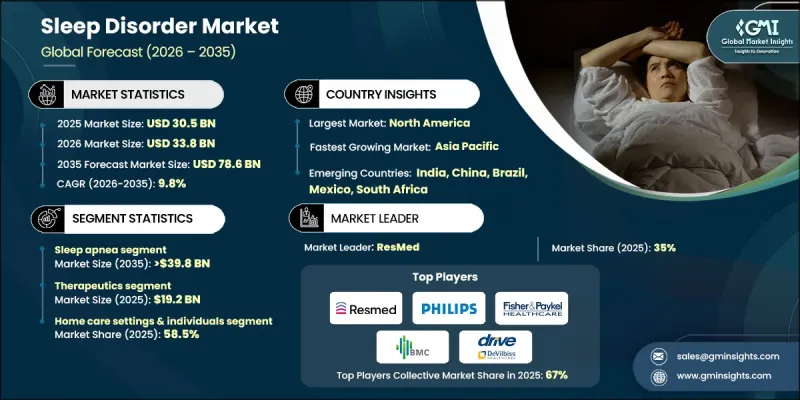
The strong growth trajectory is driven by the rising incidence of sleep-related conditions, growing public awareness, and higher diagnosis rates across both developed and emerging healthcare systems. Continuous innovation in diagnostic technologies and therapeutic solutions is further accelerating industry expansion. Healthcare providers are increasingly recognizing sleep health as a critical component of overall well-being, leading to improved screening practices and early intervention strategies. In parallel, advancements in digital health platforms, connected medical devices, and data-driven treatment approaches are reshaping how sleep disorders are identified and managed. The market is also benefiting from growing patient demand for convenient, accessible, and technology-enabled care models.
| Market Scope | |
|---|---|
| Start Year | 2025 |
| Forecast Year | 2026-2035 |
| Start Value | $30.5 Billion |
| Forecast Value | $78.6 Billion |
| CAGR | 9.8% |
Sleep disorders are clinical conditions that interfere with sleep quality, duration, and timing, negatively affecting daily functioning and long-term health outcomes. These conditions arise from physiological, psychological, or behavioral factors and require accurate diagnosis and structured management. The sleep disorder market is experiencing notable expansion due to the transition toward home-based diagnostic solutions and remote care models. Portable testing systems and connected therapeutic devices enable real-time data collection and monitoring, reducing reliance on facility-based procedures. Telehealth services support consultation and treatment optimization, improving accessibility across broader populations. Consumer adoption of wearable monitoring devices and smart sleep tracking systems is increasing engagement in sleep health management. Data generated through digital platforms is progressively incorporated into clinical workflows, enhancing treatment personalization and improving patient adherence.
The sleep apnea segment held 48.2% share in 2025. Its dominance is attributed to high prevalence rates, expanding clinical awareness, and widespread utilization of home-based diagnostic systems and continuous therapeutic technologies. Increasing metabolic and lifestyle-related risk factors have expanded the population susceptible to airway-related sleep conditions, directly elevating demand for diagnostic and management solutions. Growing recognition of the health consequences associated with untreated breathing-related sleep disorders has encouraged proactive screening and early intervention, reinforcing this segment's leadership position within the broader sleep disorder market.
The diagnostics segment is projected to grow at a CAGR of 9.1% through 2026-2035. Market growth is being supported by rising emphasis on early identification of sleep abnormalities and continuous technological enhancements in sleep testing systems. Advanced monitoring tools, combined with artificial intelligence-enabled data analysis and cloud-integrated platforms, are improving diagnostic accuracy and operational efficiency. The shift toward accessible and patient-friendly testing solutions continues to stimulate adoption across healthcare settings.
North America Sleep Disorder Market held a 38.1% share in 2025. The region benefits from a well-developed healthcare infrastructure that supports advanced diagnostic services, specialized treatment centers, and widespread therapy adoption. Strong awareness among healthcare professionals and patients regarding the association between sleep disorders and chronic health conditions has strengthened screening initiatives and preventive healthcare integration. Availability of technologically advanced diagnostic tools and connected treatment devices further accelerates market penetration, reinforcing regional dominance.
Key companies operating in the Global Sleep Disorder Market include ResMed, PHILIPS, Apple, Fisher & Paykel Healthcare, Natus, Nihon Kohden, BMC Medical, Drive Devilbiss, Oura Health, Cadwell, Sleepace, WITHINGS, WEINMANN Medical, Sleep Shepherd, and ZOLL Medical. Companies in the sleep disorder market are reinforcing their competitive positioning through innovation, strategic collaborations, and portfolio diversification. Leading players are investing in research and development to introduce advanced diagnostic devices, connected therapeutic systems, and AI-enabled analytics platforms. Partnerships with healthcare providers and digital health firms are enhancing integrated care delivery and expanding market reach. Many organizations are focusing on expanding home-based testing solutions and remote monitoring capabilities to align with evolving patient preferences. Geographic expansion into high-growth regions and strengthening distribution networks are also key priorities.
Table of Contents
Chapter 1 Research Methodology
- 1.1 Research approach
- 1.2 Quality commitments
- 1.2.1 GMI AI policy & data integrity commitment
- 1.2.1.1 Source consistency protocol
- 1.2.1 GMI AI policy & data integrity commitment
- 1.3 Research trail & confidence scoring
- 1.3.1 Research trail components
- 1.3.2 Scoring components
- 1.4 Data collection
- 1.4.1 Partial list of primary sources
- 1.5 Data mining sources
- 1.5.1 Paid sources
- 1.5.1.1 Sources, by region
- 1.5.1 Paid sources
- 1.6 Base estimates and calculations
- 1.6.1 Base year calculation for any one approach
- 1.7 Forecast model
- 1.7.1 Quantified market impact analysis
- 1.7.1.1 Mathematical impact of growth parameters on forecast
- 1.7.1 Quantified market impact analysis
- 1.8 Research transparency addendum
- 1.8.1 Source attribution framework
- 1.8.2 Quality assurance metrics
- 1.8.3 Our commitment to trust
Chapter 2 Executive Summary
- 2.1 Industry 3600 synopsis
- 2.2 Key market trends
- 2.2.1 Regional trends
- 2.2.2 Disorder type trends
- 2.2.3 Product trends
- 2.2.4 End use trends
- 2.3 CXO perspectives: Strategic imperatives
- 2.3.1 Key decision points for industry executives
- 2.3.2 Critical success factors for market players
- 2.4 Future outlook and strategic recommendations
Chapter 3 Industry Insights
- 3.1 Industry ecosystem analysis
- 3.2 Industry impact forces
- 3.2.1 Growth drivers
- 3.2.1.1 Rising prevalence of sleep disorders
- 3.2.1.2 Technological advancements in sleep diagnostics and therapeutics
- 3.2.1.3 Growing awareness of sleep health
- 3.2.1.4 Rising demand for portable, efficient, and superior devices for sleep disorders
- 3.2.2 Industry pitfalls and challenges
- 3.2.2.1 High cost of diagnostic and therapeutic devices
- 3.2.2.2 Limited access to sleep laboratories in developing regions
- 3.2.3 Market opportunities
- 3.2.3.1 Growth in home-based sleep testing and therapy
- 3.2.3.2 Integration of AI and digital health in sleep management
- 3.2.1 Growth drivers
- 3.3 Growth potential analysis
- 3.4 Regulatory landscape
- 3.4.1 North America
- 3.4.2 Europe
- 3.4.3 Asia Pacific
- 3.5 Technology landscape
- 3.5.1 Current technological trends
- 3.5.2 Emerging technologies
- 3.6 Reimbursement scenario
- 3.7 Future market trends
- 3.8 Consumer insights
- 3.9 Start-up scenarios
- 3.10 Value chain analysis
- 3.11 Porter's analysis
- 3.12 PESTEL analysis
- 3.13 Gap analysis
Chapter 4 Competitive Landscape, 2025
- 4.1 Introduction
- 4.2 Company matrix analysis
- 4.3 Company market share analysis
- 4.3.1 Global
- 4.3.2 North America
- 4.3.3 Europe
- 4.3.4 Asia Pacific
- 4.4 Competitive positioning matrix
- 4.5 Competitive analysis of major market players
- 4.6 Key developments
- 4.6.1 Mergers & acquisitions
- 4.6.2 Partnerships & collaborations
- 4.6.3 New product launches
- 4.6.4 Expansion plans
Chapter 5 Market Estimates and Forecast, By Disorder Type, 2022 - 2035 ($ Mn)
- 5.1 Key trends
- 5.2 Sleep apnea
- 5.2.1 Obstructive sleep apnea
- 5.2.2 Central sleep apnea
- 5.2.3 Complex sleep apnea
- 5.3 Insomnia
- 5.4 Restless legs syndrome (RLS)
- 5.5 Narcolepsy
- 5.6 Other disorder types
Chapter 6 Market Estimates and Forecast, By Product, 2022 - 2035 ($ Mn)
- 6.1 Key trends
- 6.2 Therapeutics
- 6.2.1 Therapeutic devices
- 6.2.1.1 Positive airway pressure (PAP) devices
- 6.2.1.1.1 Continuous positive airway pressure (CPAP) devices
- 6.2.1.1.2 Bilevel positive airway pressure (BiPAP) devices
- 6.2.1.1.3 Automatic positive airway pressure (APAP) devices
- 6.2.1.2 Oral appliances
- 6.2.1.2.1 Mandibular advancement devices
- 6.2.1.2.2 Tongue-retaining devices
- 6.2.1.2.3 Rapid maxillary expansion
- 6.2.1.2.4 Mouth guards
- 6.2.1.3 Adaptive servo-ventilation (ASV)
- 6.2.1.4 Airway clearance system
- 6.2.1.5 Oxygen devices
- 6.2.1.6 Other therapeutic devices
- 6.2.1.1 Positive airway pressure (PAP) devices
- 6.2.2 Cognitive behavioral therapy
- 6.2.1 Therapeutic devices
- 6.3 Diagnostics
- 6.3.1 Polysomnography (PSG) device
- 6.3.1.1 Ambulatory PSG devices
- 6.3.1.2 Clinical PSG devices
- 6.3.2 Home sleep testing (HST) devices
- 6.3.2.1 Type 2
- 6.3.2.2 Type 3
- 6.3.2.3 Type 4
- 6.3.3 Actigraphy systems
- 6.3.4 Sleep screening devices
- 6.3.5 Pulse oximeter
- 6.3.6 Respiratory polygraph
- 6.3.7 Wearables
- 6.3.7.1 Smart watches & bands
- 6.3.7.2 Other wearables
- 6.3.8 Non-wearbles
- 6.3.1 Polysomnography (PSG) device
Chapter 7 Market Estimates and Forecast, By End Use, 2022 - 2035 ($ Mn)
- 7.1 Key trends
- 7.2 Home care settings & individuals
- 7.3 Sleep laboratories & hospitals
Chapter 8 Market Estimates and Forecast, By Region, 2022 - 2035 ($ Mn)
- 8.1 Key trends
- 8.2 North America
- 8.2.1 U.S.
- 8.2.2 Canada
- 8.3 Europe
- 8.3.1 Germany
- 8.3.2 UK
- 8.3.3 France
- 8.3.4 Spain
- 8.3.5 Italy
- 8.3.6 Netherlands
- 8.4 Asia Pacific
- 8.4.1 China
- 8.4.2 Japan
- 8.4.3 India
- 8.4.4 Australia
- 8.4.5 South Korea
- 8.5 Latin America
- 8.5.1 Brazil
- 8.5.2 Mexico
- 8.5.3 Argentina
- 8.6 Middle East and Africa
- 8.6.1 South Africa
- 8.6.2 Saudi Arabia
- 8.6.3 UAE
Chapter 9 Company Profiles
- 9.1 Apple
- 9.2 BMC Medical
- 9.3 Cadwell
- 9.4 Drive Devilbiss
- 9.5 Fisher & Paykel Healthcare
- 9.6 Natus
- 9.7 Nihon Kohden
- 9.8 Oura Health
- 9.9 PHILIPS
- 9.10 ResMed
- 9.11 Sleep Shepherd
- 9.12 Sleepace
- 9.13 WEINMANN Medical
- 9.14 WITHINGS
- 9.15 ZOLL Medical

