
PUBLISHER: Global Market Insights Inc. | PRODUCT CODE: 1982261

PUBLISHER: Global Market Insights Inc. | PRODUCT CODE: 1982261
Data Center HVAC Market Opportunity, Growth Drivers, Industry Trend Analysis, and Forecast 2026 - 2035
The Global Data Center HVAC Market was valued at USD 13.7 billion in 2025 and is estimated to grow at a CAGR of 9.8% to reach USD 36 billion by 2035.
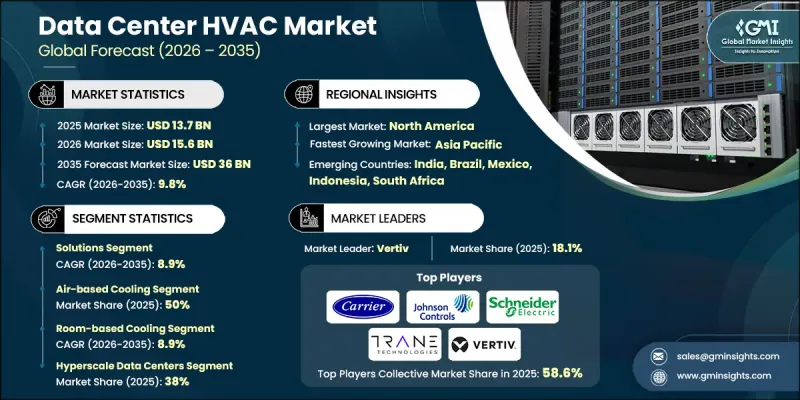
Growth in the global data center HVAC market is being fueled by rising computing intensity, expanding AI-driven workloads, and the continued development of hyperscale and enterprise facilities. As server densities increase and high-performance computing environments generate greater thermal loads, advanced cooling infrastructure has become essential to maintain operational stability and uptime. Research and development efforts across the HVAC industry are increasingly focused on liquid cooling technologies and next-generation thermal management systems capable of handling elevated power densities. At the same time, stricter regulatory oversight related to energy consumption and environmental performance is encouraging operators to enhance system efficiency and reduce carbon output. ESG-focused initiatives and net-zero commitments are prompting facility upgrades aimed at optimizing Power Usage Effectiveness and lowering operating expenses. Improvements in airflow engineering, adoption of sustainable refrigerants, and integration of energy-efficient cooling architectures are reshaping infrastructure strategies. As regulatory expectations and energy costs continue to rise, demand for intelligent, high-efficiency HVAC solutions in data centers is expected to accelerate significantly.
| Market Scope | |
|---|---|
| Start Year | 2025 |
| Forecast Year | 2026-2035 |
| Start Value | $13.7 Billion |
| Forecast Value | $36 Billion |
| CAGR | 9.8% |
Rising load capacities, sustainability targets, and regulatory compliance requirements are creating pressure for compact, scalable, and adaptable HVAC systems. Industry participants are responding by designing modular cooling platforms that can operate effectively across diverse geographies while maximizing space utilization and energy performance.
The solutions segment accounted for 76% share in 2025 and is forecast to grow at a CAGR of 8.9% from 2026 to 2035. Advanced monitoring tools equipped with artificial intelligence enable predictive maintenance, improve airflow management, and reduce unnecessary power consumption. Increased adoption of liquid-based cooling technologies is supporting high-density server environments while enhancing reliability and extending equipment lifespan through energy-conscious design.
The air-based cooling technologies segment held a 50% share in 2025 and is projected to grow at a CAGR of 8.8% during 2026-2035. Enhanced airflow optimization systems, variable-speed fan configurations, and intelligent environmental controls are improving thermal consistency and minimizing energy waste. Economizer-enabled designs are facilitating greater use of ambient air, while modular cooling units support scalability across both hyperscale and edge environments. Growing server power density is also accelerating interest in direct cooling and immersion-based methods supported by advanced coolant formulations that enhance heat transfer efficiency.
United States Data Center HVAC Market reached USD 4.7 billion in 2025. Increasing cloud integration and AI-intensive applications are driving demand for more efficient cooling architectures. Investments are being supported by electrification incentives and decarbonization initiatives, encouraging broader adoption of intelligent HVAC controls and energy-optimized systems. Integration with smart building platforms and grid-responsive technologies is enabling facilities to manage peak loads, reduce demand charges, and incorporate renewable energy sources.
Key companies operating in the Global Data Center HVAC Market include Vertiv, Schneider Electric, Carrier Global, Daikin Industries, Trane Technologies, Johnson Controls, STULZ, Alfa Laval, Danfoss, and Modine Manufacturing. Companies in the Global Data Center HVAC Market are strengthening their competitive position through continuous innovation, strategic partnerships, and geographic expansion. Leading players are investing heavily in research and development to enhance liquid cooling efficiency, improve airflow intelligence, and integrate AI-driven monitoring systems. Collaborations with cloud service providers and data center developers are enabling customized cooling deployments for high-density environments. Firms are also expanding manufacturing capacity and regional service networks to support rapid infrastructure growth. Sustainability-focused product development, including low-global-warming-potential refrigerants and energy-efficient system architectures, is becoming a central competitive differentiator.
Table of Contents
Chapter 1 Methodology
- 1.1 Research approach
- 1.2 Quality commitments
- 1.3 GMI AI policy & data integrity commitment
- 1.4 Research trail & confidence scoring
- 1.4.1 Research trail components
- 1.4.2 Scoring components
- 1.5 Data collection
- 1.5.1 Partial list of primary sources
- 1.6 Data mining sources
- 1.6.1 Paid sources
- 1.7 Base estimates and calculations
- 1.7.1 Base year calculation
- 1.8 Forecast model
- 1.9 Research transparency addendum
Chapter 2 Executive Summary
- 2.1 Industry 360° synopsis
- 2.2 Key market trends
- 2.2.1 Regional
- 2.2.2 Offering
- 2.2.3 Cooling technology
- 2.2.4 Equipment level
- 2.2.5 Cooling technique
- 2.2.6 Data center
- 2.2.7 End use
- 2.3 TAM analysis, 2026-2035
- 2.4 CXO perspectives: Strategic imperatives
Chapter 3 Industry Insights
- 3.1 Industry ecosystem analysis
- 3.1.1 Supplier landscape
- 3.1.2 Profit margin
- 3.1.3 Cost structure
- 3.1.4 Value addition at each stage
- 3.1.5 Factor affecting the value chain
- 3.1.6 Disruptions
- 3.2 Industry impact forces
- 3.2.1 Growth drivers
- 3.2.1.1 Rising data center energy consumption
- 3.2.1.2 Stricter thermal management standards
- 3.2.1.3 Growth in cloud & hyperscale infrastructure
- 3.2.1.4 Adoption of high-density computing
- 3.2.2 Industry pitfalls and challenges
- 3.2.2.1 High initial capital expenditure
- 3.2.2.2 Complex integration with legacy systems
- 3.2.3 Market opportunities
- 3.2.3.1 Liquid cooling adoption
- 3.2.3.2 AI-driven HVAC optimization
- 3.2.3.3 Edge data center expansion
- 3.2.3.4 HVAC as a service (HaaS)
- 3.2.1 Growth drivers
- 3.3 Growth potential analysis
- 3.4 Regulatory landscape
- 3.4.1 North America
- 3.4.1.1 American Society of Heating, Refrigerating and Air-Conditioning Engineers
- 3.4.1.2 U.S. Department of Energy
- 3.4.2 Europe
- 3.4.2.1 European Commission
- 3.4.2.2 Eurovent Certita Certification
- 3.4.3 Asia Pacific
- 3.4.3.1 BCA - Building and Construction Authority (Singapore)
- 3.4.3.2 JIS - Japanese Industrial Standards
- 3.4.4 Latin America
- 3.4.4.1 Associacao Brasileira de Normas Tecnicas
- 3.4.4.2 Comision Nacional de Energia
- 3.4.5 Middle East & Africa
- 3.4.5.1 UAE Ministry of Energy and Infrastructure
- 3.4.5.2 Saudi Standards, Metrology and Quality Organization
- 3.4.1 North America
- 3.5 Porter's analysis
- 3.6 PESTEL analysis
- 3.7 Technology and innovation landscape
- 3.7.1 Current technological trends
- 3.7.2 Emerging technologies
- 3.8 Pricing analysis
- 3.8.1 Pricing by product
- 3.8.2 Pricing by region
- 3.9 Production statistics
- 3.9.1 Production hubs
- 3.9.2 Consumption hubs
- 3.9.3 Export and import
- 3.10 Cost breakdown analysis
- 3.11 Patent analysis
- 3.12 Sustainability and environmental aspects
- 3.12.1 Sustainable practices
- 3.12.2 Waste reduction strategies
- 3.12.3 Energy efficiency in production
- 3.12.4 Eco-friendly initiatives
- 3.12.5 Carbon footprint considerations
- 3.13 Energy Efficiency Metrics & Benchmarking
- 3.13.1 Power Usage Effectiveness (PUE) Trends
- 3.13.2 Water Usage Effectiveness (WUE) Analysis
- 3.13.3 Carbon Usage Effectiveness (CUE) Metrics
Chapter 4 Competitive Landscape, 2025
- 4.1 Introduction
- 4.2 Company market share analysis
- 4.2.1 North America
- 4.2.2 Europe
- 4.2.3 Asia Pacific
- 4.2.4 LATAM
- 4.2.5 MEA
- 4.3 Competitive analysis of major market players
- 4.4 Competitive positioning matrix
- 4.5 Key developments
- 4.5.1 Mergers & acquisitions
- 4.5.2 Partnerships & collaborations
- 4.5.3 New product launches
- 4.5.4 Expansion plans and funding
Chapter 5 Market Estimates & Forecast, By Offering, 2022 - 2035 ($Mn)
- 5.1 Key trends
- 5.2 Solutions
- 5.2.1 Cooling infrastructure solutions
- 5.2.2 Airflow management & containment solutions
- 5.2.3 Liquid cooling integration solutions
- 5.2.4 HVAC automation & control solutions
- 5.2.5 Thermal monitoring & management solutions
- 5.2.6 Energy optimization & free cooling solutions
- 5.2.7 Modular / scalable cooling solutions
- 5.2.8 Edge data center cooling solutions
- 5.3 Services
- 5.3.1 Professional services
- 5.3.1.1 Consulting & design
- 5.3.1.2 Maintenance and support
- 5.3.1.3 Installation and deployment
- 5.3.2 Managed services
- 5.3.1 Professional services
Chapter 6 Market Estimates & Forecast, By Cooling Technology, 2022 - 2035 ($Mn)
- 6.1 Key trends
- 6.2 Air-based cooling
- 6.3 Liquid cooling
- 6.4 Evaporative cooling
- 6.5 Hybrid cooling
Chapter 7 Market Estimates & Forecast, By Equipment-Level, 2022 - 2035 ($Mn, Units)
- 7.1 Key trends
- 7.2 Air conditioning systems
- 7.3 Chillers
- 7.4 Air handling units (AHU)
- 7.5 Liquid cooling systems
- 7.6 Cooling towers
- 7.7 Economizer systems
- 7.8 Control systems
- 7.9 Others
Chapter 8 Market Estimates & Forecast, By Cooling Technique, 2022 - 2035 ($Mn)
- 8.1 Key trends
- 8.2 Room-based cooling
- 8.3 Row-based cooling
- 8.4 Rack-based cooling
Chapter 9 Market Estimates & Forecast, By Data Center, 2022 - 2035 ($Mn)
- 9.1 Key trends
- 9.2 Enterprise data centers
- 9.3 Colocation data centers
- 9.4 Hyperscale data centers
- 9.5 Edge data centers
Chapter 10 Market Estimates & Forecast, By End Use, 2022 - 2035 ($Mn)
- 10.1 Key trends
- 10.2 IT & telecommunications
- 10.3 BFSI
- 10.4 Government & defense
- 10.5 Healthcare
- 10.6 Manufacturing
- 10.7 Retail & e-commerce
- 10.8 Energy & utilities
- 10.9 Research & academic
- 10.10 Others
Chapter 11 Market Estimates & Forecast, By Region, 2022 - 2035 ($Mn)
- 11.1 Key trends
- 11.2 North America
- 11.2.1 US
- 11.2.2 Canada
- 11.3 Europe
- 11.3.1 Germany
- 11.3.2 UK
- 11.3.3 France
- 11.3.4 Italy
- 11.3.5 Spain
- 11.3.6 Nordics
- 11.3.7 Russia
- 11.3.8 Poland
- 11.3.9 Romania
- 11.4 Asia Pacific
- 11.4.1 China
- 11.4.2 India
- 11.4.3 Japan
- 11.4.4 South Korea
- 11.4.5 ANZ
- 11.4.6 Vietnam
- 11.4.7 Indonesia
- 11.5 Latin America
- 11.5.1 Brazil
- 11.5.2 Mexico
- 11.5.3 Argentina
- 11.6 MEA
- 11.6.1 South Africa
- 11.6.2 Saudi Arabia
- 11.6.3 UAE
Chapter 12 Company Profiles
- 12.1 Global companies
- 12.1.1 Alfa Laval
- 12.1.2 Carrier Global
- 12.1.3 Daikin Industries
- 12.1.4 Danfoss
- 12.1.5 Hitachi
- 12.1.6 Johnson Controls
- 12.1.7 Modine
- 12.1.8 Schneider Electric
- 12.1.9 STULZ
- 12.1.10 Trane Technologies
- 12.1.11 Vertiv
- 12.2 Regional players
- 12.2.1 Climaveneta
- 12.2.2 Envicool
- 12.2.3 Huawei Digital Power
- 12.2.4 KyotoCooling
- 12.2.5 Mitsubishi Electric
- 12.3 Emerging players
- 12.3.1 Asetek
- 12.3.2 CoolIT Systems
- 12.3.3 Green Revolution Cooling
- 12.3.4 Iceotope Technologies

