PUBLISHER: Global Market Insights Inc. | PRODUCT CODE: 1982273

PUBLISHER: Global Market Insights Inc. | PRODUCT CODE: 1982273
Spine Growing Rods Market Opportunity, Growth Drivers, Industry Trend Analysis, and Forecast 2026 - 2035
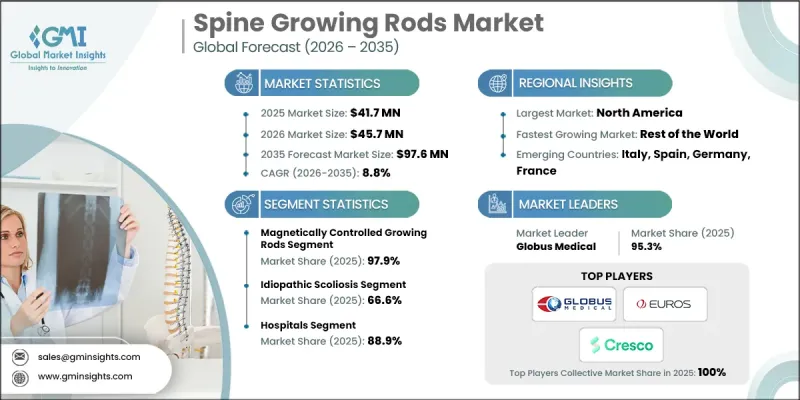
The Global Spine Growing Rods Market was valued at USD 41.7 million in 2025 and is estimated to grow at a CAGR of 8.8% to reach USD 97.6 million by 2035.
Growth across the global spine growing rods industry is propelled by the increasing diagnosis of early-onset scoliosis (EOS) and the growing clinical preference for growth-preserving spinal correction procedures. Spine growing rods are implantable systems designed to manage complex spinal deformities in pediatric patients, allowing for continued spinal development while gradually correcting the curvature. The rising incidence of EOS in children under the age of 10 is significantly contributing to market expansion, as this condition often progresses rapidly during critical growth years. Healthcare providers are increasingly focused on solutions that stabilize spinal deformities without limiting thoracic and skeletal development. Advancements in surgical techniques, broader treatment accessibility, supportive reimbursement frameworks, and continuous innovation in implant design are further accelerating adoption. As awareness grows and early diagnosis improves, demand for technologically advanced and minimally disruptive spinal implants continues to strengthen the outlook for the spine growing rods market worldwide.
| Market Scope | |
|---|---|
| Start Year | 2025 |
| Forecast Year | 2026-2035 |
| Start Value | $41.7 Million |
| Forecast Value | $97.6 Million |
| CAGR | 8.8% |
Idiopathic scoliosis accounts for nearly 80-85% of total diagnosed cases, reinforcing its position as the leading category within pediatric spinal deformities. Beyond structural complications, EOS can also influence emotional and psychological well-being, contributing to stress-related challenges in affected children. Expanding access to specialized care and continuous improvements in medical technology are supporting a stronger demand for spine growing rods as a long-term corrective approach.
The magnetically controlled growing rods segment held 97.9% share in 2025, owing to their ability to enable non-invasive rod adjustments. This technology significantly reduces the frequency of repeat surgical interventions and lowers the overall treatment burden. Magnetically controlled growing rods integrate an internal magnetic actuator that permits external lengthening, supporting spinal stability and sustained deformity correction while accommodating ongoing growth. Their clinical advantages over conventional systems continue to drive widespread preference among surgeons and healthcare institutions.
The neuromuscular scoliosis segment generated USD 6.8 million in 2025 and is anticipated to grow at a CAGR of 8.7% during 2026-2035. This segment represents a critical therapeutic area within spine growing rod applications, supported by improving survival outcomes among patients with neuromuscular disorders. As life expectancy increases within these patient populations, the incidence of progressive spinal curvature requiring corrective intervention is also rising, creating sustained demand for advanced growth-preserving implant systems.
North America Spine Growing Rods Market held a 59.4% share in 2025. The region benefits from advanced healthcare infrastructure, early integration of innovative spinal implant technologies, and strong clinical emphasis on pediatric deformity management. Growing rod systems are widely utilized across specialized pediatric spine centers and orthopedic facilities, where preserving thoracic development and long-term functional outcomes remain a primary treatment objective.
Key companies operating in the Global Spine Growing Rods Market include Globus Medical, EUROS, and Cresco. Companies in the Spine Growing Rods Market are reinforcing their market position through continuous product innovation and strategic expansion initiatives. Manufacturers are prioritizing research and development to enhance implant durability, improve magnetic control mechanisms, and optimize patient outcomes. Strategic collaborations with hospitals and specialty clinics are helping firms strengthen clinical adoption and brand recognition. Businesses are also expanding geographic reach through distribution partnerships and regulatory approvals in high-growth regions. Investment in surgeon training programs and post-market clinical studies is further supporting credibility and long-term demand. Additionally, companies are focusing on improving manufacturing efficiency and supply chain resilience to ensure consistent product availability while maintaining competitive pricing strategies in the global spine growing rods market.
Table of Contents
Chapter 1 Research Methodology
- 1.1 Research approach
- 1.2 Quality commitments
- 1.2.1 GMI AI policy & data integrity commitment
- 1.2.1.1 Source consistency protocol
- 1.2.1 GMI AI policy & data integrity commitment
- 1.3 Research trail & confidence scoring
- 1.3.1 Research trail components
- 1.3.2 Scoring components
- 1.4 Data collection
- 1.4.1 Partial list of primary sources
- 1.5 Data mining sources
- 1.5.1 Paid sources
- 1.5.1.1 Sources, by region
- 1.5.1 Paid sources
- 1.6 Base estimates and calculations
- 1.6.1 Base year calculation for any one approach
- 1.7 Forecast model
- 1.7.1 Quantified market impact analysis
- 1.7.1.1 Mathematical impact of growth parameters on forecast
- 1.7.1 Quantified market impact analysis
- 1.8 Research transparency addendum
- 1.8.1 Source attribution framework
- 1.8.2 Quality assurance metrics
- 1.8.3 Our commitment to trust
Chapter 2 Executive Summary
- 2.1 Industry 3600 synopsis
- 2.2 Key market trends
- 2.2.1 Regional trends
- 2.2.2 Technology trends
- 2.2.3 Indication trends
- 2.2.4 End use trends
- 2.3 CXO perspectives: Strategic imperatives
Chapter 3 Industry Insights
- 3.1 Industry ecosystem analysis
- 3.2 Industry impact forces
- 3.2.1 Growth drivers
- 3.2.1.1 Rising prevalence of early-onset scoliosis (EOS)
- 3.2.1.2 Demand for growth-preserving spinal interventions
- 3.2.1.3 Technological advancements in spinal implant design
- 3.2.2 Industry pitfalls and challenges
- 3.2.2.1 High cost of growing rod implant systems
- 3.2.2.2 Risk of mechanical failure and rod breakage
- 3.2.3 Market opportunities
- 3.2.3.1 Expansion of MCGR adoption in emerging economies
- 3.2.3.2 Integration of smart sensors in growing rod systems
- 3.2.1 Growth drivers
- 3.3 Growth potential analysis
- 3.4 Regulatory landscape
- 3.4.1 North America
- 3.4.2 Europe
- 3.5 Technology landscape
- 3.5.1 Current technological trends
- 3.5.2 Emerging technologies
- 3.6 Future market trends
- 3.7 Patent analysis
- 3.8 Pipeline analysis
- 3.9 Patient demographics and epidemiology
- 3.10 Porter's analysis
- 3.11 PESTEL analysis
Chapter 4 Competitive Landscape, 2025
- 4.1 Introduction
- 4.2 Company matrix analysis
- 4.3 Company market share analysis
- 4.3.1 North America
- 4.3.2 Europe
- 4.3.3 RoW
- 4.4 Competitive positioning matrix
- 4.5 Competitive analysis of major market players
- 4.6 Key developments
- 4.6.1 Mergers & acquisitions
- 4.6.2 Partnerships & collaborations
- 4.6.3 New technology launches
- 4.6.4 Expansion plans
Chapter 5 Market Estimates and Forecast, By Technology, 2022 - 2035 ($ Mn)
- 5.1 Key trends
- 5.2 Magnetically controlled growing rods
- 5.3 Mechanical one way self expanding rods
- 5.4 Spring-based self expanding systems
Chapter 6 Market Estimates and Forecast, By Indication, 2022 - 2035 ($ Mn)
- 6.1 Key trends
- 6.2 Idiopathic Scoliosis
- 6.3 Neuromuscular scoliosis
- 6.4 Congenital scoliosis
- 6.5 Syndromic scoliosis
Chapter 7 Market Estimates and Forecast, By End Use, 2022 - 2035 ($ Mn)
- 7.1 Key trends
- 7.2 Hospitals
- 7.3 Specialty orthopedic clinics
- 7.4 Ambulatory surgical centers (ASCs)
Chapter 8 Market Estimates and Forecast, By Region, 2022 - 2035 ($ Mn)
- 8.1 Key trends
- 8.2 North America
- 8.2.1 U.S.
- 8.2.2 Canada
- 8.3 Europe
- 8.3.1 Germany
- 8.3.2 France
- 8.3.3 Italy
- 8.3.4 Spain
- 8.3.5 Netherlands
- 8.3.6 Sweden
- 8.3.7 Rest of Europe
- 8.4 RoW
Chapter 9 Company Profiles
- 9.1 Cresco
- 9.2 EUROS
- 9.3 Globus Medical

