PUBLISHER: Global Market Insights Inc. | PRODUCT CODE: 1982276

PUBLISHER: Global Market Insights Inc. | PRODUCT CODE: 1982276
Residential Lighting Fixtures Market Opportunity, Growth Drivers, Industry Trend Analysis, and Forecast 2026 - 2035
The Global Residential Lighting Fixtures Market was valued at USD 19.4 billion in 2025 and is estimated to grow at a CAGR of 6.7% to reach USD 36.9 billion by 2035.
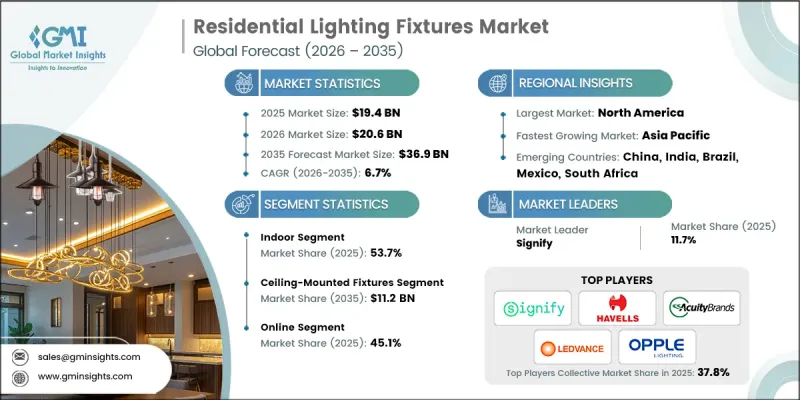
Rapid population growth and accelerating urban development continue to generate strong demand for new residential construction, directly supporting lighting fixture sales. The widespread transition from conventional fluorescent and halogen bulbs to LED lighting solutions is creating substantial growth prospects. Consumers are increasingly choosing LED technology due to its extended lifespan, superior energy efficiency, and minimal heat emission. Supportive regulatory initiatives encouraging energy-efficient lighting adoption are further reinforcing market momentum. Technological innovation is also reshaping the competitive landscape, as artificial intelligence integration enhances the functionality of ceiling and table lighting products. Growing interest in smart homes, connected ecosystems, and immersive retail environments is driving consumer engagement and influencing purchase decisions. Manufacturers are allocating significant investments toward research and development to introduce differentiated, design-focused, and energy-efficient solutions that align with evolving residential preferences across global markets.
| Market Scope | |
|---|---|
| Start Year | 2025 |
| Forecast Year | 2026-2035 |
| Start Value | $19.4 Billion |
| Forecast Value | $36.9 Billion |
| CAGR | 6.7% |
The indoor category accounted for 53.7% share in 2025. Consumer preferences within indoor lighting increasingly emphasize comfort, customization, and wellness-focused illumination. Demand for warm lighting tones, circadian-based systems, and multi-layered lighting arrangements continues to gain traction. Smart lighting solutions equipped with automation features, voice-enabled controls, and customizable scene settings are becoming mainstream choices among homeowners. Integration with broader smart home assistants and Internet of Things platforms is emerging as a critical purchase consideration, strengthening the appeal of connected residential lighting systems.
The ceiling-mounted fixtures segment is forecast to reach USD 11.2 billion by 2035. Demand for these fixtures remains strong due to their versatility across multiple residential spaces. Buyers are gravitating toward sleek, minimalist designs incorporating integrated LED modules and intelligent dimming technologies that enhance both energy efficiency and visual appeal. The growing popularity of compact and modular housing designs is further stimulating demand for slim and flush-mounted ceiling lighting solutions. Manufacturers are prioritizing adjustable color temperature features and app-based controls to ensure compatibility with expanding smart home ecosystems.
North America Residential Lighting Fixtures Market held a 31.3% share in 2025. Regional growth is being shaped by the integration of architectural aesthetics, advanced digital control systems, and intelligent residential infrastructure. Increasing collaboration between lighting technology providers and smart building solution developers is redefining product innovation. The introduction of Light + Intelligent Building North America by Messe Frankfurt in November 2025 highlights the industry's shift toward unified platforms that merge lighting products with control technologies and connected home systems. This integrated approach is encouraging cross-industry partnerships and reinforcing the strategic importance of lighting within advanced residential environments.
Key companies operating in the Global Residential Lighting Fixtures Market include Opple Lighting, Signify, Havells, Acuity Brands, Ledvance GmbH, Kichler Lighting, GE Lighting (Savant Systems), Visual Comfort & Co., and Thorn Lighting (Zumtobel Group). Leading participants in the Residential Lighting Fixtures Market are strengthening their competitive positions through innovation-driven product development, strategic partnerships, and geographic expansion. Companies are investing heavily in research and development to introduce AI-enabled and IoT-compatible lighting systems that align with smart home trends. Many players are expanding their LED portfolios with energy-efficient, design-oriented solutions to address shifting consumer preferences. Collaborations with technology firms and smart ecosystem providers are enhancing product interoperability and market reach. Businesses are also focusing on brand differentiation through premiumization strategies and experiential retail concepts that allow customers to interact with advanced lighting solutions.
Table of Contents
Chapter 1 Methodology and Scope
- 1.1 Market scope and definition
- 1.2 Research design
- 1.2.1 Research approach
- 1.2.2 Data collection methods
- 1.3 Data mining sources
- 1.3.1 Global
- 1.3.2 Regional/Country
- 1.4 Base estimates and calculations
- 1.4.1 Base year calculation
- 1.4.2 Key trends for market estimation
- 1.5 Primary research and validation
- 1.5.1 Primary sources
- 1.6 Forecast model
- 1.7 Research assumptions and limitations
Chapter 2 Executive Summary
- 2.1 Industry 360° synopsis, 2021 - 2034
- 2.2 Key market trends
- 2.2.1 Product type trends
- 2.2.2 Light source trends
- 2.2.3 Installation location trends
- 2.2.4 Distribution channel trends
- 2.2.5 Regional trends
- 2.3 TAM analysis, 2025-2034
- 2.4 CXO perspectives: Strategic imperatives
- 2.4.1 Executive decision points
- 2.4.2 Critical success factors
- 2.5 Future outlook and strategic recommendations
Chapter 3 Industry Insights
- 3.1 Industry ecosystem analysis
- 3.1.1 Supplier landscape
- 3.1.2 Profit margin analysis
- 3.1.3 Cost structure
- 3.1.4 Value addition at each stage
- 3.1.5 Factor affecting the value chain
- 3.1.6 Disruptions
- 3.2 Industry impact forces
- 3.2.1 Growth drivers
- 3.2.1.1 Growing adoption of LEDs in residential sectors across the globe
- 3.2.1.2 Growing population and urbanization across the globe
- 3.2.1.3 Supportive regulations for energy efficient lightings
- 3.2.1.4 Aesthetic preferences and demand for modern, customizable lighting designs
- 3.2.1.5 Expansion of experiential and premium retail formats in residential lighting
- 3.2.2 Industry pitfalls and challenges
- 3.2.2.1 High initial cost of advanced and smart residential lighting fixtures
- 3.2.2.2 Price sensitivity among residential consumers in developing and cost-conscious markets
- 3.2.3 Market opportunities
- 3.2.3.1 Retrofit and replacement demand from aging residential lighting infrastructure
- 3.2.3.2 Growth in rental housing and co-living spaces requiring standardized lighting upgrades
- 3.2.1 Growth drivers
- 3.3 Regulatory landscape
- 3.3.1 North America
- 3.3.2 Europe
- 3.3.3 Asia Pacific
- 3.3.4 Latin America
- 3.3.5 Middle East & Africa
- 3.4 Porter's analysis
- 3.5 PESTEL analysis
- 3.6 Technology and innovation landscape
- 3.6.1 Current technological trends
- 3.6.2 Emerging technologies
- 3.7 Emerging business models
- 3.8 Compliance requirements
- 3.9 Patent and IP analysis
- 3.10 Geopolitical and trade dynamics
Chapter 4 Competitive Landscape, 2024
- 4.1 Introduction
- 4.2 Company market share analysis
- 4.2.1 By region
- 4.2.1.1 North America
- 4.2.1.2 Europe
- 4.2.1.3 Asia Pacific
- 4.2.1.4 Latin America
- 4.2.1.5 Middle East & Africa
- 4.2.1 By region
- 4.3 Competitive benchmarking of key players
- 4.3.1 Financial performance comparison
- 4.3.1.1 Revenue
- 4.3.1.2 Profit margin
- 4.3.1.3 R&D
- 4.3.2 Product portfolio comparison
- 4.3.2.1 Product range breadth
- 4.3.2.2 Technology
- 4.3.2.3 Innovation
- 4.3.3 Geographic presence comparison
- 4.3.3.1 Global footprint analysis
- 4.3.3.2 Service network coverage
- 4.3.3.3 Market penetration by region
- 4.3.4 Competitive positioning matrix
- 4.3.4.1 Leaders
- 4.3.4.2 Challengers
- 4.3.4.3 Followers
- 4.3.4.4 Niche players
- 4.3.5 Strategic outlook matrix
- 4.3.1 Financial performance comparison
- 4.4 Key developments, 2021-2024
- 4.4.1 Mergers and acquisitions
- 4.4.2 Partnerships and collaborations
- 4.4.3 Technological advancements
- 4.4.4 Expansion and investment strategies
- 4.4.5 Digital transformation initiatives
- 4.5 Emerging/ startup competitors landscape
Chapter 5 Market Estimates and Forecast, By Product Type, 2022 - 2035 ($ Mn)
- 5.1 Key trends
- 5.2 Ceiling-mounted fixtures
- 5.3 Suspended/hanging fixtures
- 5.4 Recessed fixtures
- 5.5 Wall-mounted fixtures
- 5.6 Others
Chapter 6 Market Estimates and Forecast, By Light Source, 2022 - 2035 ($ Mn)
- 6.1 Key trends
- 6.2 Led (light emitting diode)
- 6.3 Fluorescent
- 6.4 Halogen
- 6.5 Incandescent
Chapter 7 Market Estimates and Forecast, By Installation Location, 2022 - 2035 ($ Mn)
- 7.1 Key trends
- 7.2 Indoor
- 7.3 Outdoor
Chapter 8 Market Estimates and Forecast, By Distribution Channel, 2022 - 2035 ($ Mn)
- 8.1 Key trends
- 8.2 Online
- 8.3 Offline
Chapter 9 Market Estimates and Forecast, By Region, 2022 - 2035 ($ Mn)
- 9.1 Key trends
- 9.2 North America
- 9.2.1 U.S.
- 9.2.2 Canada
- 9.3 Europe
- 9.3.1 Germany
- 9.3.2 UK
- 9.3.3 France
- 9.3.4 Spain
- 9.3.5 Italy
- 9.3.6 Netherlands
- 9.4 Asia Pacific
- 9.4.1 China
- 9.4.2 India
- 9.4.3 Japan
- 9.4.4 Australia
- 9.4.5 South Korea
- 9.5 Latin America
- 9.5.1 Brazil
- 9.5.2 Mexico
- 9.5.3 Argentina
- 9.6 Middle East and Africa
- 9.6.1 South Africa
- 9.6.2 Saudi Arabia
- 9.6.3 UAE
Chapter 10 Company Profiles
- 10.1 Global Key Players
- 10.1.1 Signify
- 10.1.2 Acuity Brands
- 10.1.3 Havells
- 10.1.4 Ledvance GmbH
- 10.2 Regional Key Players
- 10.2.1 North America
- 10.2.1.1 Cooper Lighting Solutions
- 10.2.1.2 Hubbell Incorporated
- 10.2.1.3 Lutron
- 10.2.2 Europe
- 10.2.2.1 ERCO
- 10.2.2.2 Louis Poulsen
- 10.2.2.3 Siteco GmbH
- 10.2.3 APAC
- 10.2.3.1 Opple Lighting
- 10.2.3.2 NVC Lighting
- 10.2.3.3 Panasonic
- 10.2.1 North America
- 10.3 Niche Players / Disruptors
- 10.3.1 Cree Lighting USA, LLC.
- 10.3.2 GE Lighting (Savant Systems)
- 10.3.3 Kichler Lighting
- 10.3.4 Thorn Lighting (Zumtobel-Group)
- 10.3.5 Visual Comfort & Co.
- 10.3.6 WAC Lighting

