PUBLISHER: Global Market Insights Inc. | PRODUCT CODE: 1982281

PUBLISHER: Global Market Insights Inc. | PRODUCT CODE: 1982281
EV Maintenance Market Opportunity, Growth Drivers, Industry Trend Analysis, and Forecast 2026 - 2035
The Global EV Maintenance Market was valued at USD 24.5 billion in 2025 and is estimated to grow at a CAGR of 14.7% to reach USD 96.1 billion by 2035.
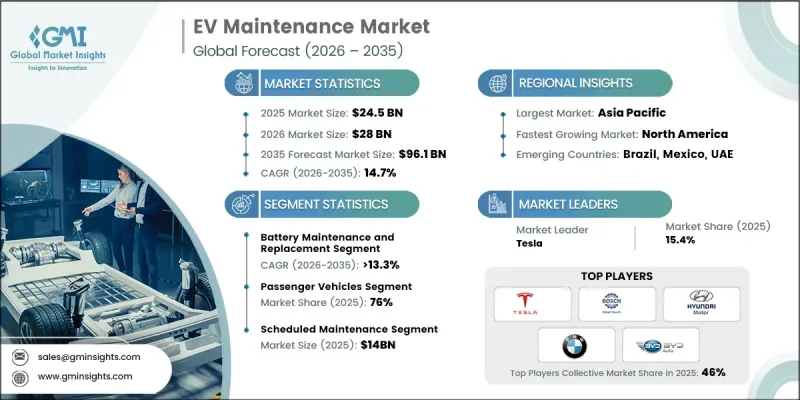
Market expansion is driven by the rising global adoption of EVs, the growth of fleet electrification, and the increasing need to maintain battery health, vehicle uptime, and regulatory compliance. Government policies and incentives promoting clean transportation, sustainability mandates, and electrification across North America, Europe, and Asia-Pacific are encouraging OEMs, fleet operators, and service providers to implement advanced maintenance strategies and predictive servicing solutions for both passenger and commercial electric vehicles. The growing pressure to maximize battery longevity, enhance energy efficiency, and minimize operational downtime is fueling demand for advanced EV maintenance services. These include battery diagnostics and replacement, electric motor servicing, HVAC and auxiliary system inspections, over-the-air (OTA) software updates, and maintenance of charging infrastructure. Increasing adoption of passenger EVs, light commercial vehicles (LCVs), and medium to heavy commercial EVs is driving the need for specialized, high-efficiency, data-driven maintenance systems. Technological innovations such as battery management systems (BMS), telematics-enabled predictive maintenance, real-time monitoring, and integrated diagnostics platforms are transforming traditional EV service approaches.
| Market Scope | |
|---|---|
| Start Year | 2025 |
| Forecast Year | 2026-2035 |
| Start Value | $24.5 Billion |
| Forecast Value | $96.1 Billion |
| CAGR | 14.7% |
The battery maintenance and replacement segment held 36% share in 2025 and is expected to grow at a CAGR of 13.3% from 2026 to 2035. This segment dominates due to the battery's critical impact on EV performance, range, energy efficiency, and safety. High replacement costs and technical complexity ensure ongoing demand for both scheduled and predictive maintenance across passenger, LCV, and medium/heavy commercial EVs.
The passenger vehicles segment held 76% share in 2025 and is expected to grow at a CAGR of 14.2% through 2035. The dominance of this segment is driven by the widespread adoption of electric passenger cars and the emphasis on battery health, motor reliability, software updates, and vehicle uptime. OEMs and authorized service centers are increasingly standardizing maintenance services, delivering data-driven, warranty-compliant servicing. Recurring maintenance demand across major regions such as China, Europe, and North America reinforces the leadership of the passenger vehicle segment.
China EV Maintenance Market accounted for 51% share, generating USD 4.5 billion in 2025. The region's growth is supported by rapid EV adoption, robust production volumes, and the strong presence of OEMs, Tier-1 suppliers, and service providers. Favorable government incentives, large-scale manufacturing infrastructure, cost-efficient service networks, and expanding digital maintenance platforms are boosting demand across passenger and commercial EVs. China remains the largest market in Asia-Pacific due to its high EV production, advanced battery and motor service adoption, and strong collaboration between OEMs, fleet operators, and digital service providers.
Leading companies operating in the Global EV Maintenance Market include BMW, Hyundai Motor, LKQ, Continental, Tesla, BYD Auto, Robert Bosch, DENSO, Volkswagen, and Magna International. Companies in the EV Maintenance Market are deploying multiple strategies to strengthen their foothold. They are investing in predictive maintenance platforms, AI-driven diagnostics, and telematics to enhance service efficiency. Strategic partnerships with OEMs, fleet operators, and charging infrastructure providers improve market reach and service integration. Firms are expanding their service networks to offer localized support and quicker turnaround for EV maintenance. Product and service diversification, including battery health monitoring, motor servicing, and software updates, enhances value propositions.
Table of Contents
Chapter 1 Methodology & Scope
- 1.1 Market scope and definition
- 1.2 Research design
- 1.2.1 Research approach
- 1.2.2 Data collection methods
- 1.3 Data mining sources
- 1.3.1 Global
- 1.3.2 Regional/Country
- 1.4 Base estimates and calculations
- 1.4.1 Base year calculation
- 1.4.2 Key trends for market estimation
- 1.5 Primary research and validation
- 1.5.1 Primary sources
- 1.6 Forecast
- 1.7 Research assumptions and limitations
Chapter 2 Executive Summary
- 2.1 Industry 360° synopsis, 2022 - 2035
- 2.2 Key market trends
- 2.2.1 Regional
- 2.2.2 Maintenance
- 2.2.3 Vehicle
- 2.2.4 Services
- 2.2.5 End Use
- 2.3 TAM Analysis, 2026-2035
- 2.4 CXO perspectives: Strategic imperatives
- 2.4.1 Executive decision points
- 2.4.2 Critical success factors
- 2.5 Future outlook and strategic recommendations
Chapter 3 Industry Insights
- 3.1 Industry ecosystem analysis
- 3.1.1 Supplier Landscape
- 3.1.2 Profit Margin
- 3.1.3 Cost structure
- 3.1.4 Value addition at each stage
- 3.1.5 Factor affecting the value chain
- 3.1.6 Disruptions
- 3.2 Industry impact forces
- 3.2.1 Growth drivers
- 3.2.1.1 Rapid EV Adoption and Fleet Expansion
- 3.2.1.2 Battery Health and Longevity Focus
- 3.2.1.3 Technological Advancements in Predictive Maintenance
- 3.2.1.4 Regulatory and Government Incentives
- 3.2.2 Industry pitfalls and challenges
- 3.2.2.1 High Initial Costs for Advanced Maintenance Systems
- 3.2.2.2 Fragmented Aftermarket and Skill Gaps
- 3.2.3 Market opportunities
- 3.2.3.1 Expansion in Commercial and Fleet Services
- 3.2.3.2 Development of Predictive and Data-Driven Services
- 3.2.3.3 Growing EV Fleet and Commercial Vehicle Adoption
- 3.2.3.4 Integration of Smart Charging and Infrastructure Maintenance
- 3.2.1 Growth drivers
- 3.3 Growth potential analysis
- 3.4 Regulatory landscape
- 3.4.1 North America
- 3.4.1.1 U.S.: EPA, CARB, NHTSA Standards
- 3.4.1.2 Canada: Transport Canada, CMVSS 305
- 3.4.2 Europe
- 3.4.2.1 Germany: BMDV, Euro 6/7 Regulations
- 3.4.2.2 France: Ministry of Transport, Euro 6/7
- 3.4.2.3 UK: Department for Transport, Euro 6/7
- 3.4.2.4 Italy: Ministry of Infrastructure & Transport, Emission Compliance
- 3.4.3 Asia Pacific
- 3.4.3.1 China: MIIT, China 6/7 Standards
- 3.4.3.2 Japan: MLIT, JIS Emission Regulations
- 3.4.3.3 South Korea: MOLIT, KS Emission Standards
- 3.4.3.4 India: MoRTH, BS6 Norms
- 3.4.4 Latin America
- 3.4.4.1 Brazil: DENATRAN, CONAMA Standards
- 3.4.4.2 Mexico: Ministry of Communications & Transport, NOM Emission Regulations
- 3.4.5 Middle East and Africa
- 3.4.5.1 UAE: RTA, ESMA Emission Regulations
- 3.4.5.2 Saudi Arabia: Ministry of Transport, SASO Emission Standards
- 3.4.1 North America
- 3.5 Porter's analysis
- 3.6 PESTEL analysis
- 3.7 Technology and Innovation Landscape
- 3.7.1 Current technological trends
- 3.7.2 Emerging technologies
- 3.8 Price trends
- 3.8.1 By region
- 3.8.2 By product
- 3.9 Cost breakdown analysis
- 3.10 Patent analysis
- 3.11 Sustainability and Environmental Aspects
- 3.11.1 Sustainable practices
- 3.11.2 Waste reduction strategies
- 3.11.3 Energy efficiency in production
- 3.11.4 Eco-friendly initiatives
- 3.11.5 Carbon footprint considerations
- 3.12 Use case scenarios
- 3.13 Software, OTA & Cybersecurity Implications on EV Maintenance
- 3.14 Fleet Electrification Impact on Maintenance Demand Patterns
Chapter 4 Competitive Landscape, 2025
- 4.1 Introduction
- 4.2 Company market share analysis
- 4.2.1 North America
- 4.2.2 Europe
- 4.2.3 Asia Pacific
- 4.2.4 Latin America
- 4.2.5 Middle East & Africa
- 4.3 Competitive analysis of major market players
- 4.4 Competitive positioning matrix
- 4.5 Strategic outlook matrix
- 4.6 Key developments
- 4.6.1 Mergers & acquisitions
- 4.6.2 Partnerships & collaborations
- 4.6.3 New product launches
- 4.6.4 Expansion plans and funding
Chapter 5 Market Estimates & Forecast, By Maintenance, 2022 - 2035 ($Bn)
- 5.1 Key trends
- 5.2 Battery Maintenance and Replacement
- 5.3 Software Updates and Diagnostics
- 5.4 Charging Infrastructure Maintenance
- 5.5 Electric Motor Servicing
- 5.6 HVAC and Auxiliary Systems Maintenance
Chapter 6 Market Estimates & Forecast, By Vehicle, 2022 - 2035 ($Bn)
- 6.1 Key trends
- 6.2 Passenger vehicles
- 6.2.1 Hatchbacks
- 6.2.2 Sedans
- 6.2.3 SUV
- 6.3 Commercial vehicles
- 6.3.1 Light commercial vehicles (LCV)
- 6.3.2 Medium commercial vehicles (MCV)
- 6.3.3 Heavy commercial vehicles (HCV)
Chapter 7 Market Estimates & Forecast, By Services, 2022 - 2035 ($Bn)
- 7.1 Key trends
- 7.2 Scheduled Maintenance
- 7.3 Predictive Maintenance
- 7.4 Emergency Maintenance
Chapter 8 Market Estimates & Forecast, By End Use, 2022 - 2035 ($Bn)
- 8.1 Key trends
- 8.2 Individual EV Owners
- 8.3 Fleet Operators
- 8.4 Government & Municipal Fleets
- 8.5 Commercial Charging Network Operators
Chapter 9 Market Estimates & Forecast, By Region, 2022 - 2035 ($Bn)
- 9.1 Key trends
- 9.2 North America
- 9.2.1 US
- 9.2.2 Canada
- 9.3 Europe
- 9.3.1 UK
- 9.3.2 Germany
- 9.3.3 France
- 9.3.4 Italy
- 9.3.5 Spain
- 9.3.6 Belgium
- 9.3.7 Netherlands
- 9.3.8 Sweden
- 9.4 Asia Pacific
- 9.4.1 China
- 9.4.2 India
- 9.4.3 Japan
- 9.4.4 Australia
- 9.4.5 Singapore
- 9.4.6 South Korea
- 9.4.7 Vietnam
- 9.4.8 Indonesia
- 9.5 Latin America
- 9.5.1 Brazil
- 9.5.2 Mexico
- 9.5.3 Argentina
- 9.6 MEA
- 9.6.1 UAE
- 9.6.2 South Africa
- 9.6.3 Saudi Arabia
Chapter 10 Company Profiles
- 10.1 Global Player
- 10.1.1 BMW
- 10.1.2 BYD Auto
- 10.1.3 Continental
- 10.1.4 DENSO
- 10.1.5 Hyundai Motor
- 10.1.6 LKQ
- 10.1.7 Magna International
- 10.1.8 Robert Bosch
- 10.1.9 Tesla
- 10.1.10 Volkswagen
- 10.2 Regional Player
- 10.2.1 BorgWarner
- 10.2.2 CATL Service Solutions
- 10.2.3 Cummins
- 10.2.4 Eberspacher
- 10.2.5 Faurecia
- 10.2.6 HJS Emission Technology
- 10.2.7 Johnson Matthey
- 10.2.8 MANN+HUMMEL
- 10.2.9 Tenneco
- 10.2.10 Valeo

