PUBLISHER: Global Market Insights Inc. | PRODUCT CODE: 1982287

PUBLISHER: Global Market Insights Inc. | PRODUCT CODE: 1982287
Vitamin C Based Skincare Product Market Opportunity, Growth Drivers, Industry Trend Analysis, and Forecast 2026 - 2035
The Global Vitamin C Based Skincare Product Market was valued at USD 4.7 billion in 2025 and is estimated to grow at a CAGR of 10.3% to reach USD 12.4 billion by 2035.
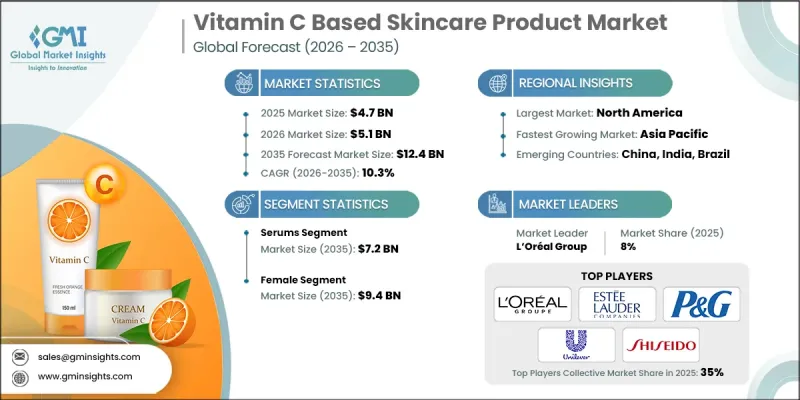
Industry growth is fueled by a pronounced consumer preference for results-driven formulations that combine clean positioning with clinically supported performance. Buyers increasingly prioritize proven brightening, tone-evening, and age-defying benefits, driving sustained demand across facial care categories. Momentum is further reinforced by the rapid rise of social-driven product discovery, the expansion of pharmacy-led dermo-cosmetic distribution, and continuous portfolio diversification by established beauty manufacturers introducing stabilized derivatives across varied price points. Strategic consolidation and investment activity among leading companies are accelerating innovation in formulation technologies, protective packaging solutions, and omnichannel distribution networks. North America and Europe remain mature revenue generators, while Asia Pacific represents a strong growth engine supported by rising skincare awareness and premiumization trends. Across the category, consumers are transitioning away from basic skincare toward high-performance systems designed for visible, measurable improvements in overall skin quality and long-term maintenance.
| Market Scope | |
|---|---|
| Start Year | 2025 |
| Forecast Year | 2026-2035 |
| Start Value | $4.7 Billion |
| Forecast Value | $12.4 Billion |
| CAGR | 10.3% |
Conventional low-strength brightening creams are steadily giving way to advanced vitamin C complexes engineered for higher stability and performance. Modern formulations incorporate pure L-ascorbic acid alongside next-generation derivatives designed to enhance compatibility and longevity. These systems are often combined with complementary antioxidants and barrier-support ingredients to optimize effectiveness and durability. Technological advancements such as encapsulation delivery methods, water-free compositions, carefully calibrated pH environments, and protective packaging formats help reduce oxidation and maintain product integrity. Lightweight liquids, fast-absorbing concentrates, and refined cream textures further improve user experience while preserving potency and minimizing sensitivity concerns.
The serums category generated USD 2.7 billion in 2025 and is forecast to reach USD 7.2 billion by 2035. This segment leads overall demand because concentrated formats deliver rapid absorption and noticeable improvements in radiance, uneven tone, and environmental stress defense. Consumers gravitate toward these formulations due to their efficient layering compatibility and reputation for faster visible transformation compared with traditional creams.
The female consumers segment accounted for USD 3.6 billion, holding 76% share in 2025, and is expected to reach USD 9.4 billion by 2035. Women remain the primary adopters of vitamin C skincare solutions, supported by strong awareness of complexion enhancement and preventative skin health strategies. Multi-step beauty regimens frequently position vitamin C treatments as foundational components, particularly for concerns related to discoloration and long-term dermal resilience.
United States Vitamin C Based Skincare Product Market reached USD 1.5 billion in 2025 and is projected to reach USD 4.5 billion by 2035. The country continues to demonstrate consistent growth driven by confidence in dermatologist-supported products, a well-established digital retail ecosystem, and strong pharmacy distribution channels. Consumers show a marked preference for high-efficacy, stabilized vitamin C solutions designed to balance strength with skin tolerance, reinforcing the nation's leadership position within the global landscape.
Key industry participants shaping the competitive environment include Beiersdorf AG, Amorepacific Corporation, Procter & Gamble Co., L'Oreal Group, Estee Lauder Companies Inc., Unilever PLC, Shiseido Company, Limited, Johnson & Johnson Consumer Inc., Murad LLC, Peter Thomas Roth Labs LLC, Paula's Choice Skincare, Sunday Riley Modern Skincare LLC, Timeless Skin Care, TruSkin Naturals LLC, and Mad Hippie Skin Care Products. These companies compete through formulation innovation, clinical positioning, premium branding, and expansion across both mass and prestige retail channels. Companies operating in the vitamin C-based skincare products market are prioritizing research-driven formulation upgrades, strategic mergers, and targeted geographic expansion to reinforce competitive positioning. Many brands are investing in advanced stabilization technologies and proprietary delivery systems to differentiate product performance and extend shelf life. Portfolio diversification across premium and accessible price tiers allows companies to capture a broader consumer base while maintaining brand equity. Partnerships with dermatology professionals and pharmacy networks strengthen clinical credibility, while digital-first marketing strategies and influencer collaborations amplify visibility and conversion rates.
Table of Contents
Chapter 1 Methodology and Scope
- 1.1 Market scope and definition
- 1.2 Research design
- 1.2.1 Research approach
- 1.2.2 Data collection methods
- 1.3 Data mining sources
- 1.3.1 Global
- 1.3.2 Regional/Country
- 1.4 Base estimates and calculations
- 1.4.1 Base year calculation
- 1.4.2 Key trends for market estimation
- 1.5 Primary research and validation
- 1.5.1 Primary sources
- 1.6 Forecast model
- 1.7 Research assumptions and limitations
Chapter 2 Executive Summary
- 2.1 Industry 360° synopsis
- 2.2 Key market trends
- 2.2.1 Regional
- 2.2.2 Product
- 2.2.3 Vitamin C Derivative
- 2.2.4 Price Tier
- 2.2.5 Gender
- 2.2.6 Distribution Channel
- 2.3 CXO perspectives: Strategic imperatives
- 2.3.1 Key decision points for industry executives
- 2.3.2 Critical success factors for market players
- 2.4 Future outlook and strategic recommendations
Chapter 3 Industry Insights
- 3.1 Industry ecosystem analysis
- 3.1.1 Supplier landscape
- 3.1.2 Profit margin
- 3.1.3 Value addition at each stage
- 3.1.4 Factor affecting the value chain
- 3.2 Industry impact forces
- 3.2.1 Growth drivers
- 3.2.1.1 Rising adoption of clinical grade brightening solutions
- 3.2.1.2 Clean-beauty movement & ingredient transparency
- 3.2.1.3 Dermatology & professional skincare influence
- 3.2.2 Industry pitfalls & challenges
- 3.2.2.1 Instability & oxidation of Vitamin C
- 3.2.2.2 Irritation & sensitivity concerns
- 3.2.3 Opportunities
- 3.2.3.1 Rise of multi active & hybrid formulations
- 3.2.3.2 Growth of APAC brightening skincare culture
- 3.2.1 Growth drivers
- 3.3 Growth potential analysis
- 3.4 Future market trends
- 3.5 Technology and innovation landscape
- 3.5.1 Current technological trends
- 3.5.2 Emerging technologies
- 3.6 Price trends
- 3.6.1 By region
- 3.6.2 By Product
- 3.7 Regulatory landscape
- 3.7.1 Standards and compliance requirements
- 3.7.2 Regional regulatory frameworks
- 3.7.3 Certification standards
- 3.8 Porter's analysis
- 3.9 PESTEL analysis
- 3.10 Trade Data Analysis
- 3.10.1 Import & Export Volume & Value Trends
- 3.10.2 Key Trade Corridors & Tariff Impact
- 3.11 Impact of AI & Generative AI on the Market
- 3.11.1 AI-Driven Disruption of Existing Business Models
- 3.11.2 Predictive Analytics for Product Development
Chapter 4 Competitive Landscape, 2025
- 4.1 Introduction
- 4.2 Company market share analysis
- 4.2.1 By region
- 4.2.1.1 North America
- 4.2.1.2 Europe
- 4.2.1.3 Asia Pacific
- 4.2.1.4 Latin America
- 4.2.1.5 Middle East and Africa
- 4.2.1 By region
- 4.3 Company matrix analysis
- 4.4 Competitive analysis of major market players
- 4.5 Competitive positioning matrix
- 4.6 Key developments
- 4.6.1 Mergers & acquisitions
- 4.6.2 Partnerships & collaborations
- 4.6.3 New product launches
- 4.6.4 Expansion plans
Chapter 5 Market Estimates and Forecast, By Product, 2022 - 2035 (USD Billion) (Thousand Units)
- 5.1 Key trends
- 5.2 Serums
- 5.3 Creams & Moisturizers
- 5.4 Ampoules & Concentrates
- 5.5 Eye Treatments
- 5.6 Masks & Treatments
- 5.7 Others
Chapter 6 Market Estimates and Forecast, By Vitamin C Derivative, 2022 - 2035 (USD Billion) (Thousand Units)
- 6.1 Key trends
- 6.2 L-Ascorbic Acid (Pure)
- 6.3 Ascorbyl Glucoside
- 6.4 Ethyl Ascorbic Acid
- 6.5 SAP/MAP
- 6.6 THD/Tetraisopalmitate
- 6.7 Others
Chapter 7 Market Estimates and Forecast, By Price Tier, 2022 - 2035 (USD Billion) (Thousand Units)
Chapter 8 Key trends
- 8.1 Mass Market (USD10-40)
- 8.2 Premium (USD40-150)
- 8.3 Luxury (>USD150)
Chapter 9 Market Estimates and Forecast, By Gender, 2022 - 2035 (USD Billion) (Thousand Units)
- 9.1 Key trends
- 9.2 Male
- 9.3 Female
Chapter 10 Market Estimates and Forecast, By Distribution Channel, 2022 - 2035 (USD Billion) (Thousand Units)
- 10.1 Key trends
- 10.2 Online
- 10.2.1 E-Commerce
- 10.2.2 Company Website
- 10.3 Offline
- 10.3.1 Hypermarkets & Supermarkets
- 10.3.2 Pharmacy/Dermocosmetics
- 10.3.3 Specialty Stores
- 10.3.4 Others (Direct Sales, Salons, Spas, Duty-Free)
Chapter 11 Market Estimates and Forecast, By Region, 2022 - 2035 (USD Billion) (Thousand Units)
- 11.1 Key trends
- 11.2 North America
- 11.2.1 U.S.
- 11.2.2 Canada
- 11.3 Europe
- 11.3.1 Germany
- 11.3.2 UK
- 11.3.3 France
- 11.3.4 Italy
- 11.3.5 Spain
- 11.4 Asia Pacific
- 11.4.1 China
- 11.4.2 Japan
- 11.4.3 India
- 11.4.4 Australia
- 11.4.5 South Korea
- 11.5 Latin America
- 11.5.1 Brazil
- 11.5.2 Mexico
- 11.5.3 Argentina
- 11.6 Middle East and Africa
- 11.6.1 South Africa
- 11.6.2 Saudi Arabia
- 11.6.3 UAE
Chapter 12 Company Profiles
- 12.1 Amorepacific Corporation
- 12.2 Beiersdorf AG
- 12.3 Estee Lauder Companies Inc.
- 12.4 Johnson & Johnson Consumer Inc.
- 12.5 L'Oreal Group
- 12.6 Mad Hippie Skin Care Products
- 12.7 Murad LLC
- 12.8 Paula's Choice Skincare
- 12.9 Peter Thomas Roth Labs LLC
- 12.10 Procter & Gamble Co.
- 12.11 Shiseido Company, Limited
- 12.12 Sunday Riley Modern Skincare LLC
- 12.13 Timeless Skin Care
- 12.14 TruSkin Naturals LLC
- 12.15 Unilever PLC

