PUBLISHER: Global Market Insights Inc. | PRODUCT CODE: 1982288

PUBLISHER: Global Market Insights Inc. | PRODUCT CODE: 1982288
Dissolved Gas Analyzer for Transmission and Distribution Market Opportunity, Growth Drivers, Industry Trend Analysis, and Forecast 2026 - 2035
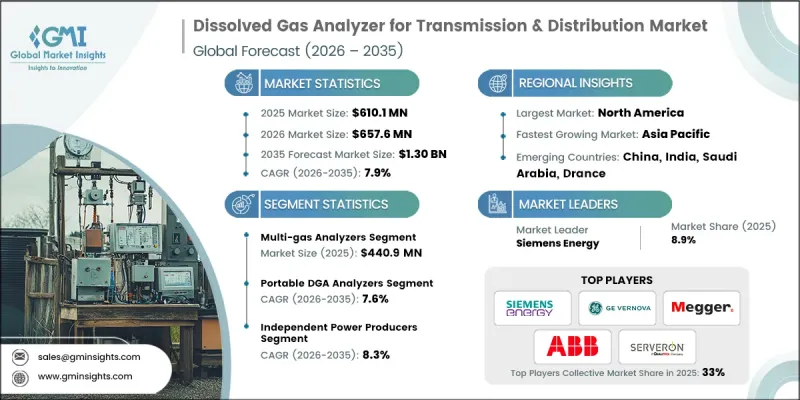
The Global Dissolved Gas Analyzer for Transmission & Distribution Market was valued at USD 610.1 million in 2025 and is estimated to grow at 7.9% to reach USD 1.30 billion by 2035.
Market expansion is driven by rising electricity consumption and the growing emphasis on grid reliability and uninterrupted power delivery. Utilities are increasing investments in smart grid infrastructure, which requires advanced monitoring technologies capable of delivering continuous, real-time diagnostics. Dissolved gas analyzers play a critical role in identifying early-stage faults in transformers and other high-voltage electrical assets, helping prevent unexpected outages and costly failures. The integration of renewable energy sources and distributed energy resources is further intensifying the need for grid stability, prompting utilities to deploy sophisticated condition monitoring solutions. Ongoing digital transformation across transmission and distribution networks is also supporting demand, as modern grid systems rely heavily on accurate and timely operational data. In addition, stricter regulatory requirements related to transformer performance and the growing adoption of condition-based maintenance strategies are reinforcing long-term market growth.
| Market Scope | |
|---|---|
| Start Year | 2025 |
| Forecast Year | 2026-2035 |
| Start Value | $610.1 Million |
| Forecast Value | $1.30 Billion |
| CAGR | 7.9% |
In 2025, the multi-gas analyzer segment generated USD 440.9 million and is expected to grow at a CAGR of 8.2% throughout 2035. Multi-gas analyzers are widely preferred because they can simultaneously detect and measure multiple fault gases, providing comprehensive transformer diagnostics in a single system. As utilities prioritize grid dependability and predictive maintenance, demand for multi-gas solutions continues to strengthen. Their ability to enhance fault detection accuracy and reduce maintenance risks makes them a vital component of modern transmission and distribution networks.
The portable DGA analyzers segment accounted for 57% share in 2025 and is anticipated to grow at a CAGR of 7.6% from 2026 to 2035. Portable units are gaining traction due to their operational flexibility and ease of deployment in field conditions. These systems enable rapid on-site gas analysis, making them particularly valuable for utilities and service providers conducting routine inspections and emergency diagnostics. The increasing focus on cost-efficient monitoring solutions and the need for periodic transformer assessments are key factors accelerating adoption within this segment.
United States Dissolved Gas Analyzer for Transmission & Distribution Market held a 77% share in 2025. Market growth in the U.S. is supported by rising demand for reliable power supply, aging grid infrastructure, and the growing requirement for advanced monitoring technologies to prevent equipment failures. Expanding renewable energy integration and ongoing smart grid development are further stimulating demand. Federal initiatives aimed at modernizing transmission and distribution infrastructure are also contributing to higher deployment rates of dissolved gas analyzers across the country.
Key companies operating in the Global Dissolved Gas Analyzer for Transmission & Distribution Market include ABB, Siemens Energy, GE Vernova, Hitachi Energy, Vaisala, Qualitrol Company, Maschinenfabrik Reinhausen, Megger, Dynamic Ratings, Serveron Corporation, Servomex, Hiden Analytical, Met One Instruments, MTE Meter Test Equipment, and Weidmann Electrical Technology. Companies in the Dissolved Gas Analyzer for Transmission & Distribution Market are strengthening their competitive position through continuous product innovation, digital integration, and strategic partnerships. Leading players are investing in advanced sensor technologies, AI-driven analytics, and cloud-based monitoring platforms to deliver more accurate and real-time transformer diagnostics. Many firms are expanding their service portfolios by offering predictive maintenance solutions and long-term monitoring contracts to utilities. Geographic expansion and collaboration with grid operators are also key strategies to capture emerging infrastructure modernization projects.
Table of Contents
Chapter 1 Methodology and scope
- 1.1 Market scope and definition
- 1.2 Research design
- 1.2.1 Research approach
- 1.2.2 Data collection methods
- 1.3 Data mining sources
- 1.3.1 Global
- 1.3.2 Regional/country
- 1.4 Base estimates and calculations
- 1.4.1 Base year calculation
- 1.4.2 Key trends for market estimation
- 1.5 Primary research and validation
- 1.5.1 Primary sources
- 1.6 Forecast model
- 1.7 Research assumptions and limitations
Chapter 2 Executive summary
- 2.1 Industry 360° synopsis
- 2.2 Key market trends
- 2.2.1 Regional
- 2.2.2 Product Type
- 2.2.3 Deployment Type
- 2.2.4 Application
- 2.2.5 End Users
- 2.2.6 Distribution Channel
- 2.3 CXO perspectives: strategic imperatives
- 2.3.1 Key decision points for industry executives
- 2.3.2 Critical success factors for market players
- 2.4 Future outlook and strategic recommendations
Chapter 3 Industry insights
- 3.1 Industry ecosystem analysis
- 3.1.1 Supplier landscape
- 3.1.2 Profit margin
- 3.1.3 Value addition at each stage
- 3.1.4 Factor affecting the value chain
- 3.2 Industry impact forces
- 3.2.1 Growth drivers
- 3.2.2 Industry pitfalls & challenges
- 3.2.3 Opportunities
- 3.3 Growth potential analysis
- 3.4 Future market trends
- 3.5 Technology and innovation landscape
- 3.5.1 Current technological trends
- 3.5.2 Emerging technologies
- 3.6 Price trends
- 3.6.1 By region
- 3.6.2 By product type
- 3.7 Regulatory landscape
- 3.7.1 Standards and compliance requirements
- 3.7.2 Regional regulatory frameworks
- 3.7.3 Certification standards
- 3.8 Porter's analysis
- 3.9 PESTEL analysis
Chapter 4 Competitive landscape, 2025
- 4.1 Introduction
- 4.2 Company market share analysis
- 4.2.1 By region
- 4.2.1.1 North America
- 4.2.1.2 Europe
- 4.2.1.3 Asia Pacific
- 4.2.1.4 Latin America
- 4.2.1.5 MEA
- 4.2.1 By region
- 4.3 Company matrix analysis
- 4.4 Competitive analysis of major market players
- 4.5 Competitive positioning matrix
- 4.6 Key developments
- 4.6.1 Mergers & acquisitions
- 4.6.2 Partnerships & collaborations
- 4.6.3 New product launches
- 4.6.4 Expansion plans
Chapter 5 Market Estimates & Forecast, By Product Type, 2022 - 2035 ($Million, Thousand Units)
- 5.1 Key trends
- 5.2 Multi-gas analyzers
- 5.3 Single-gas analyzers
Chapter 6 Market Estimates & Forecast, By Deployment Type, 2022 - 2035 ($Million, Thousand Units)
- 6.1 Key trends
- 6.2 Online DGA monitoring systems
- 6.3 Portable DGA analyzers
Chapter 7 Market Estimates & Forecast, By Material, 2022 - 2035 ($Million, Thousand Units)
- 7.1 Key trends
- 7.2 Power transformers
- 7.2.1 Generator step-up (GSU) transformers
- 7.2.2 Transmission network transformers
- 7.2.3 Auto transformers & phase-shifting transformers
- 7.3 Distribution transformers
- 7.4 Specialty transformers
Chapter 8 Market Estimates & Forecast, By End Users, 2022 - 2035 ($Million, Thousand Units)
- 8.1 Key trends
- 8.2 Electric utilities
- 8.2.1 Transmission system operators
- 8.2.2 Distribution network operators
- 8.3 Industrial
- 8.4 Independent power producers
- 8.5 EPC contractors
Chapter 9 Market Estimates & Forecast, By Distribution Channel, 2022 - 2035 ($Million, Thousand Units)
- 9.1 Key trends
- 9.2 Direct sales
- 9.3 Indirect sales
Chapter 10 Market Estimates & Forecast, By Region, 2022 - 2035 ($Million, Thousand Units)
- 10.1 Key trends
- 10.2 North America
- 10.2.1 U.S.
- 10.2.2 Canada
- 10.3 Europe
- 10.3.1 Germany
- 10.3.2 UK
- 10.3.3 France
- 10.3.4 Spain
- 10.3.5 Italy
- 10.3.6 Netherlands
- 10.4 Asia Pacific
- 10.4.1 China
- 10.4.2 Japan
- 10.4.3 India
- 10.4.4 Australia
- 10.4.5 South Korea
- 10.5 Latin America
- 10.5.1 Brazil
- 10.5.2 Mexico
- 10.5.3 Argentina
- 10.6 MEA
- 10.6.1 South Africa
- 10.6.2 Saudi Arabia
- 10.6.3 UAE
Chapter 11 Company Profiles
- 11.1 ABB
- 11.2 Dynamic Ratings
- 11.3 GE Vernova
- 11.4 Hiden Analytical
- 11.5 Hitachi Energy
- 11.6 Maschinenfabrik Reinhausen
- 11.7 Megger
- 11.8 Met One Instruments
- 11.9 MTE Meter Test Equipment
- 11.10 Qualitrol Company
- 11.11 Serveron Corporation
- 11.12 Servomex
- 11.13 Siemens Energy
- 11.14 Vaisala
- 11.15 Weidmann Electrical Technology

