
PUBLISHER: Global Market Insights Inc. | PRODUCT CODE: 1982290

PUBLISHER: Global Market Insights Inc. | PRODUCT CODE: 1982290
ASEAN Induction Heating Systems Market Opportunity, Growth Drivers, Industry Trend Analysis, and Forecast 2026 - 2035
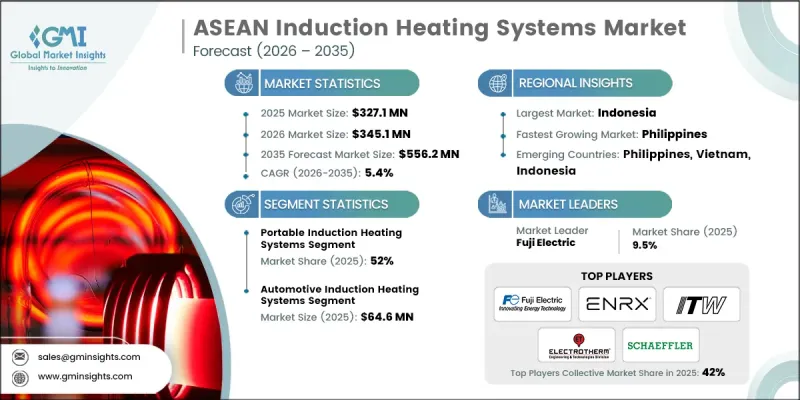
ASEAN Induction Heating Systems Market was valued at USD 327.1 million in 2025 and is estimated to grow at a CAGR of 5.4% to reach USD 556.2 million by 2035.
Market growth is propelled by accelerating industrial automation across ASEAN economies and the increasing integration of precision-based heating technologies in manufacturing operations. Rising emphasis on energy-efficient thermal processing solutions within metal fabrication and heavy industry is further strengthening demand. Induction heating systems utilize electromagnetic induction to generate heat directly within conductive materials, enabling controlled and contactless heating without combustion-based sources. Expanding urbanization and infrastructure investments throughout ASEAN are creating strong requirements for induction-driven heating applications in structural fabrication and construction activities. Improvements in electricity accessibility and grid modernization programs across the region are encouraging industries to transition from conventional fuel-powered heating methods to electrically driven systems. In addition, stricter environmental policies and corporate sustainability initiatives aimed at lowering carbon emissions are accelerating the adoption of induction heating as a cleaner alternative. The growing electrification of industrial processes and rising integration of renewable energy sources are establishing favorable conditions for the wider deployment of induction heating technology across ASEAN markets.
| Market Scope | |
|---|---|
| Start Year | 2025 |
| Forecast Year | 2026-2035 |
| Start Value | $327.1 Million |
| Forecast Value | $556.2 Million |
| CAGR | 5.4% |
The portable induction heating systems segment accounted for 52% share in 2025 and is anticipated to grow at a CAGR of 5% through 2035. Increased demand for mobile and flexible heating solutions in field-based industrial servicing and equipment maintenance is supporting segment expansion. Industries are adopting portable systems for localized heating, stress management, and precision-based repair operations, strengthening product penetration across multiple end-use sectors.
The automotive induction heating systems segment reached USD 64.6 million in 2025. Expanding vehicle production capacity and rising electrification trends across emerging ASEAN economies are contributing to increased deployment of induction heating solutions in component manufacturing. The growing emphasis on lightweight materials and controlled heat treatment processes in automotive production lines is further accelerating market development.
Indonesia Induction Heating Systems Market held 15% share, generating USD 57.9 million in 2025. Strengthening manufacturing capabilities and ongoing upgrades within industrial zones are driving the installation of advanced stationary heating systems. Investments in infrastructure modernization and heavy equipment maintenance activities are also encouraging broader adoption of induction-based thermal processing technologies across the country.
Key participants operating in the ASEAN Induction Heating Systems Market include Inductotherm Group, Ambrell Corporation, TRUMPF, Fuji Electric, Enrx, Ultraflex Power Technologies, Radyne, Electrotherm, Schaeffler (Singapore), ITW Welding Singapore, KITASHIBA ELECTRIC, Interpower Induction, Advanced Corporation for Materials & Equipments, Rapid Heat Systems, Solidheat Industries, Thermo International, TM Induction Heating, Heatrotherm, Uchino, and Neturen. Companies operating in the ASEAN Induction Heating Systems Market are strengthening their competitive position through technological innovation and regional expansion strategies. Many manufacturers are investing in research and development to enhance system efficiency, digital control capabilities, and energy optimization features. Strategic collaborations with industrial contractors and manufacturing firms are enabling customized solutions tailored to sector-specific requirements. Firms are also expanding local service networks to provide installation, maintenance, and after-sales support, improving customer retention. Portfolio diversification into portable and stationary systems allows companies to address varied industrial needs.
Table of Contents
Chapter 1 Methodology & Scope
- 1.1 Research approach
- 1.2 Quality commitments
- 1.2.1 GMI AI policy & data integrity commitment
- 1.2.1.1 Source consistency protocol
- 1.2.1 GMI AI policy & data integrity commitment
- 1.3 Research trail & confidence scoring
- 1.3.1 Research trail components
- 1.3.2 Scoring components
- 1.4 Data collection
- 1.4.1 Partial list of primary sources
- 1.5 Data mining sources
- 1.5.1 Paid sources
- 1.5.1.1 Sources, by region
- 1.5.1 Paid sources
- 1.6 Base estimates and calculations
- 1.6.1 Base year calculation for any one approach
- 1.7 Market estimates & forecasts parameters
- 1.8 Forecast model
- 1.8.1 Quantified market impact analysis
- 1.8.1.1 Mathematical impact of growth parameters on forecast
- 1.8.1 Quantified market impact analysis
- 1.9 Research transparency addendum
- 1.9.1 Source attribution framework
- 1.9.2 Quality assurance metrics
- 1.9.3 Our commitment to trust
- 1.10 Market definitions
Chapter 2 Executive Summary
- 2.1 Industry synopsis, 2022 - 2035
- 2.2 Business trends
- 2.3 Product trends
- 2.4 End use trends
- 2.5 Country trends
Chapter 3 Industry Insights
- 3.1 Industry ecosystem analysis
- 3.1.1 Raw material availability & sourcing analysis
- 3.1.2 Manufacturing capacity assessment
- 3.1.3 Supply chain resilience & risk factors
- 3.1.4 Distribution network analysis
- 3.2 Regulatory landscape
- 3.3 Industry impact forces
- 3.3.1 Growth drivers
- 3.3.2 Industry pitfalls & challenges
- 3.4 Growth potential analysis
- 3.5 Porter's analysis
- 3.5.1 Bargaining power of suppliers
- 3.5.2 Bargaining power of buyers
- 3.5.3 Threat of new entrants
- 3.5.4 Threat of substitutes
- 3.6 PESTEL analysis
- 3.6.1 Political factors
- 3.6.2 Economic factors
- 3.6.3 Social factors
- 3.6.4 Technological factors
- 3.6.5 Legal factors
- 3.6.6 Environmental factors
- 3.7 Cost structure analysis of induction heating systems
- 3.8 Emerging opportunities & trends
- 3.9 Investment analysis & future prospects
- 3.10 Sustainability initiatives & industry 4.0 integration
Chapter 4 Competitive Landscape, 2026
- 4.1 Introduction
- 4.2 Company market share analysis, by country, 2025
- 4.2.1 Thailand
- 4.2.2 Singapore
- 4.2.3 Malaysia
- 4.2.4 Philippines
- 4.2.5 Vietnam
- 4.2.6 Indonesia
- 4.3 Competitive positioning matrix
- 4.4 Key developments
- 4.4.1 Mergers & acquisitions
- 4.4.2 Partnerships & collaborations
- 4.4.3 New product launches
- 4.4.4 Expansion plans & funding
Chapter 5 Market Size and Forecast, By Product, 2022 - 2035 (USD Million)
- 5.1 Key trends
- 5.2 Portable
- 5.3 Stationary
Chapter 6 Market Size and Forecast, By End Use, 2022 - 2035 (USD Million)
- 6.1 Key trends
- 6.2 Automotive
- 6.3 Aerospace
- 6.4 Power generation
- 6.5 Shipbuilding
- 6.6 Oil & gas
- 6.7 Others
Chapter 7 Market Size and Forecast, By Country, 2022 - 2035 (USD Million)
- 7.1 Key trends
- 7.2 Thailand
- 7.3 Singapore
- 7.4 Malaysia
- 7.5 Philippines
- 7.6 Vietnam
- 7.7 Indonesia
Chapter 8 Company Profiles
- 8.1 Advanced Corporation for Materials & Equipments
- 8.2 Ambrell Corporation
- 8.3 Electrotherm
- 8.4 Enrx
- 8.5 Fuji Electric
- 8.6 Heatrotherm
- 8.7 Inductotherm Group
- 8.8 Interpower Induction
- 8.9 ITW Welding Singapore
- 8.10 KITASHIBA ELECTRIC
- 8.11 Neturen
- 8.12 Radyne
- 8.13 Rapid Heat Systems
- 8.14 Schaeffler (Singapore)
- 8.15 Solidheat Industries
- 8.16 Thermo International
- 8.17 TM Induction Heating
- 8.18 TRUMPF
- 8.19 Uchino
- 8.20 Ultraflex Power Technologies

